

- Updated: June 14, 2026
- 6 min read
HRBench: Benchmarking and Understanding Thinking-Mode Switch Strategies in Hybrid-Reasoning LLMs
Direct Answer
HRBench is a unified benchmarking suite that systematically evaluates how hybrid‑reasoning large language models (LLMs) switch between different thinking modes—such as fast, cheap inference and slow, high‑quality reasoning. By exposing the trade‑offs between answer accuracy and computational cost, HRBench gives developers a concrete way to choose or design switching strategies that fit real‑world constraints.
Background: Why This Problem Is Hard
Hybrid‑reasoning LLMs promise the best of two worlds: the speed of a shallow, token‑efficient pass and the depth of a multi‑step, chain‑of‑thought (CoT) process. In practice, however, deciding *when* to invoke the expensive mode is non‑trivial. The difficulty stems from three intertwined factors:
- Heterogeneous cost signals. Token usage, latency, and GPU memory vary dramatically across model families and deployment environments, making a single “budget” hard to define.
- Task‑dependent difficulty. A math problem may require deep reasoning, while a factual lookup can be answered with a single pass. Existing methods often rely on heuristics that do not generalize across domains such as science, code, or logic puzzles.
- Fragmented evaluation. Prior research evaluates switching strategies on different models, datasets, and hardware setups, preventing apples‑to‑apples comparison. Without a common yardstick, it is impossible to know whether a new routing algorithm truly improves efficiency or merely benefits from a favorable test condition.
These challenges matter because enterprises are increasingly deploying LLMs at scale. A mis‑chosen reasoning mode can inflate cloud bills, increase latency for end‑users, or degrade answer quality—outcomes that directly affect product viability.
What the Researchers Propose
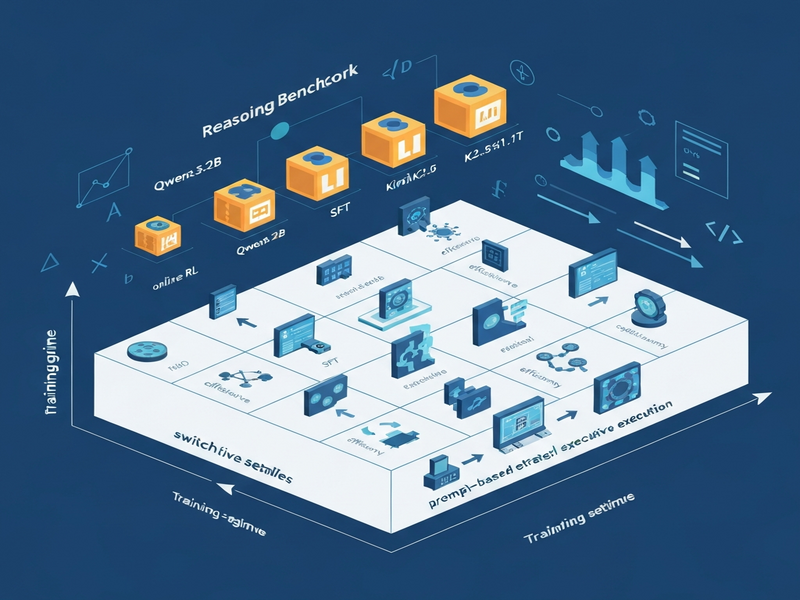
The authors introduce HRBench, a modular evaluation framework that maps the design space of thinking‑mode switch strategies along two orthogonal axes:
- Switching Strategy Families – three high‑level categories:
- Prompt‑based selection: The model decides internally, guided by specially crafted prompts.
- External routing: An outside controller (e.g., a lightweight classifier) routes inputs to the appropriate mode.
- Speculative execution: A cheap “speculative” pass generates a provisional answer; a costly verifier runs only when confidence is low.
- Training Regimes – four levels of model adaptation:
- Training‑free (zero‑shot),
- Supervised fine‑tuning (SFT),
- Offline reinforcement learning (RL), and
- Online RL with live feedback.
Combining the three families with the four regimes yields twelve controlled settings. HRBench supplies reference implementations for each, ensuring that researchers can swap components without rewriting the entire pipeline.
How It Works in Practice
At a conceptual level, HRBench orchestrates three layers:
- Input Processor – normalizes the raw query, extracts meta‑features (e.g., token length, domain tags), and forwards them to the selector.
- Mode Selector – implements one of the twelve strategies. For prompt‑based methods, it injects a decision prompt into the LLM’s context. For routing, it runs a lightweight model (often a logistic regression or tiny transformer) that predicts “fast” vs. “deep”. For speculative execution, it launches a cheap pass and monitors a confidence estimator.
- Reasoning Engine – the chosen LLM mode executes the task. If the speculative path triggers verification, a second, more powerful pass runs and its output replaces the provisional answer.
The framework logs two primary metrics for every request: token cost (a proxy for compute) and accuracy (measured against gold‑standard answers). By plotting these dimensions, practitioners can locate the “sweet spot” for their service‑level agreements.
What sets HRBench apart is its strict separation of concerns. Researchers can experiment with a new routing classifier while keeping the underlying LLM and benchmark datasets constant, or they can test a novel fine‑tuning recipe across all three strategy families without re‑implementing data loaders.
Evaluation & Results
The authors evaluated HRBench on six LLMs ranging from a 2‑billion‑parameter Qwen3.5‑2B to a 1.1‑trillion‑parameter Kimi‑K2.5. Five reasoning benchmarks covered mathematics (MATH), scientific QA (ScienceQA), code generation (HumanEval), logical deduction (LogicalDeduction), and multi‑step word problems (GSM‑8K). Each method was run under identical hardware and token‑budget constraints.
Key observations include:
- Prompt‑based methods excel at token‑accuracy trade‑offs. By asking the model to self‑assess, these approaches often achieve near‑full accuracy while saving 15‑30% of tokens compared to always‑run‑deep mode.
- External routing offers stable cost reductions. Simple classifiers consistently cut token usage by 20‑35% with only a modest dip (1‑3%) in accuracy, making them attractive for latency‑sensitive services.
- Speculative execution boosts accuracy at higher cost. When the cheap pass is confident, the system saves tokens; otherwise, the verifier corrects errors, leading to a net accuracy gain of up to 4% on hard math tasks, albeit with a 10% token overhead.
- Training regime matters. Fine‑tuned models benefit most from prompt‑based selection, while offline RL improves routing decisions for larger models. Online RL showed promise but required substantial interaction data.
- Scale and domain interact. Smaller models (<2B) gain the most from routing, whereas the largest model (Kimi‑K2.5) already performs well in zero‑shot mode, reducing the marginal benefit of any switch.
These findings demonstrate that no single strategy dominates across all scenarios; the optimal choice depends on model size, task domain, and operational constraints.
Why This Matters for AI Systems and Agents
For AI product teams, HRBench provides a decision matrix that translates abstract research claims into concrete engineering trade‑offs. When building an autonomous agent that must answer user queries, developers can:
- Pick a routing classifier to guarantee a predictable cost envelope, essential for SaaS pricing models.
- Leverage prompt‑based self‑assessment to keep latency low while still achieving high accuracy on critical tasks.
- Integrate speculative execution for safety‑critical workflows (e.g., financial advice) where a verification step is mandatory.
Because HRBench is open‑source and includes reference code, teams can plug the framework into existing orchestration layers—such as the Workflow automation studio—and immediately start measuring cost‑accuracy curves on their own data. This accelerates the feedback loop between research and production, reducing the risk of over‑provisioning compute resources.
What Comes Next
While HRBench establishes a solid baseline, several open challenges remain:
- Dynamic budgets. Real‑time cost constraints (e.g., burst traffic) require selectors that can adapt on the fly, a capability not fully explored in the current suite.
- Cross‑modal reasoning. Extending the benchmark to multimodal inputs (images, code snippets, tables) will test whether existing strategies generalize beyond pure text.
- Human‑in‑the‑loop verification. For high‑stakes domains, integrating human feedback into the speculative verification path could improve safety without exploding token cost.
- Meta‑learning of selectors. Training a meta‑controller that learns to choose among the three families based on context could yield a universal “thinking‑mode optimizer”.
Practitioners interested in experimenting with these directions can start by exploring the UBOS platform overview, which offers modular AI components and a marketplace for custom routing models. For organizations looking to embed hybrid‑reasoning capabilities into customer‑facing bots, the AI marketing agents showcase how cost‑aware reasoning can improve conversion while staying within budget.
Finally, the community is invited to contribute new strategies, datasets, or visualizations back to the HRBench repository, ensuring that the benchmark evolves alongside the rapidly advancing field of hybrid‑reasoning LLMs.
Read the full HRBench paper for technical details, code, and data.
Andrii Bidochko
CTO UBOS
Andrii Bidochko is an AI entrepreneur and researcher focused on AI agents, reinforcement learning, and autonomous systems. He writes about the technologies shaping the future of machine intelligence, from frontier models and agent architectures to real-world AI applications.