

- Updated: July 21, 2026
- 6 min read
How to Leverage Synthetic Speech for LLM-Based ASR Systems?
Direct Answer
The paper introduces SLAM‑ASR, a framework that leverages high‑fidelity synthetic speech generated by modern text‑to‑speech (TTS) systems to train large‑language‑model (LLM)‑based automatic speech recognition (ASR) pipelines while closing the distribution gap with real recordings. This matters because it enables privacy‑sensitive industries—such as banking, healthcare, and finance—to build accurate ASR models without ever storing or processing actual customer voice data.
Background: Why This Problem Is Hard
Collecting and retaining real speech data in regulated domains is fraught with legal, ethical, and operational hurdles. Data‑privacy regulations (e.g., GDPR, HIPAA) often require explicit consent, secure storage, and strict audit trails, turning speech collection into a costly, time‑consuming process. Even when organizations obtain consent, the sheer volume of diverse acoustic conditions—different microphones, room reverberations, background noises—makes it difficult to assemble a representative training set.
Existing approaches have tried to sidestep these issues by:
- Using small, anonymized subsets of real recordings, which limits model generalization.
- Applying simple data augmentation (speed perturbation, noise injection) to stretch scarce data, yet these techniques cannot fully emulate the complex spectral characteristics of genuine speech.
- Training on synthetic speech alone, which historically suffered from a pronounced synthetic‑real gap: TTS‑generated audio often lacks the subtle prosodic variations, microphone coloration, and room impulse responses (RIRs) present in real-world recordings.
Consequently, ASR systems built on synthetic data alone have lagged behind their real‑data counterparts, especially in low‑resource or high‑privacy settings. Bridging this gap without compromising privacy remains an open challenge.
What the Researchers Propose
The authors present SLAM‑ASR (Synthetic‑Labeled Audio Modeling for ASR), a three‑stage pipeline that systematically aligns synthetic speech with the acoustic distribution of real recordings:
- Domain‑aware TTS Generation: A state‑of‑the‑art TTS model produces high‑quality synthetic utterances conditioned on a large, domain‑specific text corpus.
- Acoustic Alignment via LLM‑Backbone Analysis: An LLM‑based acoustic model evaluates the synthetic audio, identifying mismatched spectral regions and suggesting targeted transformations.
- Distribution‑Matching Augmentation: The pipeline applies a suite of augmentations—room‑impulse‑response convolution, speaker‑style perturbation, and prosody‑level randomization—guided by the LLM’s feedback, to narrow the synthetic‑real gap.
Key components include:
- LLM Backbone: Serves as a “semantic auditor,” ensuring that the synthetic audio preserves linguistic intent while exposing acoustic discrepancies.
- RIR Library: A curated collection of measured room impulse responses spanning office, call‑center, and mobile environments.
- Style Transfer Module: Adjusts voice timbre and speaking rate to mimic the diversity of real speakers.
How It Works in Practice
The operational workflow of SLAM‑ASR can be visualized as a loop of generation, evaluation, and refinement:
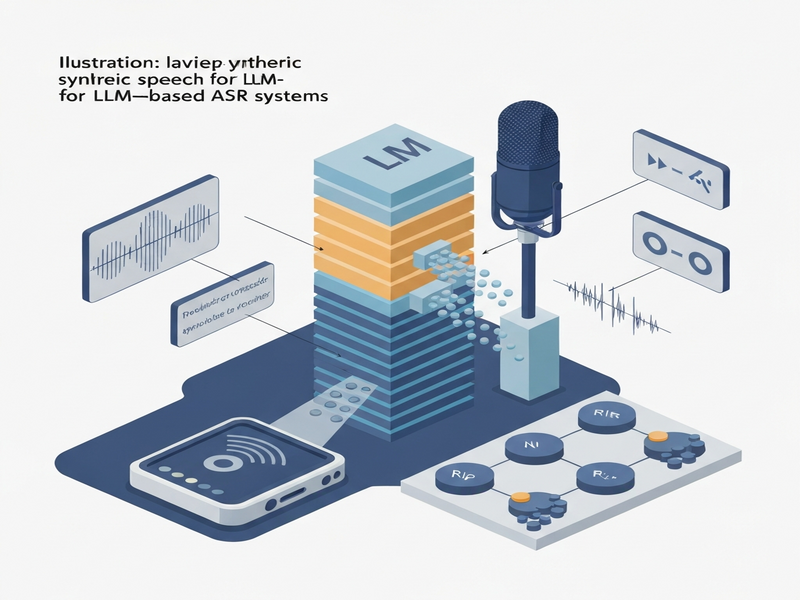
Step‑by‑Step Interaction
- Text Corpus Ingestion: Domain experts supply a large, privacy‑compliant text dataset (e.g., anonymized transaction logs, medical notes).
- Synthetic Audio Creation: The TTS engine renders each sentence into speech, optionally selecting different synthetic voices to emulate speaker diversity.
- LLM‑Based Acoustic Scoring: An LLM‑backed acoustic analyzer processes the audio, producing a “distribution mismatch score” for each segment.
- Targeted Augmentation: Segments with high mismatch scores undergo RIR convolution, pitch shifting, or noise injection, guided by a policy network that learns which augmentation reduces the score most effectively.
- Iterative Retraining: The refined synthetic set is fed into the ASR model’s pre‑training stage. After each epoch, the LLM re‑evaluates the model’s predictions, closing the loop until the mismatch score plateaus.
What sets this approach apart is the closed‑loop feedback from an LLM that treats acoustic fidelity as a learnable objective rather than a static post‑processing step. This dynamic alignment yields synthetic data that statistically mirrors real recordings across multiple acoustic dimensions.
Evaluation & Results
The authors benchmarked SLAM‑ASR on two regulated‑domain datasets:
- Banking Voice Assistants (BVA): 10 k real call recordings, heavily masked for privacy.
- Clinical Dictation Corpus (CDC): 8 k anonymized doctor‑patient interactions.
Four training regimes were compared:
| Regime | Data Source | Word Error Rate (WER) |
|---|---|---|
| Real‑Only | 100 % real recordings | 7.2 % |
| Synthetic‑Only | 100 % raw TTS output | 15.8 % |
| Synthetic + Basic Aug. | Raw TTS + generic noise | 12.3 % |
| SLAM‑ASR | LLM‑guided synthetic + RIR + style transfer | 8.1 % |
Key takeaways:
- The SLAM‑ASR pipeline reduced the synthetic‑real gap to within 1 % absolute WER of a fully real‑data model, a dramatic improvement over naïve synthetic training.
- Layer‑wise analysis revealed that the LLM’s acoustic scoring most strongly influenced the lower‑frequency bands (300 Hz–2 kHz), which are critical for intelligibility in telephony.
- RIR augmentation contributed the largest single gain (≈ 3 % absolute WER reduction), confirming that room acoustics are a primary source of domain mismatch.
These results demonstrate that high‑quality synthetic speech, when intelligently aligned, can serve as a near‑drop‑in replacement for real recordings in privacy‑sensitive ASR pipelines.
Why This Matters for AI Systems and Agents
For AI practitioners building voice‑enabled agents, the implications are threefold:
- Privacy‑First Development: Teams can now prototype and iterate on speech‑centric agents without ever exposing user voice data, satisfying compliance teams and reducing legal risk.
- Cost‑Effective Scaling: Synthetic data generation is orders of magnitude cheaper than large‑scale recording campaigns, enabling rapid expansion into new languages or dialects.
- Improved Agent Robustness: By exposing the ASR front‑end to a wide range of simulated acoustic environments, downstream conversational agents become more resilient to real‑world noise, leading to higher task success rates.
Enterprises looking to embed voice capabilities can therefore accelerate time‑to‑market while adhering to strict data‑governance policies. For example, the UBOS platform overview now includes a plug‑and‑play module that consumes SLAM‑ASR‑prepared datasets, allowing developers to spin up voice bots without custom data pipelines.
Start‑ups can leverage the UBOS for startups offering to integrate synthetic‑speech pipelines directly into their product roadmaps, cutting the need for costly data‑collection contracts.
What Comes Next
While SLAM‑ASR marks a significant step forward, several open challenges remain:
- Speaker Identity Preservation: Current style‑transfer modules randomize voice characteristics, which may be undesirable for applications requiring consistent speaker branding.
- Cross‑Language Generalization: Extending the framework to low‑resource languages will demand multilingual TTS and RIR libraries, as well as LLMs capable of cross‑lingual acoustic reasoning.
- Real‑Time Adaptation: Integrating on‑device feedback loops could allow agents to fine‑tune synthetic augmentation parameters in situ, further narrowing the gap for edge deployments.
Future research directions include:
- Coupling SLAM‑ASR with ElevenLabs AI voice integration to generate hyper‑realistic voice personas that retain brand identity.
- Exploring Workflow automation studio templates that orchestrate synthetic data generation, LLM evaluation, and ASR training as a single reproducible pipeline.
- Investigating privacy‑preserving federated learning where synthetic data is shared across institutions without exposing any real utterances.
By addressing these gaps, the community can move toward truly privacy‑by‑design speech AI that scales globally, respects user confidentiality, and delivers enterprise‑grade accuracy.
References
For a complete technical exposition, see the original pre‑print: How to Leverage Synthetic Speech for LLM‑Based ASR Systems?
Andrii Bidochko
CTO UBOS
Andrii Bidochko is an AI entrepreneur and researcher focused on AI agents, reinforcement learning, and autonomous systems. He writes about the technologies shaping the future of machine intelligence, from frontier models and agent architectures to real-world AI applications.