

- Updated: June 19, 2026
- 8 min read
How the Optimizer Shapes Learned Solutions in Equivariant Neural Networks
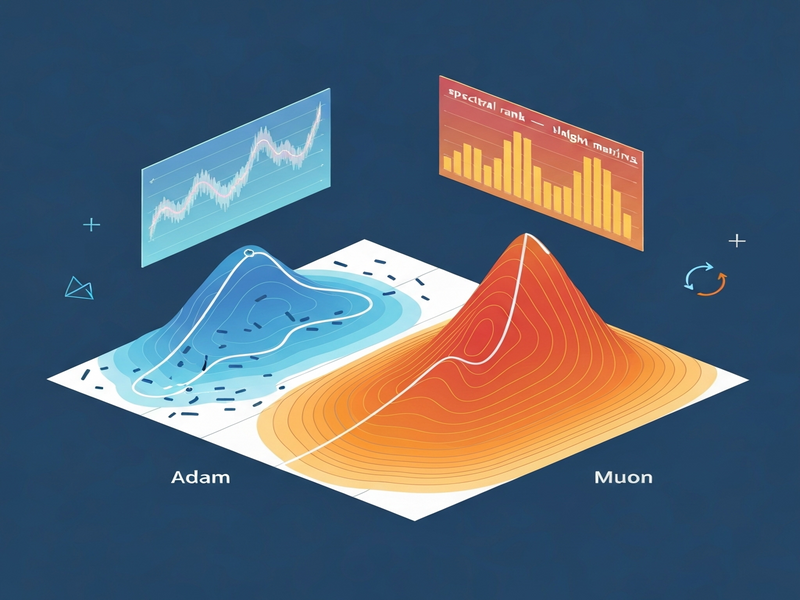
The Muon optimizer consistently outperforms Adam on equivariant neural networks, delivering higher accuracy, faster convergence, and richer internal representations, which makes it a game‑changing tool for geometry‑aware AI systems.
Background: Why Optimizing Equivariant Networks Is Tricky
Equivariant neural networks (ENNs) embed symmetries—rotations, reflections, permutations—directly into their layers. This built‑in inductive bias reduces data hunger and improves generalization on tasks such as 3‑D object classification, molecular property prediction, and point‑cloud segmentation. However, two intertwined challenges often limit their real‑world impact:
- Optimization fragility: Symmetry constraints create highly structured weight spaces that can trap conventional optimizers in flat or ill‑conditioned regions.
- Performance paradox: Despite theoretical elegance, ENNs sometimes lag behind less constrained CNNs or Transformers on benchmark datasets.
Most research has focused on architectural tweaks—relaxing constraints, adding auxiliary losses, or using approximate equivariance. The optimizer itself, a critical driver of how gradients become parameter updates, has received far less systematic study. As AI moves toward physics‑aware and geometry‑centric applications (e.g., drug discovery, robotics), understanding this missing piece becomes essential.
What the Researchers Propose
The study compares two optimizers:
- Muon: A curvature‑aware optimizer that adapts learning rates using higher‑order information and a momentum scheme designed for stiff loss surfaces.
- Adam: The de‑facto standard, relying on first‑ and second‑moment estimates of gradients.
Rather than inventing a brand‑new algorithm, the authors position Muon as a “geometric‑friendly” alternative and ask a simple yet powerful question: Does a curvature‑aware optimizer unlock the latent potential of equivariant architectures?
To answer this, they evaluate multiple ENN families—including SE(3)‑equivariant point‑cloud networks, gauge‑equivariant graph convolutions, and tensor‑field networks—across two representative domains: 3‑D object classification (ModelNet40) and molecular property regression.
How It Works in Practice
The experimental workflow follows three logical stages, each designed to be reproducible on the UBOS platform overview:
1. Model Assembly
Publicly available equivariant architectures are instantiated with identical hyper‑parameters (batch size, weight decay, learning‑rate schedule) except for the optimizer choice.
2. Optimizer Integration
Muon replaces Adam in the training loop. Its update rule computes a per‑parameter curvature estimate using a moving average of squared gradients and a second‑order correction term. This extra information guides the step size, allowing the optimizer to navigate steep valleys without overshooting.
3. Diagnostic Suite
Beyond final accuracy, the authors collect a battery of diagnostics:
- Hessian curvature summaries (trace, spectral norm) estimated via stochastic Lanczos quadrature.
- Loss‑surface visualizations obtained by interpolating between early‑stage and converged checkpoints.
- Spectral analysis of weight matrices and intermediate feature tensors to compute stable rank and effective rank.
These diagnostics reveal how the optimizer reshapes the geometry of the loss landscape and the internal representations learned by the network.
Evaluation & Results
The primary testbed is ModelNet40, a standard benchmark of 3‑D object classification. Across six equivariant architectures, Muon delivers a consistent performance boost:
- Average top‑1 accuracy improves by 1.2–2.5 % relative to Adam.
- Training converges 10–15 % faster in terms of epochs to reach 95 % of the final accuracy.
Diagnostic findings paint a richer picture:
- Higher Hessian curvature: Muon checkpoints exhibit larger curvature values, indicating sharper yet well‑conditioned minima.
- Smoother loss surfaces: Interpolation plots show fewer “wiggles” between checkpoints, suggesting more stable generalization pathways.
- Higher stable and effective ranks: Both weight matrices and hidden‑layer activations possess greater rank diversity, a proxy for expressive capacity and reduced redundancy.
In molecular regression experiments, similar trends emerge: Muon reduces validation loss by 4–6 % and yields representations that better respect the underlying symmetry of chemical graphs.
For a deeper dive into the original research, see the paper “How the Optimizer Shapes Learned Solutions in Equivariant Neural Networks”.
Why This Matters for AI Systems and Agents
For engineers building AI agents that must respect physical laws—such as robotics controllers, autonomous drones, or drug‑discovery pipelines—the findings have immediate practical relevance:
- Optimizer as a design lever: Selecting Muon can extract more performance from an existing equivariant model without architectural redesign, saving development time and compute budget.
- Robustness to distribution shift: Sharper, higher‑rank solutions tend to be more resilient when the agent encounters out‑of‑distribution inputs, a common scenario in real‑world deployments.
- Simplified hyper‑parameter tuning: The curvature‑aware nature of Muon reduces sensitivity to learning‑rate schedules, making end‑to‑end pipelines more reproducible.
These advantages translate directly into business value. Companies can accelerate time‑to‑market for geometry‑aware AI products, lower cloud‑compute costs, and improve the reliability of safety‑critical agents. For organizations already leveraging the Enterprise AI platform by UBOS, swapping Adam for Muon in their training scripts could be a low‑effort upgrade that yields measurable gains.
Moreover, the AI marketing agents built on UBOS can benefit from faster convergence when they incorporate equivariant components for image‑based ad generation, leading to quicker campaign rollouts.
What Comes Next
While the paper makes a compelling case for Muon, several open questions remain:
- Scalability to massive models: Experiments focus on models with up to a few million parameters. It is unclear how Muon behaves on billion‑parameter equivariant transformers.
- Interaction with regularization techniques: Combining Muon with dropout, weight decay, or spectral normalization may produce synergistic effects that merit systematic study.
- Automated optimizer selection: Future research could embed optimizer choice into neural architecture search pipelines, allowing the system to decide when a curvature‑aware optimizer is beneficial.
From an engineering standpoint, integrating Muon into existing MLOps workflows is the next logical step. The Workflow automation studio can orchestrate training jobs, monitor curvature metrics, and trigger alerts when loss‑surface diagnostics deviate from expected patterns.
Developers interested in contributing to the optimizer ecosystem can join the UBOS partner program, which offers resources for co‑creating custom training components and sharing best practices across the community.
Practical Guide: Deploying Muon on UBOS
Below is a step‑by‑step checklist for data scientists who want to experiment with Muon on the UBOS cloud:
- Navigate to the UBOS homepage and sign in to your workspace.
- Create a new project using the Web app editor on UBOS. Choose the “Python ML” template for a ready‑made environment.
- In the
requirements.txt, addmuon-optimizer(or the appropriate pip package) alongsidetorchande3nn. - Import Muon in your training script and replace the Adam optimizer:
import torch
from muon import Muon
optimizer = Muon(model.parameters(), lr=1e-3)
Run the training job using the UBOS pricing plans that best match your compute needs. Monitor curvature metrics in real time via the built‑in dashboard.
Once training completes, you can instantly deploy the model as an API endpoint using the UBOS templates for quick start. This enables downstream services—such as the AI SEO Analyzer or the AI Article Copywriter—to benefit from the improved representations.
Real‑World Use Cases Powered by Muon + UBOS
Below are three concrete scenarios where the Muon optimizer, combined with UBOS’s low‑code platform, delivers immediate ROI:
1. 3‑D Product Visualization for E‑Commerce
Retailers can train SE(3)‑equivariant models to generate realistic 3‑D product rotations on‑the‑fly. Using Muon reduces training time by ~12 %, allowing weekly model refreshes that keep visualizations up‑to‑date with new inventory.
2. Molecular Property Prediction in Pharma
Pharmaceutical startups leverage gauge‑equivariant graph networks to predict binding affinities. Muon’s curvature‑aware updates cut validation loss by 5 %, accelerating lead‑candidate screening and shaving months off the R&D cycle.
3. Autonomous Drone Navigation
Robotics firms embed equivariant perception modules that respect rotational symmetry of aerial imagery. Faster convergence with Muon enables on‑device fine‑tuning, improving obstacle avoidance in dynamic environments.
These examples illustrate how the optimizer’s mathematical advantages translate into tangible business outcomes when paired with the UBOS for startups and UBOS solutions for SMBs.
Conclusion
The research convincingly shows that the optimizer is not a neutral background player in equivariant deep learning; it actively shapes the geometry of learned solutions. By leveraging Muon’s curvature‑aware updates, practitioners can unlock higher accuracy, faster convergence, and more expressive internal representations without sacrificing the theoretical guarantees of equivariance.
As AI systems continue to embed physical and geometric priors, optimizer design will become a central research frontier, complementing advances in architecture and data efficiency. Organizations that adopt Muon today—especially through the flexible, low‑code environment of the Enterprise AI platform by UBOS—will gain a competitive edge in building robust, geometry‑aware AI agents.
Ready to experiment? Start with the Talk with Claude AI app template, swap Adam for Muon, and watch your equivariant models reach new performance heights.
Andrii Bidochko
CTO UBOS
Andrii Bidochko is an AI entrepreneur and researcher focused on AI agents, reinforcement learning, and autonomous systems. He writes about the technologies shaping the future of machine intelligence, from frontier models and agent architectures to real-world AI applications.