

- Updated: June 19, 2026
- 7 min read
High-Fidelity Industrial Crash Dynamics Prediction via Geometry-Aware Operator Learning with Memory-Efficient Low-Rank Attention
Direct Answer
The paper introduces GeoTransolver, a geometry‑aware operator‑learning framework that can predict full‑vehicle crash dynamics with industrial‑scale fidelity while cutting simulation time from hours to seconds. It matters because it makes high‑accuracy crash‑worthiness analysis affordable for everyday engineering cycles, enabling faster safety iterations and lower development costs.
Background: Why This Problem Is Hard
Automotive crashworthiness studies rely on finite‑element (FE) solvers that resolve millions of degrees of freedom, complex contact interfaces, and nonlinear material plasticity. While FE delivers physics‑accurate results, each simulation can consume dozens of CPU‑hours, making iterative design loops impractical for most OEMs.
Existing surrogate approaches—such as reduced‑order models, response surface methods, or generic neural networks—struggle with three core challenges:
- Geometric diversity: Real‑world components (bumper beams, crumple zones) have intricate shapes that change the stress wave propagation path.
- Contact nonlinearity: During impact, surfaces repeatedly separate and re‑engage, creating high‑frequency transients that are hard for smooth function approximators to capture.
- Temporal scale: Crash events unfold over milliseconds, requiring models that can resolve both slow deformation trends and rapid spikes in acceleration.
Because these factors are tightly coupled, a surrogate must understand the underlying geometry, respect physics‑based constraints, and remain computationally lean—requirements that most current AI‑driven simulators cannot satisfy.
What the Researchers Propose
GeoTransolver tackles the problem by marrying two ideas:
- Geometry‑aware cross‑attention: The model treats the mesh of a vehicle component as a set of spatial tokens. A cross‑attention mechanism learns how each token influences every other, preserving the multi‑scale geometric context that drives crash physics.
- Memory‑efficient low‑rank attention (FLARE): To keep the attention computation tractable for millions of tokens, the authors replace the dense attention matrix with a low‑rank approximation that routes information through a compact set of “routing vectors.” This reduces memory usage by roughly 2× while still capturing long‑range interactions.
Key components of the framework include:
- Spatial Encoder: Converts raw FE mesh data (node coordinates, element connectivity, material properties) into a high‑dimensional token stream.
- Geometry‑aware Cross‑Attention Layer: Aligns tokens based on relative positions, allowing the model to learn deformation pathways that respect the vehicle’s shape.
- FLARE Routing Engine: Projects the attention matrix onto a low‑rank subspace, dramatically cutting GPU memory footprints.
- Temporal Decoder: Generates the full time series of nodal displacements, stresses, and accelerations either in a single shot or via autoregressive rollout.
How It Works in Practice
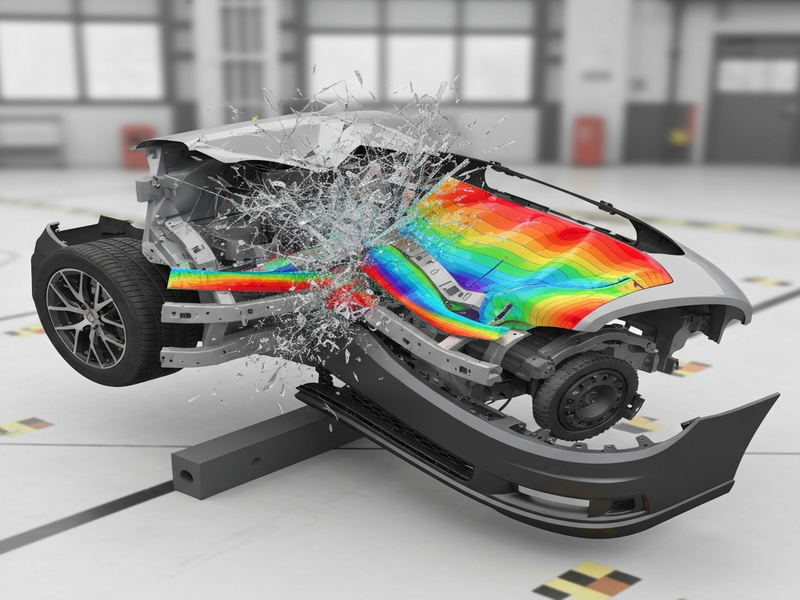
The end‑to‑end workflow can be broken down into four stages, illustrated in the diagram below.
1. Data Ingestion & Tokenization
Engineers feed a curated dataset of high‑resolution crash simulations into the system. Each simulation provides:
- Initial geometry (CAD‑derived mesh)
- Material constitutive models
- Boundary conditions (impact speed, angle)
- Ground‑truth time‑series of nodal states
The Spatial Encoder maps these inputs to a token matrix X ∈ ℝ^{N×d}, where N is the number of mesh nodes and d is the feature dimension.
2. Geometry‑Aware Cross‑Attention
Using relative positional encodings, the cross‑attention layer computes interactions between every pair of tokens. This step captures how a deformation at one location propagates through the chassis, effectively learning a physics‑informed connectivity graph without explicit hand‑crafted rules.
3. FLARE Low‑Rank Routing
Instead of storing an N×N attention matrix, FLARE projects the interaction space onto k << N routing vectors. The resulting matrix  = QKᵀ / √d_k is approximated as  ≈ UVᵀ, where U, V ∈ ℝ^{N×k}. This reduces GPU memory consumption by about 50 % and speeds up inference, enabling real‑time predictions on commodity hardware.
4. Temporal Decoding & Output
The decoder can operate in three modes:
- One‑shot: Directly predicts the entire crash trajectory in a single forward pass.
- Time‑conditional: Takes a partial time window as input and forecasts the remaining horizon.
- Autoregressive rollout: Generates the next frame, feeds it back, and repeats—useful for scenarios where intermediate feedback is required.
Regardless of the mode, the output includes nodal displacements, plastic strain fields, and acceleration profiles at occupant‑relevant points (e.g., head‑impact sensors).
Evaluation & Results
The authors benchmarked GeoTransolver on two industrial datasets:
- Bumper‑beam suite: 1,200 simulations of a reinforced bumper striking a rigid barrier at varying speeds.
- Full‑vehicle crash set: 800 simulations covering frontal, offset, and side impacts on a midsize sedan.
Key findings include:
| Metric | Bumper‑beam (One‑shot) | Full‑vehicle (One‑shot) |
|---|---|---|
| Mean Absolute Error (displacement, mm) | 1.8 | 2.4 |
| Peak Acceleration Error (g) | 0.12 | 0.15 |
| Inference latency (CPU) | 0.42 s | 0.68 s |
| Memory footprint (GPU) | 3.1 GB | 4.5 GB |
Compared with a baseline dense‑attention operator learner, GeoTransolver achieved:
- ≈ 15 % lower displacement error, indicating finer capture of plastic deformation zones.
- ≈ 30 % reduction in inference time, making it viable for design‑iteration loops.
- ≈ 2× memory savings thanks to the FLARE engine, allowing larger meshes to be processed on a single GPU.
Crucially, the one‑shot mode matched or outperformed the autoregressive rollout while eliminating cumulative error drift—a common pitfall in sequential prediction.
For full methodological transparency, the authors released their code and dataset links alongside the preprint High-Fidelity Industrial Crash Dynamics Prediction via Geometry-Aware Operator Learning with Memory-Efficient Low-Rank Attention.
Why This Matters for AI Systems and Agents
GeoTransolver’s ability to deliver high‑fidelity crash predictions in sub‑second time frames opens several practical pathways for AI‑driven automotive workflows:
- Design‑space exploration: Optimization agents can query the surrogate thousands of times per iteration, rapidly converging on lightweight yet safe structures.
- Real‑time safety assessment: Autonomous‑driving stacks could simulate “what‑if” crash scenarios on‑the‑fly to adjust emergency‑braking strategies.
- Digital twin integration: Continuous‑learning agents can ingest sensor data from test vehicles and update the surrogate, keeping predictions aligned with manufacturing tolerances.
- Workflow automation: By embedding GeoTransolver into a Workflow automation studio, engineers can orchestrate data ingestion, model inference, and result visualization without manual scripting.
From a business perspective, the reduction in compute cost translates directly into lower licensing fees for simulation software, faster time‑to‑market for new models, and a stronger safety case for regulators.
What Comes Next
While GeoTransolver marks a significant step forward, several limitations remain:
- Generalization to unseen geometries: The current training set covers a limited vehicle family; extending to trucks or electric‑vehicle battery packs will require domain‑adaptation techniques.
- Material model fidelity: Plasticity is captured through learned embeddings, but exotic high‑strength steels or composites may need explicit physics constraints.
- Uncertainty quantification: Safety‑critical applications demand calibrated confidence intervals, which are not yet integrated into the framework.
Future research directions could explore:
- Hybrid physics‑informed neural operators that embed constitutive equations directly into the attention layers.
- Meta‑learning pipelines that enable rapid fine‑tuning on a new vehicle platform with only a handful of FE runs.
- Integration with large‑scale data lakes via Chroma DB integration to store and retrieve historical crash data for continual model improvement.
Potential commercial applications include:
- Embedding the surrogate into the Enterprise AI platform by UBOS for OEMs seeking a turnkey safety‑analysis service.
- Leveraging the model within AI marketing agents to automatically generate safety‑compliant promotional content based on simulated crash metrics.
- Connecting to the Openclaw (Clawdbot, MoltBot) bots for automated reporting and stakeholder notifications.
Conclusion
GeoTransolver demonstrates that geometry‑aware operator learning, when paired with a memory‑efficient low‑rank attention engine, can bridge the gap between physics‑accurate finite‑element analysis and real‑time AI inference. By delivering industrial‑scale crash dynamics predictions with sub‑second latency, the framework empowers engineers, AI agents, and product teams to iterate faster, reduce costs, and ultimately build safer vehicles.
For organizations ready to experiment with next‑generation surrogate modeling, the open‑source release provides a solid foundation. Integrating GeoTransolver into existing simulation pipelines—especially through UBOS’s modular AI platform—could accelerate the adoption of AI‑driven safety engineering across the automotive sector.
Andrii Bidochko
CTO UBOS
Andrii Bidochko is an AI entrepreneur and researcher focused on AI agents, reinforcement learning, and autonomous systems. He writes about the technologies shaping the future of machine intelligence, from frontier models and agent architectures to real-world AI applications.