

- Updated: July 10, 2026
- 6 min read
Heaviside Continuity of Rolling Coefficients for Eliminating Epistemic Entropy in Large Language Models
Direct Answer
The paper introduces Heaviside Continuity of Rolling Coefficients (HCRC), a verification‑first execution framework that gates each language‑model token generation behind a predicate‑driven “Heaviside Gate.” By requiring an independent verification signal before advancing the model’s internal state, HCRC eliminates the propagation of erroneous reasoning steps, dramatically reducing false completions without altering the underlying LLM.
This matters because it offers a systematic, model‑agnostic way to curb epistemic entropy—the hidden uncertainty that makes large language models appear confident while hallucinating—thereby enabling safer, more reliable AI agents for production workloads.
Background: Why This Problem Is Hard
Large language models excel at producing fluent text, yet they lack an intrinsic self‑check mechanism. Autoregressive decoding treats each token as a final decision, moving the hidden state forward regardless of whether the intermediate reasoning is sound. In practice, this leads to two intertwined challenges:
- Undetectable hallucinations: The model can confidently assert false facts, and downstream components have no way to verify the correctness of the reasoning that produced them.
- Epistemic entropy accumulation: Errors in early tokens corrupt the hidden state, causing a cascade of increasingly unreliable outputs.
Current mitigation strategies—prompt engineering, post‑hoc fact‑checking, or fine‑tuning on curated data—address the symptom rather than the root cause. Prompt engineering relies on brittle heuristics; post‑hoc checks only react after the fact, often after the model has already committed to a wrong answer; fine‑tuning demands massive compute and still cannot guarantee zero‑hallucination behavior. As LLMs become core components of autonomous agents, code generators, and decision‑support tools, the inability to verify intermediate steps becomes a critical reliability bottleneck.
What the Researchers Propose
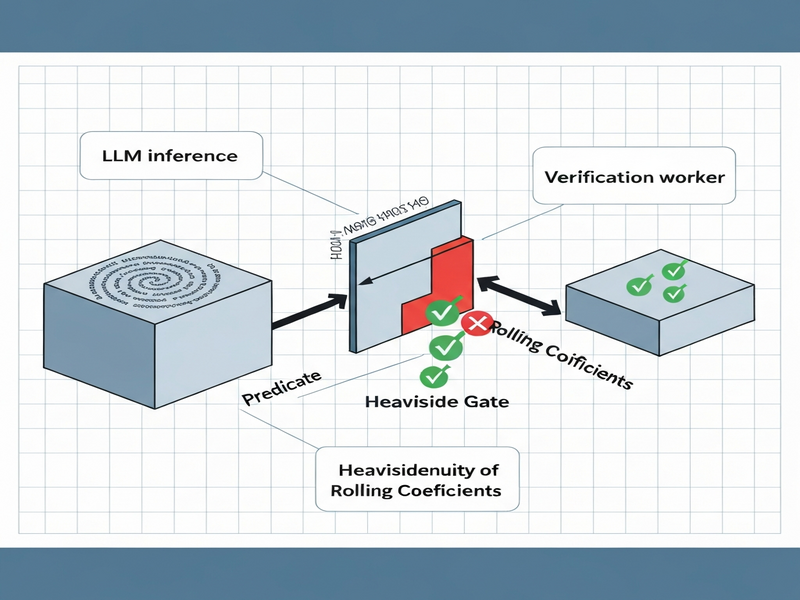
HCRC reframes inference as a series of predicate‑gated state transitions. The core idea is simple yet powerful:
- A Heaviside Gate sits between the language model and its next token generation step.
- The gate evaluates a correctness predicate—for example, “does the generated code compile?” or “does the answer satisfy a known logical constraint?”—using an independent verification worker.
- If the predicate returns true, the gate lets the token (and the associated hidden state) pass through; otherwise, execution halts or rolls back, preventing the error from contaminating future steps.
The framework introduces three logical agents:
- Proposer: The primary LLM that suggests the next token or chunk of text.
- Verifier: A parallel, lightweight model or tool (e.g., a static analyzer, a unit‑test runner, or a knowledge base lookup) that checks the proposer’s output against the predicate.
- Gatekeeper: The Heaviside Gate that orchestrates the hand‑off, enforcing a “continue‑only‑if‑verified” policy.
Crucially, HCRC does not require any changes to the proposer’s weights; it operates entirely at the execution layer, making it compatible with any off‑the‑shelf LLM.
How It Works in Practice
Conceptual Workflow
The end‑to‑end flow can be visualized as a loop:
- Generate Candidate: The proposer emits a candidate token or a short sequence (e.g., a line of code).
- Parallel Verification: Simultaneously, the verifier runs a domain‑specific check—such as compiling the code, evaluating a mathematical expression, or querying a factual database.
- Heaviside Decision: The gate receives the verifier’s Boolean signal. If
true, the candidate is committed; iffalse, the gate either requests a new candidate or halts execution entirely. - State Update: Only verified tokens update the model’s hidden state, preserving a clean trajectory for subsequent generations.
Component Interaction
In a typical deployment, the three components run on separate compute resources to avoid latency bottlenecks:
- The proposer may be a large, GPU‑accelerated model (e.g., GPT‑4‑Turbo) hosted on a cloud endpoint.
- The verifier is often a smaller CPU‑friendly model or a deterministic tool (e.g., a linter, a SAT solver, or a retrieval‑augmented generator) that can return results in milliseconds.
- The gatekeeper is a lightweight orchestrator—implemented as a microservice—that merges the two streams, applies the Heaviside step function, and decides whether to forward the token.
What distinguishes HCRC from prior “post‑generation filtering” pipelines is the temporal ordering: verification occurs *before* the hidden state advances, guaranteeing that no invalid information ever influences later reasoning.
Evaluation & Results
Benchmark Suite
The authors evaluated HCRC on two families of tasks:
- Software‑engineering challenges: Automated code synthesis, bug fixing, and unit‑test generation across 13 different proposers from four major providers.
- Logical reasoning problems: Multi‑step math puzzles and constraint‑satisfaction queries where intermediate correctness can be programmatically checked.
Key Findings
- For the strongest proposers, the false‑completion rate (FCR) dropped from a baseline of 4‑7 % to 0 % when the Heaviside Gate was enabled.
- Latency remained competitive: the verification step added an average of 12 ms per token, and in some configurations the overall wall‑clock time was even lower because the gate prevented costly downstream re‑computations.
- Weaker proposers, which previously produced corrupted downstream state, now halted gracefully instead of propagating errors, giving system designers a clear signal to intervene.
- In a production‑grade coding assistant that ran for several months, HCRC acted as the “control plane” for file mutations, progress reporting, and memory compaction, demonstrating real‑world stability.
These results prove that verification‑first execution can achieve reliability levels traditionally associated only with much larger models, without any additional training data or parameter scaling.
Why This Matters for AI Systems and Agents
For practitioners building autonomous agents, the HCRC paradigm offers a concrete safety valve:
- Deterministic error handling: Agents can stop execution the moment a predicate fails, avoiding silent degradation of performance.
- Modular verification: Teams can plug in domain‑specific checkers (e.g., security scanners, compliance validators) without retraining the core LLM.
- Resource efficiency: By preventing invalid states early, downstream compute—such as memory‑intensive reasoning or multi‑model orchestration—is saved.
- Compliance and auditability: The gatekeeper logs every predicate outcome, providing an immutable trail for regulatory review.
Enterprises that already rely on the Enterprise AI platform by UBOS can integrate HCRC as a middleware layer, turning any existing LLM service into a verification‑enabled engine with minimal code changes.
What Comes Next
While HCRC demonstrates impressive gains, several open challenges remain:
- Predicate design: Crafting expressive yet computationally cheap correctness predicates for open‑ended domains (e.g., creative writing) is non‑trivial.
- Verifier scalability: As the number of parallel checks grows, orchestrating them without introducing latency spikes will require smarter scheduling and possibly learned verification models.
- Graceful degradation: In scenarios where verification fails repeatedly, agents need fallback strategies—such as asking for clarification or switching to a more conservative model.
- Standardization: A community‑wide API for Heaviside‑style gating could accelerate adoption across heterogeneous AI stacks.
Future research may explore adaptive gating, where the gate dynamically relaxes or tightens predicates based on confidence estimates, or meta‑verification, where the verifier itself is subject to higher‑order checks.
Organizations interested in pioneering these extensions can join the UBOS partner program, gaining early access to SDKs, reference implementations, and co‑development opportunities.
References
- Pitsane, M. Y., & Mogale, H. (2026). Heaviside Continuity of Rolling Coefficients for Eliminating Epistemic Entropy in Large Language Models. arXiv preprint arXiv:2607.04562v1.
- Additional background on LLM hallucinations and verification can be found in recent surveys on AI safety (e.g., OpenAI, 2024).
Image Placeholder
Andrii Bidochko
CTO UBOS
Andrii Bidochko is an AI entrepreneur and researcher focused on AI agents, reinforcement learning, and autonomous systems. He writes about the technologies shaping the future of machine intelligence, from frontier models and agent architectures to real-world AI applications.