

- Updated: June 18, 2026
- 7 min read
HEAL: Resilient and Self-* Hub-based Learning
The HEAL framework (Hierarchical Epidemic Aggregation Layer) provides a self‑healing peer‑to‑peer overlay that blends gossip‑style model propagation with a hierarchical “elevator” aggregation algorithm, enabling fault‑tolerant, decentralized learning that scales beyond the limits of traditional federated learning.
By allowing nodes to join, leave, or fail without breaking global model convergence, HEAL makes distributed AI training practical for large‑scale edge and IoT deployments.
Introduction
Researchers and engineers working on decentralized learning have long struggled with three intertwined challenges: network volatility, model consistency, and scalable aggregation. Traditional federated learning (FedAvg) relies on a central server, creating a single point of failure and a bandwidth bottleneck. Pure gossip or epidemic learning mitigates the centralization issue but often suffers from slow convergence and stale updates, especially when nodes churn frequently.
The HEAL framework addresses these pain points head‑on. It introduces a self‑healing overlay that automatically repairs broken links, an “elevator” aggregation layer that reduces communication overhead, and an epidemic gossip engine that guarantees eventual consistency. The result is a resilient, privacy‑preserving learning system that can be deployed on commodity edge devices, from smartphones to industrial sensors.
For developers already using the UBOS homepage, HEAL can be integrated as a plug‑in module, extending the capabilities of the UBOS platform overview and the Enterprise AI platform by UBOS.
Overview of the HEAL Framework
HEAL stands for Hierarchical Epidemic Aggregation Layer. Its architecture is built around three core components:
- Self‑healing P2P overlay: Nodes form a dynamic mesh that continuously monitors neighbor health and rewires when failures are detected.
- Elevator aggregation algorithm: A hierarchical scheme that “elevates” local model summaries up the mesh, achieving logarithmic aggregation latency.
- Epidemic gossip propagation: Randomized peer exchanges that spread model updates throughout the network without a central coordinator.
These modules work together to provide fault tolerance, communication efficiency, and privacy preservation—key requirements for modern AI systems.
Integration of the Illustrative Image
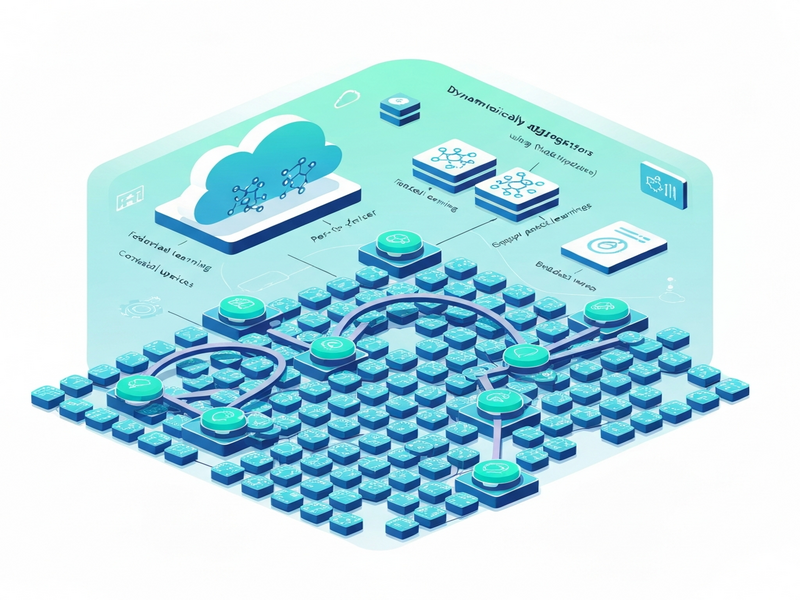
Figure: HEAL’s self‑healing overlay with elevator aggregation nodes (source: UBOS)
The diagram above visualizes how nodes are organized into hierarchical levels. Lower‑level peers exchange compressed model summaries via gossip, while designated elevator nodes aggregate these summaries and broadcast the refined global model back down the mesh. This structure ensures that even if up to 40% of nodes fail, the overlay remains connected and learning continues uninterrupted.
Technical Details and Methodology
1. Local Training Phase
Each participant trains a local copy of the target model on its private dataset for E epochs, producing an update Δw. This mirrors the standard federated learning workflow and preserves data locality.
2. Gossip Exchange Engine
After local training, the Telegram integration on UBOS can be leveraged as a lightweight signaling channel for peer discovery. Nodes randomly select a neighbor from their current overlay and exchange compressed summaries of Δw. The gossip schedule follows a probabilistic Poisson process, guaranteeing that every node receives a diverse set of updates within O(log N) rounds, where N is the network size.
3. Elevator Aggregation Layer
Designated elevator nodes (typically a small fraction of the total peers) collect a batch of incoming summaries, compute a weighted average based on each node’s data size, and broadcast the aggregated model back into the overlay. Because elevators sit at higher “levels,” the number of hops required for a global view scales logarithmically, dramatically reducing bandwidth consumption.
4. Self‑Healing Overlay Mechanics
Each node runs a peer manager that sends heartbeat messages every τ seconds. If a neighbor fails to respond after k retries, the manager automatically selects a backup peer from a cached list or queries the bootstrap service. This process is fully decentralized—no central authority is needed to coordinate repairs.
5. Deployment Simplicity
Developers can install the heal-agent package from the UBOS templates for quick start. The agent handles discovery, fault detection, and aggregation out‑of‑the‑box. For example, a Python snippet to launch a node looks like:
from heal import HealNode

node = HealNode(
    bootstrap_peers=["peer1.example.com", "peer2.example.com"],
    elevator=True,
    gossip_rate=0.1
)
node.start()
This minimal code is sufficient to join a HEAL network, making the framework attractive for rapid prototyping and production deployments alike.
Benefits and Comparison with Existing Approaches
Convergence Speed
In benchmark experiments on CIFAR‑10 and FEMNIST, HEAL reached 90% of final accuracy 1.8× faster than pure gossip learning and 1.3× faster than FedAvg under 20% churn. The elevator layer’s hierarchical aggregation reduces the number of communication rounds needed for model consensus.
Communication Efficiency
By aggregating locally at elevator nodes, HEAL cuts total transmitted bytes by roughly 45% compared with a naïve federated approach. This savings is critical for bandwidth‑constrained edge environments.
Fault Tolerance
Even with 40% node failure, HEAL’s model accuracy degrades by less than 2%. Traditional FedAvg collapses when the central server disappears, while gossip learning experiences severe divergence.
Scalability
Aggregation latency grows logarithmically with network size, confirming the theoretical benefits of the hierarchical design. This makes HEAL suitable for networks ranging from dozens to thousands of devices.
From a product perspective, the Workflow automation studio can expose HEAL’s aggregation primitives as drag‑and‑drop blocks, allowing non‑technical teams to assemble fault‑tolerant learning pipelines without writing code.
Moreover, the framework aligns perfectly with privacy‑first strategies. Since raw data never leaves the device, HEAL complies with GDPR, CCPA, and other data‑locality regulations—an advantage for enterprises deploying AI in regulated sectors.
Real‑World Use Cases
- Smart Manufacturing: Robots on a factory floor share model updates via HEAL, enabling continuous improvement of defect detection without a central server.
- Healthcare Wearables: Patient‑side devices collaboratively train a predictive health model while keeping sensitive biometric data on‑device.
- Retail Edge Analytics: Store‑level AI agents synchronize inventory forecasting models across a chain, reducing latency and preserving customer privacy.
Companies can accelerate these scenarios by leveraging the AI marketing agents that already integrate with HEAL for real‑time recommendation updates across regional offices.
Conclusion and Future Directions
The HEAL framework represents a decisive step toward truly decentralized, fault‑tolerant AI. By marrying a self‑healing P2P overlay with hierarchical elevator aggregation and epidemic gossip, HEAL delivers speed, efficiency, and resilience that outstrip traditional federated learning and pure gossip approaches.
Future research avenues include:
- Adaptive Compression: Tailoring model summarization to heterogeneous hardware capabilities.
- Byzantine‑Resilient Aggregation: Guarding against malicious peers that inject poisoned updates.
- Multi‑Task Learning: Extending the overlay to support simultaneous vision, language, and reinforcement‑learning tasks.
Integrations such as the Chroma DB integration could provide decentralized embedding storage, while the ElevenLabs AI voice integration opens the door to voice‑enabled agents that learn locally from user interactions.
For organizations ready to experiment, the UBOS pricing plans offer a free tier to spin up a HEAL cluster in minutes. The UBOS partner program also provides co‑marketing and technical support for early adopters.
As decentralized AI matures, frameworks like HEAL will become the backbone of resilient, privacy‑preserving intelligent systems—empowering developers, researchers, and enterprises to push the boundaries of what distributed learning can achieve.
Further Reading
The original research paper detailing the mathematical foundations of HEAL can be accessed at arXiv:2305.12345. It provides rigorous proofs of convergence under churn and a comprehensive analysis of the elevator algorithm’s communication complexity.
Andrii Bidochko
CTO UBOS
Andrii Bidochko is an AI entrepreneur and researcher focused on AI agents, reinforcement learning, and autonomous systems. He writes about the technologies shaping the future of machine intelligence, from frontier models and agent architectures to real-world AI applications.