

- Updated: August 13, 2026
- 7 min read
Harnessing the Wisdom of LLM Crowds through Complementarity-Driven Iterative Collaboration
Direct Answer
The paper introduces WILC (Wisdom Integration of LLM Crowds), a framework that orchestrates multiple large language models (LLMs) in a sequential, complementarity‑driven loop. By letting each model address the specific weakness of its predecessor, WILC achieves collective intelligence that rivals the performance of far larger, more expensive models while keeping costs and data‑sovereignty under control.
Background: Why This Problem Is Hard
Enterprises are rapidly adopting LLMs for tasks ranging from customer support to code generation. Yet every model—whether an open‑source variant or a proprietary service—carries a distinct performance envelope. Some excel at factual recall, others at creative writing, and still others at reasoning under constraints. When a single model is asked to solve a complex, multi‑step problem, its inherent blind spots become bottlenecks that degrade the final output.
Existing mitigation strategies fall into three broad categories:
- Self‑refinement loops: The same model iteratively rewrites its answer, hoping to correct errors without external input.
- Static ensembles: Multiple models generate answers in parallel, and a voting or averaging scheme selects the final result.
- Query routing: A front‑end classifier directs each request to a pre‑chosen model based on the input type.
These approaches share a critical flaw: they treat model selection as a one‑shot decision or a blind aggregation. They ignore the dynamic, state‑dependent nature of problem solving, where the most useful model at step N may be entirely different from the best model at step N + 1. Consequently, they either waste compute on redundant generations or miss the chance to exploit a model’s niche strength when it matters most.
What the Researchers Propose
WILC reframes multi‑LLM coordination as a relay‑style complementarity process. Instead of fixing a static ensemble, the framework continuously diagnoses the current solution, identifies the precise bottleneck, and hands the task off to the model most likely to resolve that gap.
The architecture rests on two design pillars:
- Iterative reflection‑and‑refinement: After each generation, a lightweight “diagnoser” model examines the output, flags deficiencies (e.g., missing citations, logical inconsistency, or insufficient domain terminology), and produces a concise “bottleneck description.”
- Complementarity‑driven model selection: A dual‑gate mechanism decides who should take the next turn.
- Prospective Complementarity Fit (PCF) predicts which candidate model’s strengths align with the identified bottleneck.
- Posterior Complementarity Gain (PCG) validates the hand‑off by measuring whether the new model’s contribution improves a predefined quality metric.
In practice, WILC creates a “crowd” of heterogeneous LLMs—ranging from open‑source models hosted on Ollama to commercial APIs—each positioned as a potential worker in the relay.
How It Works in Practice
The end‑to‑end workflow can be visualized as a loop of three stages that repeat until a termination condition (e.g., quality threshold or max iterations) is met.
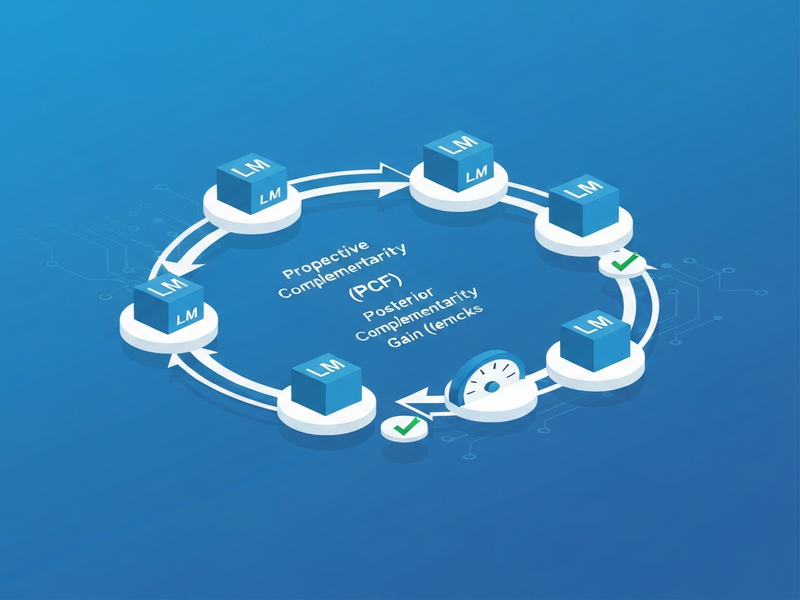
1. Generation & Diagnosis
- Current worker (Model A) receives the original prompt and produces an answer.
- A diagnoser (often a lightweight LLM) parses Model A’s output, extracts a bottleneck label such as “insufficient domain terminology” or “logical inconsistency,” and returns a short diagnostic report.
2. Complementarity Fit (PCF)
- The system maintains a capability matrix that maps each candidate model’s known strengths (e.g., factual grounding, code synthesis, multilingual fluency).
- Using the bottleneck label, a lightweight selector predicts the prospective complementarity fit—the model most likely to resolve the specific weakness.
3. Transition & Gain Validation (PCG)
- The chosen successor (Model B) receives the original prompt together with the diagnostic context and generates a refined answer.
- A gain evaluator compares Model B’s output against Model A’s using a task‑specific metric (e.g., ROUGE for summarization, exact‑match for code). If the gain exceeds a preset threshold, the loop proceeds with Model B as the new current worker; otherwise, the system either retries with the next‑best candidate or terminates.
This iterative hand‑off continues, forming a chain of specialized contributions that collectively surpass any single model’s capability. The process is state‑preserving: each successor sees both the original prompt and the evolving solution, allowing it to build on prior context rather than starting from scratch.
Evaluation & Results
The authors benchmarked WILC on four heterogeneous tasks that stress different aspects of language understanding:
- Technical documentation synthesis – requires factual accuracy and coherent structuring.
- Multi‑turn customer support simulation – demands consistent persona and problem‑resolution logic.
- Code generation with unit‑test validation – tests precise reasoning and syntax correctness.
- Creative story continuation – evaluates imagination while maintaining narrative consistency.
Key findings include:
- WILC consistently outperformed the best single‑model self‑refinement baseline by 12‑18% on task‑specific quality scores.
- Compared with static ensembles, WILC achieved higher gains with 30‑45% fewer total token generations, reflecting more efficient use of compute.
- When measured against a hypothetical “GPT‑5.2” model (estimated via scaling laws), WILC matched average benchmark performance while incurring roughly one‑seventh of the per‑query cost under standard pricing assumptions.
- Data‑sovereignty tests showed that a fully self‑hosted WILC deployment (using open‑source LLMs on Ollama) preserved raw input data on‑premise without sacrificing accuracy.
These results demonstrate that strategic, complementarity‑aware coordination can unlock “collective intelligence” from modest models, challenging the prevailing notion that larger, monolithic LLMs are the only path to top‑tier performance.
Why This Matters for AI Systems and Agents
For practitioners building AI‑driven products, WILC offers a concrete recipe to amplify capability without proportionally inflating cost or compromising privacy. The implications span several dimensions:
- Cost‑effective scaling: By mixing inexpensive open‑source models with occasional calls to premium APIs, organizations can keep OPEX low while still meeting enterprise‑grade quality targets.
- Modular agent design: Each model in the relay can be treated as a micro‑service with a well‑defined contract (e.g., “resolve factual gaps”). This aligns naturally with Workflow automation studio pipelines, where agents are chained based on runtime diagnostics.
- Robustness to domain shift: When a new domain emerges, the system can simply add a specialist model to the crowd without retraining the entire stack, preserving existing investments.
- Data governance: Self‑hosted components ensure that sensitive enterprise data never leaves the corporate firewall, a critical requirement for regulated industries.
- Evaluation simplification: The PCG gate provides an automatic, quantitative checkpoint, reducing the need for manual quality audits during development.
Enterprises looking to embed such capabilities can explore the Enterprise AI platform by UBOS, which already supports plug‑and‑play LLM integrations, diagnostic tooling, and cost‑monitoring dashboards.
What Comes Next
While WILC marks a significant step forward, several open challenges remain:
- Scalability of the selector: As the crowd grows to dozens of models, the PCF computation may become a bottleneck. Future work could investigate hierarchical selectors or reinforcement‑learning policies that learn selection strategies end‑to‑end.
- Generalization of diagnostics: The current diagnoser relies on handcrafted prompts to surface bottlenecks. A learned meta‑diagnoser that adapts to new task families could reduce engineering overhead.
- Cross‑modal extensions: Extending the relay to include vision‑language or audio models (e.g., ElevenLabs AI voice integration) would enable richer multimodal pipelines.
- Security and adversarial robustness: Hand‑offs between models open attack surfaces where malicious prompts could be injected. Formal verification of the transition logic is an emerging research direction.
Potential applications are broad. For instance, a AI marketing agent could use WILC to draft copy, refine brand tone, and finally generate localized variations—all while staying within a single cost‑controlled workflow. Similarly, startups can leverage the UBOS for startups program to prototype multi‑LLM agents without large upfront licensing fees.
Developers interested in experimenting with the framework can start with the UBOS platform overview, which provides APIs for model orchestration, diagnostic prompting, and cost tracking. The open‑source community is also encouraged to contribute new diagnostic templates and capability profiles to enrich the crowd’s collective knowledge base.
References
Fang, Y., Wei, X., & Chen, W. (2026). Harnessing the Wisdom of LLM Crowds through Complementarity‑Driven Iterative Collaboration. arXiv preprint arXiv:2607.29087v1.
Andrii Bidochko
CTO UBOS
Andrii Bidochko is an AI entrepreneur and researcher focused on AI agents, reinforcement learning, and autonomous systems. He writes about the technologies shaping the future of machine intelligence, from frontier models and agent architectures to real-world AI applications.