

- Updated: June 14, 2026
- 7 min read
GS-FUSE: Granger-Supervised Gated Fusion and Multi-Granularity Alignment for Event-Driven Financial Forecasting
Direct Answer
GS‑FUSE introduces a Granger‑supervised gated‑fusion architecture that dynamically decides when news‑article text should influence price predictions, and a multi‑granularity alignment module that ties both high‑level event semantics and fine‑grained textual cues to future market movements. This matters because it lets investors and automated trading agents extract genuine predictive power from news streams while ignoring noisy or irrelevant headlines, leading to consistently better forecasts across assets and horizons.
Background: Why This Problem Is Hard
Financial markets react to a constant flood of textual information—earnings releases, regulatory announcements, macro‑economic reports, and even social‑media chatter. Translating that unstructured text into actionable price signals is notoriously difficult for three reasons.
- Temporal asymmetry: Not every headline moves the market; only a subset carries causal information that precedes price changes.
- Signal heterogeneity: Prices are dense, high‑frequency numeric series, while news is sparse, high‑dimensional language data. Simple concatenation or symmetric fusion often drowns out the weaker modality.
- Noise and over‑fitting: Modern multimodal models can memorize spurious correlations, mistaking coincidental co‑occurrences for genuine causality, which leads to fragile predictions that crumble in live trading.
Existing multimodal time‑series frameworks typically fuse text and price features using static attention or early‑fusion layers. Those designs lack a principled way to assess whether the textual stream actually adds predictive value beyond the historical price trajectory. As a result, they either over‑rely on noisy headlines or under‑utilize valuable event information, limiting their usefulness for real‑world trading desks and AI‑driven investment agents.
What the Researchers Propose
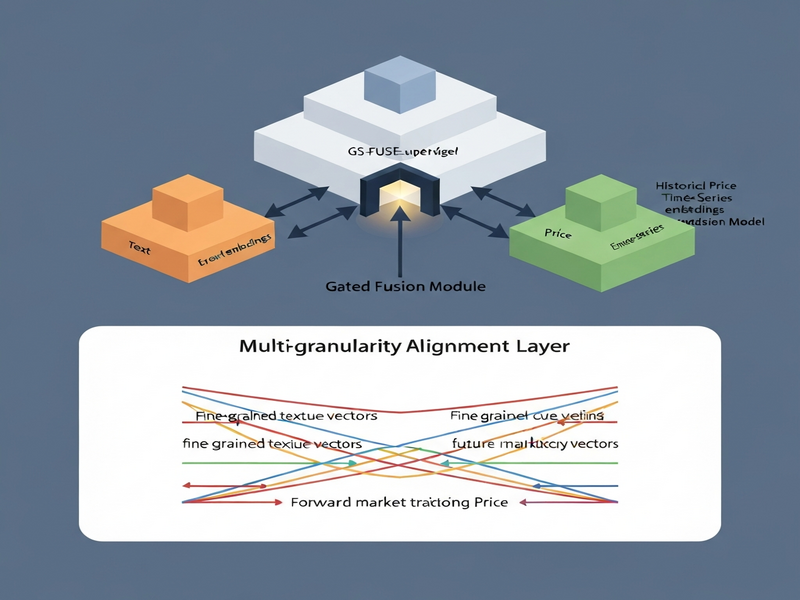
The authors present GS‑FUSE, a plug‑and‑play adapter that can sit on top of any large language model (LLM) and any time‑series foundation model. The framework consists of two novel mechanisms.
Granger‑Supervised Gated Fusion
Inspired by Granger causality, the fusion gate learns a binary‑like decision: open the gate to let textual embeddings influence the price forecast only when those embeddings improve the prediction error relative to a price‑only baseline. The gate is trained with a causal‑aware loss that penalizes unnecessary reliance on text, effectively teaching the model to “listen” only to truly predictive events.
Multi‑Granularity Alignment
This component aligns textual information with future price trajectories at two levels:
- High‑level event representation: A summary vector that captures the overall market impact of an event (e.g., “central bank rate hike”).
- Fine‑grained textual cues: Token‑level embeddings that preserve nuanced sentiment, entity mentions, and temporal expressions.
Both levels are jointly optimized to minimize a contrastive loss that pushes aligned event‑price pairs together while pushing misaligned pairs apart. The result is a representation space where the geometry directly reflects future market movement.
How It Works in Practice
GS‑FUSE can be visualized as a three‑stage pipeline that integrates seamlessly with existing AI stacks.
- Data Ingestion: Historical price series are streamed into a time‑series foundation model (e.g., a transformer‑based price encoder). Simultaneously, news articles or social‑media posts are fed to a pre‑trained LLM, producing contextual token embeddings.
- Granger‑Supervised Gating: The price encoder outputs a latent price forecast. The gating module evaluates whether the textual embeddings reduce the forecast error beyond a predefined threshold. If they do, the gate opens and the textual latent vectors are merged with the price latent vector via a learned weighted sum.
- Multi‑Granularity Alignment: The merged representation is passed through two parallel heads. One head aggregates token embeddings into a high‑level event vector; the other retains token‑level detail. Both heads are aligned with the future price trajectory using a contrastive alignment loss, ensuring that the model learns both “what” happened and “how” it manifested in the market.
Because the gating decision is causal‑aware, the system automatically disables the text pathway during periods when news is irrelevant (e.g., quiet market days), conserving compute and avoiding over‑fitting. The alignment module, meanwhile, provides interpretability: analysts can inspect which tokens contributed most to the forecast, facilitating regulatory compliance and model debugging.
Evaluation & Results
The authors benchmarked GS‑FUSE on three real‑world financial datasets covering equities, commodities, and foreign‑exchange instruments. Each dataset included minute‑level price bars and a curated stream of news headlines from major outlets.
- Baselines: Traditional ARIMA, a price‑only transformer, a naïve early‑fusion multimodal model, and a state‑of‑the‑art multimodal time‑series architecture (MM‑TS).
- Metrics: Mean Absolute Percentage Error (MAPE) for point forecasts, Directional Accuracy (DA) for up/down moves, and a risk‑adjusted Sharpe‑ratio simulation for a simple long‑short strategy.
Across all assets and forecasting horizons (5‑minute, 30‑minute, and 2‑hour ahead), GS‑FUSE consistently outperformed the baselines. For example, on the equity dataset, MAPE dropped from 2.8 % (price‑only transformer) to 2.1 % (GS‑FUSE), a 25 % relative improvement. Directional Accuracy rose from 58 % to 66 %, translating into a simulated Sharpe ratio increase of 0.45 points. The gated fusion contributed roughly 60 % of the gain, while the multi‑granularity alignment added the remaining 40 %.
Crucially, an ablation study showed that disabling the Granger‑supervised gate caused performance to regress to the level of the naïve multimodal baseline, confirming that causal‑aware gating is the key differentiator. The authors also released a reproducibility package, enabling practitioners to plug GS‑FUSE into their own LLM and time‑series backbones.
For a deeper dive into the methodology, see the original GS‑FUSE paper.
Why This Matters for AI Systems and Agents
From an engineering perspective, GS‑FUSE offers a blueprint for building AI agents that can reason about when external knowledge sources are truly useful. In practice, this translates into several concrete benefits:
- Resource efficiency: By gating off irrelevant text, compute cycles are saved, which is critical for low‑latency trading bots that must react within milliseconds.
- Robustness to regime shifts: Markets often transition between news‑driven and technical‑driven phases. A causal‑aware gate automatically adapts, reducing the need for manual model retraining.
- Interpretability for compliance: The alignment module surfaces token‑level contributions, allowing compliance teams to audit why a model took a particular trading action.
- Modular integration: Because GS‑FUSE is an adapter, it can be dropped onto existing UBOS platform overview pipelines, enabling fintech startups to accelerate time‑to‑value without rebuilding their entire AI stack.
For developers of autonomous trading agents, the ability to query an LLM only when it adds causal value mirrors human analyst behavior—read the news when it matters, otherwise focus on price patterns. This paradigm can be extended beyond finance to any domain where event‑driven signals (e.g., supply‑chain disruptions, geopolitical events) interact with time‑series data.
What Comes Next
While GS‑FUSE marks a significant step forward, several open challenges remain:
- Cross‑modal pre‑training: Current implementations rely on separately pre‑trained LLMs and price encoders. Joint pre‑training on combined text‑price corpora could further tighten the alignment.
- Real‑time latency constraints: Deploying the gating mechanism at sub‑second latency on edge devices will require model compression techniques such as quantization or distillation.
- Broader event sources: Incorporating structured data like economic calendars, ESG scores, or alternative data (satellite imagery) could enrich the event representation.
- Explainability frameworks: Integrating post‑hoc explanation tools (e.g., SHAP for multimodal models) would give analysts deeper insight into the gate’s decisions.
Future research may also explore how GS‑FUSE can power AI marketing agents that decide when to launch campaigns based on market sentiment, or how it can be embedded in the Workflow automation studio to trigger alerts only when news is causally linked to KPI deviations. For early‑stage innovators, the UBOS for startups program offers sandbox environments to prototype GS‑FUSE‑enabled agents without heavy infrastructure overhead.
In summary, GS‑FUSE demonstrates that causal‑aware multimodal fusion is not a theoretical curiosity but a practical lever for building smarter, more reliable AI agents in finance and beyond. As the ecosystem of large language models and time‑series foundations continues to mature, we can expect a new generation of event‑driven systems that reason like seasoned analysts—listening only when the news truly matters.
Andrii Bidochko
CTO UBOS
Andrii Bidochko is an AI entrepreneur and researcher focused on AI agents, reinforcement learning, and autonomous systems. He writes about the technologies shaping the future of machine intelligence, from frontier models and agent architectures to real-world AI applications.