

- Updated: June 18, 2026
- 7 min read
Grounded Cache Routing for Retrieval-Augmented Generation: When Is It Safe to Reuse an Answer?
Direct Answer
GroundedCache is a safety‑first cache router for Retrieval‑Augmented Generation (RAG) that only reuses a previously generated answer when four inexpensive validation gates all pass. By enforcing query similarity, evidence overlap, source‑version consistency, and lexical support, the system eliminates most unsafe cache hits while preserving the latency benefits of caching.
Background: Why This Problem Is Hard
Modern RAG services combine a large language model (LLM) with an external knowledge base, fetching relevant documents and then prompting the model to synthesize an answer. To keep costs low and response times short, many deployments cache intermediate artifacts—key‑value (KV) pairs for transformer prefixes, document chunks, or even whole answers. Prefix‑level caching is well‑understood; however, answer‑level caches are fragile for three intertwined reasons:
- Prompt drift: Small changes in the user query can lead the model to produce a different, equally correct answer, making a naïve cache lookup risky.
- Corpus evolution: As the underlying document store is updated, the evidence that originally justified a cached answer may become stale or contradictory.
- Adversarial collisions: Malicious actors can craft queries that deliberately collide with cached entries, hijacking the response and potentially injecting misinformation.
Existing systems such as RAGCache, TurboRAG, and EPIC focus on maximizing hit rates, often ignoring the safety dimension. The result is a trade‑off: higher throughput at the expense of occasional incorrect or outdated answers—a scenario unacceptable for enterprise‑grade agents, compliance‑sensitive applications, and any product that promises factual reliability.
What the Researchers Propose
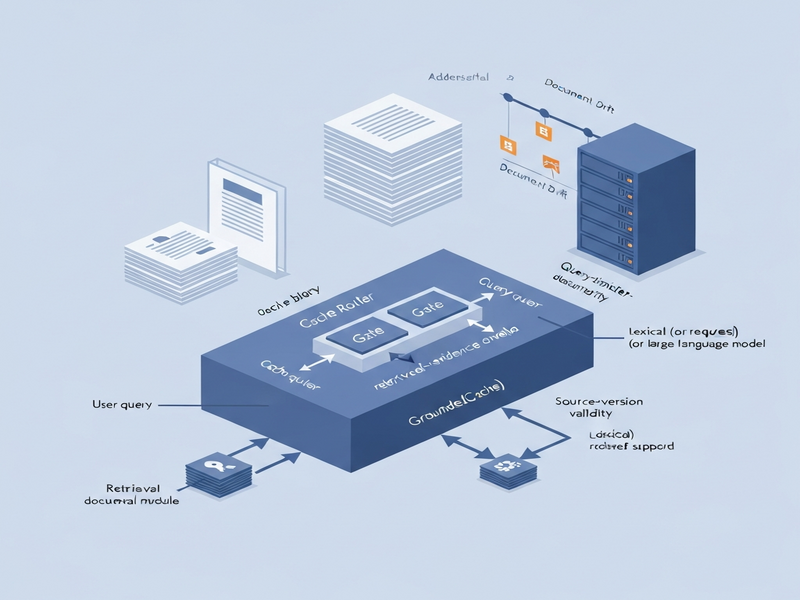
The authors introduce GroundedCache, a routing layer that decides whether a cached answer can be safely reused. The framework is built around four “gates,” each inexpensive to compute and collectively providing defense‑in‑depth:
- Query similarity gate: Checks that the incoming query is semantically close to the query that originally generated the cached answer.
- Evidence overlap gate: Ensures that the set of documents retrieved for the new query overlaps sufficiently with the evidence used for the cached answer.
- Source‑version gate: Verifies that the version identifiers (e.g., timestamps, hash digests) of the underlying knowledge source have not changed since the cache entry was created.
- Lexical support gate: Confirms that the freshly retrieved evidence contains enough lexical or semantic cues to back the cached answer, either via a simple string match or a learned judge model.
If all four gates succeed, the router returns the cached answer; otherwise, it falls back to the full RAG pipeline. The design philosophy is explicit: “When is it safe to reuse?” rather than “How fast can we reuse?”
How It Works in Practice
The operational flow of GroundedCache can be visualized as a linear pipeline with two parallel branches: the fast‑path cache check and the full RAG fallback. Below is a step‑by‑step description:
- Incoming request arrives with a user query.
- The query encoder produces a dense vector representation.
- The cache index performs a nearest‑neighbor lookup to retrieve candidate cached answers whose original queries are within a similarity threshold (Gate 1).
- For each candidate, the system re‑executes the retrieval step, pulling the latest documents from the knowledge base.
- The evidence overlap gate computes the Jaccard similarity between the new document set and the cached evidence set; candidates below the overlap threshold are discarded (Gate 2).
- The source‑version gate compares version metadata (e.g., document timestamps) to ensure no updates have occurred since caching (Gate 3).
- Finally, the lexical support gate runs a lightweight matcher or a small classifier that checks whether the new evidence contains phrases or concepts that substantiate the cached answer (Gate 4).
- If a candidate passes all four gates, the router returns the cached answer instantly; otherwise, the request proceeds to the full RAG path, generating a fresh answer and populating the cache for future queries.
This architecture differs from prior work in two key ways. First, it treats caching as a conditional safety check rather than a blanket optimization. Second, the gates are deliberately cheap—each can be evaluated in microseconds—so the added latency is negligible compared to the cost of a full LLM generation.
Evaluation & Results
The authors built a six‑regime workload that stresses cache safety rather than raw hit rate. The regimes span:
- HotpotQA hot queries: Repeatedly asked questions that should benefit from caching.
- mtRAG document drift: Scenarios where the underlying corpus is periodically updated, testing source‑version awareness.
- Adversarial collision: Crafted queries designed to trigger false cache hits.
- Three additional mixed‑traffic regimes that combine benign and malicious patterns.
Across two benchmark datasets and 12,000 real‑LLM generations using Qwen2.5‑7B‑Instruct on vLLM with automatic prefix caching, GroundedCache achieved the following:
- Unsafe‑served rate (USR) dropped to 0.0 % on every HotpotQA regime, compared with 15‑35 % under a naïve cache.
- In the mtRAG drift regime, USR fell from 51.5 % to 1.5 %—a 34× reduction.
- Even in the deliberately adversarial regime, USR was cut by more than 30×, while latency increased by only 1‑7 % (p50 latency 1.04‑1.07× the no‑cache baseline).
Ablation studies revealed that the lexical support gate contributed the most to safety, acting as the “load‑bearing” mechanism. The other three gates added negligible overhead but provided valuable defense‑in‑depth, especially when the lexical gate was tuned for higher recall.
Why This Matters for AI Systems and Agents
For practitioners building production‑grade RAG pipelines, GroundedCache offers a pragmatic path to combine the cost savings of caching with the reliability required for enterprise deployments. The immediate benefits include:
- Reduced token consumption: By avoiding unnecessary LLM calls, organizations can lower API spend dramatically.
- Predictable latency: The safety gates add sub‑millisecond overhead, preserving the fast‑response experience users expect from conversational agents.
- Compliance friendliness: Guarantees that answers are always grounded in the latest version of the knowledge base, simplifying audit trails.
- Robustness against attacks: The multi‑gate design mitigates adversarial query collisions, a growing concern for public‑facing AI assistants.
These capabilities align closely with the needs of AI marketing agents that must deliver up‑to‑date product information, as well as the UBOS platform overview which emphasizes modular, secure AI workflows. Teams can embed GroundedCache into the Workflow automation studio to orchestrate safe, low‑latency RAG services across multiple business units.
What Comes Next
While the results are compelling, several open challenges remain:
- Scalability of the evidence overlap gate: In massive corpora, computing overlap efficiently may require approximate set similarity techniques.
- Dynamic gate thresholds: Adaptive thresholds based on query difficulty or user intent could further improve the trade‑off between safety and hit rate.
- Cross‑modal evidence: Extending the framework to multimodal retrieval (images, audio) will demand new lexical or semantic support mechanisms.
- Integration with emerging LLM serving stacks: As next‑generation inference engines (e.g., Ollama) adopt prefix caching, aligning GroundedCache with their APIs will be essential.
Future research could explore learning the gate parameters jointly with the LLM, turning the safety router into a differentiable component. For early adopters, the authors have released the full implementation, workload suite, and evaluation harness, making it straightforward to prototype on the UBOS for startups environment or the Enterprise AI platform by UBOS.
References
- Grounded Cache Routing paper
- Shah, S. H. (2026). Grounded Cache Routing for Retrieval‑Augmented Generation: When Is It Safe to Reuse an Answer?
- Related works: RAGCache, TurboRAG, CacheBlend, EPIC, ContextPilot, PCR, LMCache.
Andrii Bidochko
CTO UBOS
Andrii Bidochko is an AI entrepreneur and researcher focused on AI agents, reinforcement learning, and autonomous systems. He writes about the technologies shaping the future of machine intelligence, from frontier models and agent architectures to real-world AI applications.