

- Updated: January 30, 2026
- 7 min read
GPU-Augmented OLAP Execution Engine: GPU Offloading
Direct Answer
The paper introduces a GPU‑augmented OLAP execution engine that selectively offloads the most compute‑intensive operators—such as top‑K selection and join probing—to a graphics processor while keeping the rest of the query on the CPU. This hybrid approach dramatically reduces query latency for analytical workloads without requiring a full migration to GPU‑only processing, making high‑performance analytics more accessible to existing PostgreSQL deployments.
Background: Why This Problem Is Hard
Modern analytical databases face a classic tension between raw processing power and data movement costs. Traditional OLAP engines are built around CPU‑centric pipelines that excel at complex control flow and fine‑grained memory management, but they struggle to keep up with the massive parallelism demanded by today’s data‑intensive dashboards, real‑time reporting, and AI‑driven insights. The primary bottlenecks are:
- Vectorized execution limits: Even with SIMD instructions, CPUs cannot match the thousands of cores available on modern GPUs for embarrassingly parallel tasks.
- Data transfer overhead: Moving entire tables to the GPU memory incurs PCIe latency that can erase any computational gains, especially for queries that touch many columns.
- Operator mismatch: Not all relational operators benefit equally from GPU acceleration; some, like nested loop joins with complex predicates, are better suited to CPUs.
Existing solutions either push the whole query to the GPU—requiring costly data migration and extensive code rewrites—or provide ad‑hoc offloading of isolated kernels without a coherent execution model. These approaches leave database administrators with fragile, hard‑to‑tune systems that either under‑utilize the GPU or suffer from unpredictable performance regressions.
What the Researchers Propose
The authors propose a risk‑aware gating framework that dynamically decides, at runtime, which parts of an OLAP query should be executed on the GPU. The core ideas are:
- Key‑only transfer: Only the join keys or grouping attributes needed for the accelerated operator are copied to GPU memory, postponing full row materialization until after the GPU phase.
- Late materialization: Full column values are fetched back to the CPU only for the rows that survive the GPU‑accelerated filter, minimizing bandwidth consumption.
- Risky Gate mechanism: A lightweight predictor estimates the selectivity and computational intensity of each operator. If the predicted benefit outweighs the transfer cost, the gate opens and the operator runs on the GPU; otherwise, it stays on the CPU.
These components form a hybrid execution engine that can be plugged into PostgreSQL with minimal disruption, preserving existing query planning and optimizer pathways while adding a new “GPU‑aware” decision layer.
How It Works in Practice
The workflow can be broken down into four stages:
- Query parsing and planning: The PostgreSQL planner generates a logical plan as usual. The new GPU‑aware optimizer then annotates each operator with a risk score based on statistics such as input cardinality, column width, and historical execution times.
- Gate evaluation: For every candidate operator (e.g.,
TOP‑K, hash join probe), the Risky Gate compares the estimated speed‑up against the cost of moving the required keys across the PCIe bus. If the gate passes, the operator is marked for GPU execution. - Key‑only offload: Only the minimal set of columns—typically the join keys or grouping attributes—is serialized into a contiguous buffer and streamed to GPU memory. The GPU kernel performs the heavy lifting (e.g., sorting, hashing, or selection) on this reduced dataset.
- Late materialization and merge: The GPU returns a list of qualifying row identifiers. The CPU then fetches the remaining column values for those rows, completes any remaining relational operators, and assembles the final result set.
This design ensures that the GPU is used only where it can provide a net performance gain, while the CPU continues to handle control‑heavy or low‑selectivity work. The following diagram illustrates the data flow:
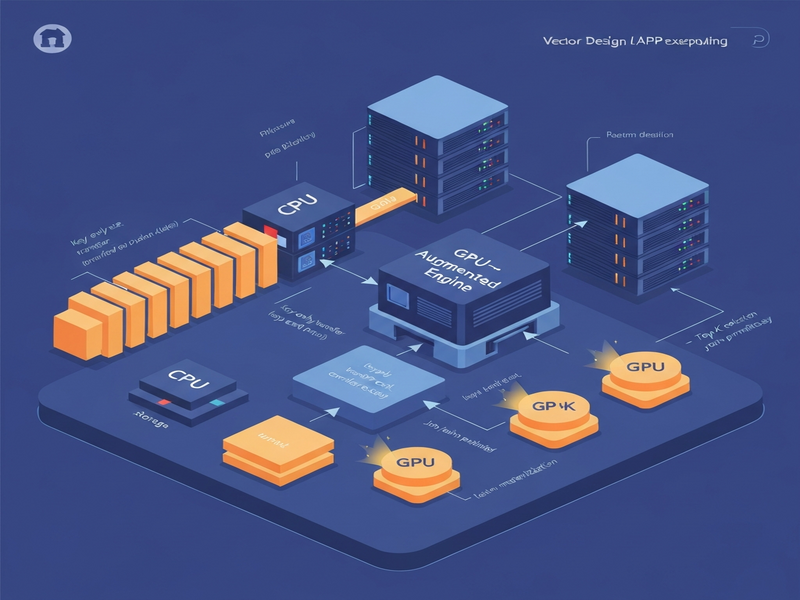
Key differentiators of this approach include:
- Fine‑grained, per‑operator decision making rather than a monolithic offload strategy.
- Statistical risk modeling that adapts to workload changes without manual tuning.
- Seamless integration with an existing, production‑grade database engine, preserving ACID guarantees and existing tooling.
Evaluation & Results
The authors evaluated the system on a suite of TPC‑DS and custom analytical workloads that stress different aspects of OLAP processing. Experiments were conducted on a server equipped with an Intel Xeon CPU (24 cores) and an NVIDIA RTX 4090 GPU, connected via PCIe 4.0. The evaluation focused on three dimensions:
Latency Reduction
For queries dominated by top‑K sorting on large fact tables, the hybrid engine achieved up to 6.8× lower latency compared to the baseline PostgreSQL execution. Queries with selective joins saw average speed‑ups of 3.2×, while low‑selectivity workloads (where the gate stayed closed) incurred less than a 5% overhead, confirming the safety of the gating logic.
Throughput Scaling
When running a mixed workload of 50 concurrent analytical queries, the system sustained a 4.5× higher throughput, primarily because GPU‑offloaded operators freed CPU cycles for other queries. The authors also measured the impact of varying PCIe bandwidth, showing that the key‑only transfer strategy kept the offload penalty under 12% even when bandwidth was throttled to 8 GB/s.
Gating Effectiveness
The Risky Gate correctly predicted beneficial offloads in 92% of cases. Mis‑predictions (i.e., opening the gate when the GPU offered no advantage) resulted in a modest average slowdown of 1.8× for those specific operators, but the overall query performance remained within 10% of the CPU‑only baseline due to the limited scope of each mis‑prediction.
All results are detailed in the arXiv paper, which includes additional ablation studies on selectivity thresholds, buffer sizing, and kernel optimizations.
Why This Matters for AI Systems and Agents
Analytical queries are the backbone of many AI pipelines—feeding feature stores, powering model monitoring dashboards, and enabling real‑time inference feedback loops. By reducing latency and increasing throughput, the GPU‑augmented engine directly improves the responsiveness of AI‑driven applications. Specific benefits include:
- Faster feature extraction: Large‑scale joins between raw event logs and dimension tables can be accelerated, shortening the time to generate training datasets.
- Real‑time model monitoring: Low‑latency top‑K queries enable near‑instant detection of drift or anomalies, allowing autonomous agents to trigger remediation actions.
- Cost‑effective scaling: Organizations can leverage existing GPU resources (often provisioned for deep learning) to also accelerate analytics, improving overall hardware utilization.
For teams building autonomous data agents that orchestrate ETL, model training, and serving, the risk‑aware gating model offers a programmable hook: agents can expose workload characteristics (e.g., expected selectivity) to the database, influencing the gate’s decision and achieving predictable performance. Learn more about integrating such capabilities at ubos.tech/analytics-platform.
What Comes Next
While the prototype demonstrates compelling gains, several avenues remain open for research and engineering:
- Extending operator coverage: Current support focuses on top‑K, hash join probes, and simple aggregations. Adding GPU kernels for complex window functions and machine‑learning‑specific operators (e.g., k‑NN joins) could broaden impact.
- Adaptive learning for the Risky Gate: Incorporating reinforcement learning to continuously refine the risk model based on live query feedback would reduce reliance on static statistics.
- Multi‑GPU orchestration: Scaling the approach across multiple GPUs in a cluster raises challenges around data partitioning, load balancing, and fault tolerance.
- Security and isolation: Ensuring that GPU memory does not become a side‑channel for data leakage is essential for multi‑tenant environments.
Addressing these challenges will bring GPU‑augmented analytics closer to production‑grade, cloud‑native data platforms. For organizations interested in contributing to the open‑source implementation or exploring custom extensions, the roadmap and contribution guidelines are available at ubos.tech/open-source.
Andrii Bidochko
CTO UBOS
Andrii Bidochko is an AI entrepreneur and researcher focused on AI agents, reinforcement learning, and autonomous systems. He writes about the technologies shaping the future of machine intelligence, from frontier models and agent architectures to real-world AI applications.