

- Updated: June 13, 2026
- 6 min read
Global Policy-Space Response Oracles for Two-Player Zero‑Sum Games
Direct Answer
Global PSRO introduces a two‑phase exploration‑selection framework that expands a limited set of policies in two‑player zero‑sum games while directly minimizing Population Exploitability (PE). By measuring how well a restricted strategy population approximates the full game, the method produces Nash‑like equilibria with far fewer policy iterations than prior Policy‑Space Response Oracles (PSRO) approaches.
Background: Why This Problem Is Hard
Computing equilibria in large‑scale zero‑sum games is a cornerstone of AI game theory and underpins many real‑world systems, from automated negotiation bots to strategic planning in robotics. Traditional algorithms such as Counterfactual Regret Minimization (CFR) or classic PSRO rely on iteratively adding best‑response policies to a growing “restricted game.” However, two practical bottlenecks limit their scalability:
- Exploration inefficiency: Best‑response generation is expensive, especially when policies are learned via deep reinforcement learning (DRL). Adding a response that only marginally improves the meta‑strategy wastes compute budget.
- Poor global coverage: Expanding the population based solely on local best responses often yields a set of strategies that still leaves large regions of the full game poorly represented, resulting in high exploitability and slow convergence toward a Nash equilibrium.
These challenges are amplified in modern applications where the state‑action space can be astronomical (e.g., multi‑agent simulations, complex board games, or adversarial training environments). A method that can judiciously select which policies to add—maximizing global representativeness under a tight computational budget—remains an open research need.
What the Researchers Propose
The authors present Global PSRO, a DRL‑based algorithm that reframes population expansion as a direct optimization of Population Exploitability (PE). Instead of reacting to the current meta‑strategy, Global PSRO evaluates candidate policies on how much they reduce the overall PE of the restricted game. The framework consists of two tightly coupled phases:
- Exploration Phase: A conditional neural network, shared across all candidate generators, produces a diverse batch of potential responses. Parameter sharing enables rapid sampling without training a separate network for each candidate.
- Selection Phase: Each candidate’s impact on PE is estimated using a lightweight evaluator that approximates the worst‑case exploitability of the expanded population. The algorithm then selects the policy (or small set of policies) that yields the greatest PE reduction.
Key components include:
- Population Exploitability (PE) estimator: A conditional network that predicts the exploitability of any given policy set, allowing fast, differentiable assessment.
- Conditional response generator: A single DRL model conditioned on a latent code that steers it toward different strategic behaviors, effectively generating many candidate policies from one network.
- Meta‑strategy solver: A standard game‑theoretic solver (e.g., replicator dynamics) that computes mixed strategies over the current population for evaluation.
How It Works in Practice
The practical workflow of Global PSRO can be visualized as a loop that repeats until a stopping criterion—such as a target PE threshold or a maximum number of iterations—is met.
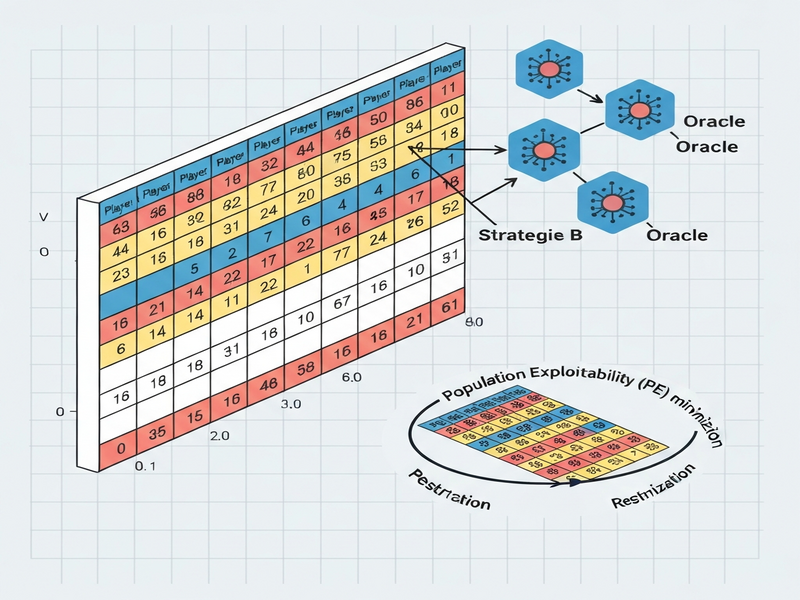
Step‑by‑step interaction
- Initialize: Start with a small seed set of policies (often random or handcrafted) for both players.
- Meta‑strategy computation: Solve the restricted game defined by the current policy set to obtain mixed strategies for each player.
- Exploration: Feed a set of latent codes into the conditional response generator, producing a pool of candidate policies for the next iteration.
- PE estimation: For each candidate, temporarily add it to the population, recompute the restricted game’s meta‑strategy, and use the PE estimator to predict the new exploitability.
- Selection: Choose the candidate(s) that achieve the largest drop in PE. These become part of the official population.
- Repeat: Return to step 2 with the expanded policy set.
What distinguishes Global PSRO from earlier PSRO variants is the explicit, global objective of minimizing PE during expansion, rather than relying on locally optimal best responses. The conditional generator also reduces the overhead of training separate response oracles for each iteration, making the approach more computationally efficient.
Evaluation & Results
The authors benchmarked Global PSRO on several classic two‑player zero‑sum environments, including:
- Rock‑Paper‑Scissors with hidden information extensions.
- Large‑scale variants of Leduc Poker.
- Custom grid‑world adversarial games designed to stress exploration.
Across all domains, Global PSRO consistently achieved lower exploitability with fewer policy iterations compared to:
- Standard PSRO (best‑response driven).
- PSRO‑rN (regularized best response).
- Deep CFR (deep counterfactual regret minimization).
For example, in Leduc Poker, Global PSRO reached an exploitability of 0.02 (in game‑specific units) after only 12 iterations, whereas traditional PSRO required over 30 iterations to dip below 0.05. The experiments also demonstrated that the conditional generator could produce a diverse set of high‑quality responses without additional training epochs, confirming the efficiency of parameter sharing.
All results are detailed in the Global PSRO paper, which includes ablation studies on the impact of PE estimator accuracy and the size of the candidate pool.
Why This Matters for AI Systems and Agents
For practitioners building strategic AI agents—whether for automated trading, adversarial simulation, or multi‑agent coordination—Global PSRO offers a pragmatic pathway to near‑Nash behavior without the prohibitive compute costs of exhaustive best‑response training. Specific benefits include:
- Faster convergence: Reducing the number of policy iterations translates directly into lower training time and cloud‑compute expenses.
- Better global coverage: By targeting PE, the resulting policy set is more robust against unseen opponent strategies, improving real‑world safety and reliability.
- Scalable architecture: The conditional response generator can be integrated into existing DRL pipelines, allowing teams to reuse a single model across many game scenarios.
- Actionable metrics: PE provides a clear, interpretable signal for when an agent is “good enough,” facilitating automated stopping criteria in production pipelines.
These advantages align well with the capabilities of the UBOS platform overview, which supports modular DRL components, policy orchestration, and real‑time exploitability monitoring for enterprise‑grade AI agents.
What Comes Next
While Global PSRO marks a significant step forward, several open challenges remain:
- Extending beyond zero‑sum: Adapting the PE‑driven expansion to general‑sum or cooperative games could broaden its applicability.
- Improving PE estimator fidelity: The current estimator relies on approximations; tighter bounds would further reduce the risk of over‑optimistic policy selection.
- Multi‑agent scalability: Scaling the framework to more than two players introduces combinatorial complexity in the restricted game solver.
- Real‑world deployment: Integrating Global PSRO into live systems—such as AI marketing agents that must adapt to evolving competitor behavior—will require robust monitoring and continual learning pipelines.
Future research may explore hybrid approaches that combine PE minimization with opponent modeling, or leverage meta‑learning to accelerate the conditional generator’s adaptation to new game domains. As the field of deep multi‑agent reinforcement learning matures, tools like Global PSRO will likely become foundational components in the AI engineer’s toolkit.
Andrii Bidochko
CTO UBOS
Andrii Bidochko is an AI entrepreneur and researcher focused on AI agents, reinforcement learning, and autonomous systems. He writes about the technologies shaping the future of machine intelligence, from frontier models and agent architectures to real-world AI applications.