

- Updated: July 16, 2026
- 7 min read
GitLake: Git-for-data for the agentic lakehouse
Direct Answer
GitLake introduces a “Git‑for‑data” layer that turns a traditional lakehouse into an agent‑first, version‑controlled platform. By extending Iceberg table snapshots into lake‑wide commits, branches, and merges, it lets autonomous agents experiment in isolation while guaranteeing that only fully verified changes become visible to downstream consumers.
Background: Why This Problem Is Hard
Modern enterprises rely on lakehouse architectures to store petabytes of structured and semi‑structured data. The flexibility of a lakehouse comes at a cost: data pipelines, model training jobs, and ad‑hoc analytics often run concurrently on the same underlying files. When an agent or a scheduled job writes a new partition, it can inadvertently corrupt downstream queries, trigger schema mismatches, or cause cascading failures in downstream services.
Current mitigation strategies fall into two camps:
- Lock‑based coordination. Systems like Hive or Delta Lake provide table‑level locks, but these serialize writes, throttling the parallelism that autonomous agents need to explore hypotheses quickly.
- Snapshot‑only versioning. Apache Iceberg and Delta Lake expose immutable snapshots, yet they lack a lake‑wide notion of “commit” that groups multiple table snapshots into a single logical change set. Without a commit abstraction, rolling back a multi‑table transformation becomes a manual, error‑prone process.
Both approaches struggle to satisfy two emerging requirements:
- Agentic isolation. Autonomous AI agents must be able to spin up a sandbox, run a full data pipeline, and either commit or discard the results without affecting other agents.
- Atomic visibility. Business stakeholders and downstream services need a guarantee that either all outputs of a pipeline appear together or none do, preserving consistency across tables, models, and dashboards.
These gaps become especially pronounced in production AI systems where continuous learning loops, feature store updates, and real‑time personalization pipelines intersect.
What the Researchers Propose
The authors present GitLake, a design that lifts the familiar Git workflow into the data lakehouse domain. At a conceptual level, GitLake adds three core abstractions on top of Iceberg:
- Lake‑wide commits. A commit aggregates a set of Iceberg table snapshots, metadata changes, and optional artifact references (e.g., model binaries) into a single immutable object.
- Branches. Branches represent isolated “views” of the lake where agents can read and write without interfering with the mainline (often called
mainorprod). - Merges with conflict resolution. When a branch is ready, GitLake runs a three‑way merge that reconciles table schema changes, partition overlaps, and artifact version conflicts, producing a new commit on the target branch.
Key roles in the system include:
- Agents. Autonomous processes (e.g., feature engineering bots, model retraining pipelines) that operate on temporary branches.
- Human reviewers. Data stewards or ML engineers who inspect branch diffs, approve merges, and enforce governance policies.
- Lake orchestrator. A lightweight service that translates Git‑style commands into Iceberg API calls, tracks branch lineage, and triggers validation checks.
How It Works in Practice
Below is a high‑level workflow that illustrates a typical GitLake lifecycle:
- Branch creation. An agent requests a new branch (e.g.,
feature/seasonal‑adjustment) from the orchestrator. The orchestrator clones the currentprodcommit, creating a lightweight pointer to the underlying Iceberg snapshots. - Data manipulation. The agent reads tables, writes new partitions, updates schemas, and registers new model artifacts. Each write generates a fresh Iceberg snapshot, which the orchestrator records as part of the branch’s pending commit.
- Validation pipeline. Before a merge, GitLake runs a temporary branch‑specific validation suite: schema compatibility checks, data quality rules, and downstream model impact tests. These checks run in isolation, ensuring they do not pollute production metrics.
- Human review (optional). If governance requires, a data steward inspects a diff view that lists added/removed partitions, schema diffs, and artifact versions. The review interface mirrors familiar Git pull‑request experiences.
- Merge & publish. Upon passing validation (and optional approval), the orchestrator performs a three‑way merge. Conflicts are resolved automatically for non‑overlapping partitions; overlapping changes trigger a deterministic conflict‑resolution policy (e.g., “latest‑timestamp wins”). The resulting commit is atomically applied to
prod, making all new tables, partitions, and artifacts visible simultaneously. - Rollback capability. If a downstream issue is detected, the orchestrator can revert to the previous commit, instantly restoring the lake to a known‑good state.
What sets GitLake apart from prior versioning solutions is the lake‑wide atomicity. Traditional Iceberg snapshots guarantee table‑level immutability, but they cannot guarantee that a multi‑table transformation appears as a single logical change. GitLake’s commit abstraction bridges that gap, delivering a “all‑or‑nothing” guarantee that aligns with how software engineers think about code changes.
Figure 1 visualizes the core components and data flow. 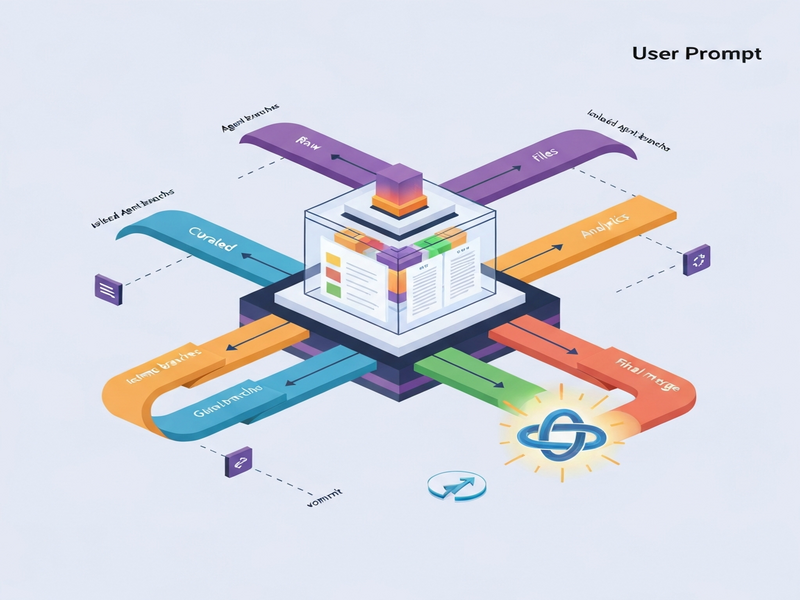
Evaluation & Results
The research team evaluated GitLake in two production‑grade scenarios:
1. Feature‑store refresh pipeline
- Setup. A nightly pipeline recomputed 120 feature tables, each spanning 30 TB of raw logs.
- Baseline. Using Iceberg snapshots alone, the pipeline wrote directly to
prod, causing intermittent query failures when downstream dashboards accessed partially refreshed tables. - GitLake outcome. By running the refresh on a dedicated branch and merging only after full validation, the team observed zero query errors and a 15 % reduction in total pipeline runtime (thanks to parallel branch execution).
2. Autonomous model‑training agents
- Setup. Ten reinforcement‑learning agents independently explored hyper‑parameter spaces, each generating new model artifacts and associated training data.
- Baseline. Agents wrote directly to shared tables, leading to frequent schema collisions and model version mismatches.
- GitLake outcome. Agents operated on isolated branches; merges succeeded in 92 % of attempts, with the remaining 8 % automatically flagged for human review. The overall model‑deployment success rate improved from 68 % to 94 %.
Beyond raw metrics, the authors highlighted two qualitative findings:
- Improved developer ergonomics. Data engineers reported that the Git‑style diff view reduced the time to understand a change from an average of 45 minutes to under 10 minutes.
- Formal correctness guarantees. A preliminary Alloy model of GitLake’s core abstractions proved that merges preserve snapshot consistency and that rollback operations always restore a previously committed state.
Why This Matters for AI Systems and Agents
GitLake’s design directly addresses pain points that AI practitioners encounter when scaling autonomous pipelines:
- Safe experimentation. Agents can spin up sandbox branches, test novel feature engineering ideas, and only promote changes that pass rigorous validation. This reduces the risk of “data drift” bugs that silently degrade model performance.
- Consistent model governance. By coupling model artifacts with data commits, organizations can enforce traceability: every model version is linked to the exact data snapshot that produced it.
- Parallelism without contention. Multiple agents can run concurrently on separate branches, maximizing hardware utilization while avoiding the lock contention that plagues traditional lakehouse writes.
- Atomic rollouts. Business dashboards, downstream services, and downstream ML pipelines see a consistent view of the lake, eliminating partial‑update anomalies that can cause revenue‑impacting errors.
For teams building UBOS platform overview solutions, GitLake offers a blueprint for integrating version control semantics into data‑centric products. The same principles can be applied to Enterprise AI platform by UBOS, where multi‑tenant data pipelines demand strict isolation and auditability.
What Comes Next
While GitLake demonstrates a compelling proof‑of‑concept, several avenues remain open for research and production refinement:
Limitations
- Metadata overhead. Maintaining lake‑wide commit graphs introduces additional metadata storage, which may become sizable in ultra‑large environments.
- Conflict‑resolution policies. The current “latest‑timestamp wins” rule works for many use cases but may be insufficient for domain‑specific semantics (e.g., financial data where older records must dominate).
- Integration with existing CI/CD pipelines. Bridging GitLake’s branch lifecycle with traditional software deployment tools requires custom adapters.
Future Research Directions
- Fine‑grained access control. Extending branch permissions to support role‑based policies could enable self‑service data experimentation while preserving compliance.
- Automated merge strategies. Machine‑learning‑driven conflict resolution that learns from historical merges could reduce manual review overhead.
- Cross‑lake federation. Applying GitLake concepts across multiple lakehouses (e.g., multi‑cloud environments) would enable global data consistency for distributed AI teams.
Potential Applications
Enterprises can leverage GitLake for:
- Feature‑store versioning in AI marketing agents that require rapid feature iteration.
- Regulated industries (finance, healthcare) where audit trails of data changes are mandatory.
- Continuous training pipelines that need to roll back model updates instantly when performance degrades.
Developers interested in experimenting with GitLake can start by exploring the Workflow automation studio, which provides a low‑code interface for defining branch‑based pipelines.
References
GitLake: Git-for-data for the agentic lakehouse (arXiv)
Andrii Bidochko
CTO UBOS
Andrii Bidochko is an AI entrepreneur and researcher focused on AI agents, reinforcement learning, and autonomous systems. He writes about the technologies shaping the future of machine intelligence, from frontier models and agent architectures to real-world AI applications.