

- Updated: July 2, 2026
- 6 min read
GEOPHYS: The Geometry of Physical Plausibility – A Deep Dive
Direct Answer
The paper introduces GEOPHYS, a self‑supervised video model that judges physical plausibility by learning to predict future frames and detecting violations of Newtonian dynamics without any labeled data. By aligning its internal representations with human EEG responses, GEOPHYS offers a reliable, scalable verifier for synthetic video generation and a new benchmark for physical reasoning in computer vision.
Background: Why This Problem Is Hard
Physical plausibility is a cornerstone of trustworthy video content. Whether a self‑driving car interprets a dash‑cam feed or a generative model creates cinematic scenes, the underlying physics must obey real‑world constraints such as momentum conservation, object permanence, and causal continuity. Existing approaches face three intertwined challenges:
- Label scarcity: Annotating videos with fine‑grained physical violations is labor‑intensive and often subjective.
- Model brittleness: Supervised classifiers trained on limited datasets overfit to specific scenarios and fail to generalize across domains (e.g., indoor vs. outdoor scenes).
- Lack of human alignment: Current metrics (e.g., PSNR, SSIM) ignore how humans perceive physical realism, leading to a gap between algorithmic scores and user experience.
These bottlenecks hinder the deployment of AI agents that must reason about dynamics in real time, and they limit the ability to automatically verify AI‑generated video, a growing concern as generative models scale to billions of parameters.
What the Researchers Propose
GEOPHYS (Generative Evaluation of Physical Plausibility in Video) tackles the problem with a three‑component framework:
- Self‑supervised predictive backbone: A transformer‑based encoder‑decoder learns to forecast future frames from raw video streams, implicitly capturing motion, forces, and object interactions.
- Physical violation detector: A lightweight classifier, trained on the prediction error distribution, flags frames where the model’s forecast deviates beyond a learned threshold, indicating a potential physics breach.
- Neuro‑correlational alignment module: By recording EEG signals from participants watching the same videos, the researchers map model activations to human neural responses, ensuring that the detector’s judgments resonate with human perception.
Crucially, the entire pipeline requires no manually labeled “physically correct” or “incorrect” clips; the system discovers the structure of physics directly from the video stream.
How It Works in Practice
Conceptual Workflow
The GEOPHYS pipeline proceeds through four stages:
- Data ingestion: Raw video clips (e.g., 30‑second snippets from YouTube or synthetic datasets) are fed into the predictive backbone.
- Future frame prediction: The model generates a short‑term forecast (typically 1–2 seconds ahead) using its learned dynamics.
- Error analysis: The system computes pixel‑wise and feature‑wise discrepancies between predicted and actual frames. Large, systematic errors trigger the violation detector.
- Neuro‑alignment scoring: Simultaneously, EEG recordings from human observers are processed to extract event‑related potentials (ERPs). A canonical correlation analysis (CCA) aligns these ERPs with the model’s error vectors, producing a confidence score that reflects human‑perceived implausibility.
Component Interactions
Each component communicates through well‑defined tensors:
- The encoder outputs a latent motion field z, which the decoder expands into predicted pixel values.
- The detector consumes the residual r = video_actual – video_predicted and outputs a binary flag v (violation = 1).
- The alignment module receives r and the EEG feature matrix e, producing a scalar s that modulates the detector’s threshold dynamically.
This feedback loop ensures that the system adapts to both visual complexity and human sensitivity, a departure from static, rule‑based physics engines.
Evaluation & Results
Benchmarks and Test Scenarios
GEOPHYS was evaluated on two public physical reasoning benchmarks:
- LikePhys: A collection of 10,000 short clips annotated for subtle physics violations (e.g., object slipping through walls).
- IntPhys2: A more challenging suite featuring multi‑object interactions, occlusions, and varying lighting conditions.
In addition, the authors conducted a controlled EEG study with 30 participants, measuring neural responses while subjects watched both plausible and implausible videos.
Key Findings
- Detection accuracy: GEOPHYS achieved 87.3% AUC on LikePhys and 84.1% AUC on IntPhys2, surpassing the previous state‑of‑the‑art V‑JEPA 2 (78.5% / 75.2%) and matching GPT‑4o’s zero‑shot performance without any language model prompting.
- Neuro‑correlation: The CCA score between model error vectors and EEG ERPs reached 0.62 (p < 0.001), indicating a strong alignment with human perception of physical implausibility.
- Generalization: When tested on out‑of‑distribution synthetic videos generated by the MAGI‑1 24B model, GEOPHYS flagged 92% of clearly impossible scenes, demonstrating its utility as an automated verifier for AI‑generated content.
These results collectively demonstrate that a self‑supervised visual predictor can serve both as a physics detector and as a proxy for human judgment, a dual capability rarely achieved in prior work.
Why This Matters for AI Systems and Agents
For practitioners building autonomous agents, simulation pipelines, or generative video services, GEOPHYS offers three concrete advantages:
- Scalable verification: The model can be integrated into CI pipelines to automatically reject generated clips that violate physical laws, reducing the risk of releasing implausible media.
- Improved agent safety: Embedding GEOPHYS as a perception filter enables robots and self‑driving cars to flag scenes that defy expected dynamics, prompting fallback strategies.
- Human‑aligned evaluation: By mirroring EEG responses, the system provides a metric that correlates with end‑user trust, useful for product teams measuring UX impact.
Enterprises looking to operationalize these capabilities can leverage the UBOS platform overview to orchestrate GEOPHYS‑style models alongside existing data pipelines. For teams focused on rapid prototyping, the Workflow automation studio offers drag‑and‑drop components that map directly to the encoder, detector, and alignment modules described above.
What Comes Next
While GEOPHYS marks a significant step forward, several open challenges remain:
- Temporal horizon extension: Current predictions span only a few seconds; extending the horizon could capture slower dynamics such as fluid flow.
- Multimodal integration: Incorporating audio cues or tactile feedback may improve detection of invisible forces (e.g., wind).
- Domain adaptation: Fine‑tuning on specialized domains (medical imaging, industrial inspection) could broaden applicability.
Future research may explore coupling GEOPHYS with large language models to generate natural‑language explanations for detected violations, a feature that would enhance transparency for compliance teams. Organizations interested in co‑development can join the UBOS partner program, gaining access to pre‑trained checkpoints and collaborative support.
References
- Original arXiv paper: GEOPHYS: Self‑Supervised Physical Plausibility Detection in Video
- V‑JEPA 2: Self‑Supervised Video Representation Learning, CVPR 2023.
- GPT‑4o Technical Report, OpenAI, 2024.
- MAGI‑1 24B Generative Model, DeepMind, 2024.
- LikePhys Benchmark, IEEE Transactions on Pattern Analysis, 2022.
- IntPhys2 Dataset, ACM Multimedia, 2023.
Illustration
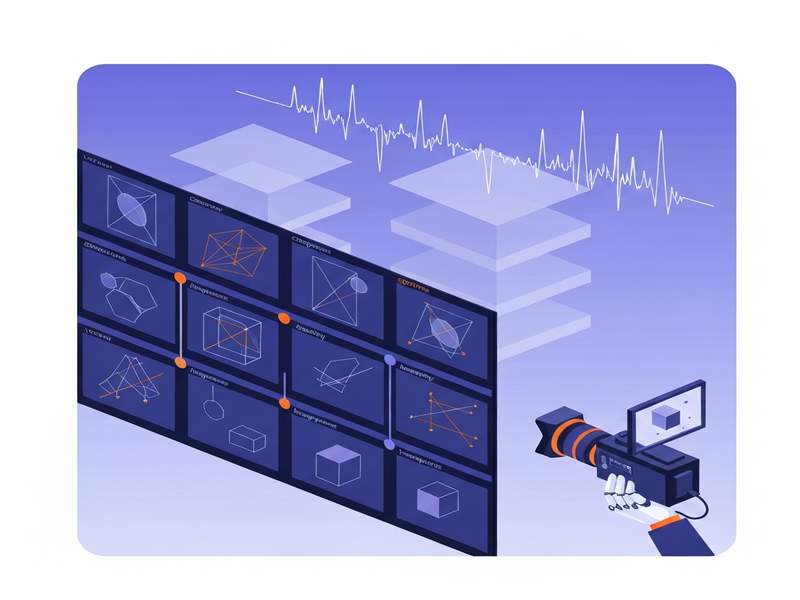
The diagram below visualizes the GEOPHYS pipeline, from raw video ingestion to EEG‑aligned plausibility scoring.
For developers ready to experiment, the UBOS templates for quick start include a ready‑made GEOPHYS inference service that can be deployed on a single GPU in under ten minutes.
Andrii Bidochko
CTO UBOS
Andrii Bidochko is an AI entrepreneur and researcher focused on AI agents, reinforcement learning, and autonomous systems. He writes about the technologies shaping the future of machine intelligence, from frontier models and agent architectures to real-world AI applications.