

- Updated: June 11, 2026
- 8 min read
Geometry of Human Perceptual Domains Emerges Transiently in LLM Representations
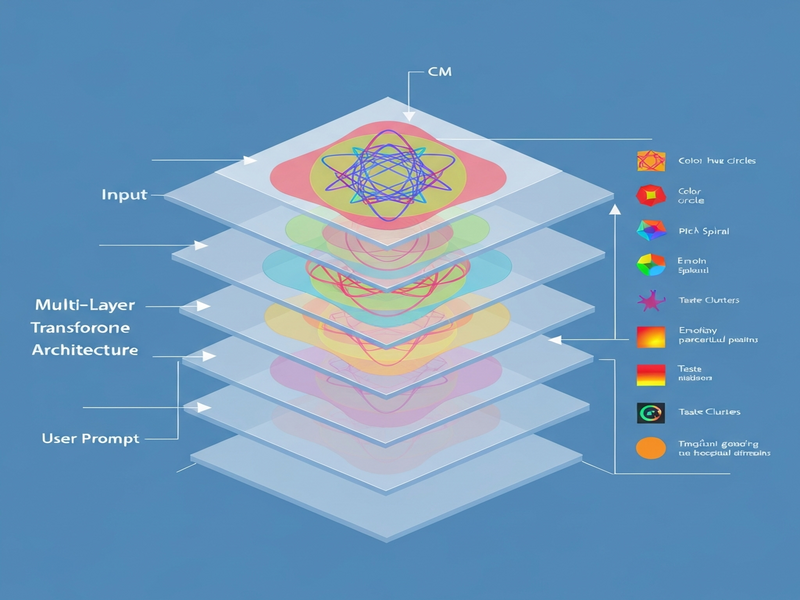
Direct Answer
The paper “Geometry of Human Perceptual Domains Emerges Transiently in LLM Representations” demonstrates that large language models (LLMs) spontaneously develop geometric structures in their internal activations that mirror human perceptual organization—such as color, pitch, emotion, and taste—despite being trained only on text. This matters because it reveals a hidden alignment between language‑only training and the way humans experience the world, opening a pathway for more human‑like reasoning, evaluation, and control of AI agents.
Background: Why This Problem Is Hard
Understanding how LLMs internally represent concepts has been a central challenge since the rise of transformer‑based models. Researchers have shown that word embeddings capture analogies (e.g., king – man + woman ≈ queen), but extending this insight to richer, multi‑dimensional perceptual spaces is far from trivial.
Key obstacles include:
- Absence of direct supervision. LLMs are trained on raw text without any labeled sensory data, so any emergence of perceptual geometry must arise implicitly.
- Layer‑wise opacity. Transformers consist of dozens of layers, each transforming representations in complex ways. Pinpointing where, if at all, perceptual structure appears requires systematic probing across depth.
- Domain diversity. Human perception spans color, pitch, taste, emotion, and more—each with its own psychophysical metrics. A single method must be flexible enough to evaluate all these domains.
- Evaluation rigor. Prior work often relies on anecdotal visualizations or low‑dimensional projections, which can be misleading. Robust statistical alignment with human baselines is needed.
Because of these challenges, most existing studies stop at “embeddings are useful” without asking whether the geometry matches how humans actually experience the world. The new research tackles this gap head‑on.
What the Researchers Propose
The authors introduce a systematic probing framework that treats each perceptual domain as a separate “geometry extraction task.” In essence, they:
- Collect canonical human‑rated datasets for color, pitch, emotion, and taste, each providing a ground‑truth metric space (e.g., CIELAB for color, mel scale for pitch).
- Pass a large set of stimulus descriptors (e.g., “crimson,” “C‑sharp,” “bittersweet”) through the residual streams of multiple open‑weight transformer models.
- Apply linear projection techniques (e.g., canonical correlation analysis) to map high‑dimensional activations onto low‑dimensional subspaces that can be directly compared with the human metric spaces.
- Track the quality of this alignment layer by layer, producing a “geometric emergence curve” for each domain and each model.
Crucially, the framework does not inject any perceptual supervision during training; it merely observes what the model has already learned. The key components are:
- Stimulus Encoder. Converts textual descriptors into token sequences fed to the LLM.
- Residual Stream Extractor. Captures the hidden state after each transformer block, preserving the full representation before the next attention‑feed‑forward operation.
- Domain Projector. Learns a linear map that aligns the extracted activations with the human reference space for a given perceptual domain.
- Alignment Metric. Quantifies similarity using Procrustes distance, Pearson correlation, and downstream classification accuracy.
How It Works in Practice
The workflow can be visualized as a three‑stage pipeline:
1. Data Preparation
For each perceptual domain, the researchers assemble a curated list of descriptors (e.g., 200 color names, 150 musical intervals, 120 emotion adjectives, 80 taste terms). Each descriptor is paired with a human‑derived coordinate in the appropriate psychophysical space.
2. Layer‑wise Extraction
Each descriptor is tokenized and fed to the target LLM (e.g., LLaMA‑2‑13B, Falcon‑40B, Mistral‑7B). After every transformer block, the residual stream—a vector of size equal to the model’s hidden dimension—is recorded. This yields a stack of activation matrices, one per layer.
3. Geometric Alignment
For a given layer, a linear regression (or CCA) learns a projection matrix that best maps the activation vectors onto the human metric vectors. The quality of this mapping is evaluated on a held‑out subset, ensuring that the alignment is not merely memorization.
What sets this approach apart is the systematic, depth‑wise tracking of alignment, allowing the authors to observe a “rise‑and‑fall” pattern: early layers show weak, diffuse geometry; middle layers exhibit strong, coherent structure; later layers see the geometry attenuate as the model focuses on higher‑level linguistic tasks.
Evaluation & Results
The study examined three open‑weight transformer families, each with multiple scale variants. The evaluation covered four perceptual domains, yielding a total of twelve emergence curves.
Scenarios Tested
- Cross‑model comparison. Does geometry emerge similarly in models of different size and architecture?
- Domain‑specific trajectories. Do color, pitch, emotion, and taste follow the same depth pattern?
- Transient behavior. Is the geometric signal sustained, amplified, or diminished across layers?
Key Findings
- Universal emergence. All three model families displayed statistically significant alignment with human perceptual spaces, despite never seeing sensory data.
- Domain‑dependent peaks. Color and pitch reached peak alignment around layers 12‑14, while emotion and taste peaked slightly later (layers 15‑18), suggesting that affective concepts require deeper semantic integration.
- Transient trajectory. The alignment curve consistently followed a “low‑medium‑high‑low” shape: weak in the first 4‑6 layers, rising sharply in the middle, then gradually declining after the peak.
- Model size effect. Larger models (e.g., 40B parameters) achieved higher peak alignment and a broader plateau, indicating that capacity amplifies the fidelity of emergent perceptual geometry.
These results were validated using permutation tests and by confirming that random projections failed to reproduce the observed alignment, ruling out chance correlations.
Why This Matters for AI Systems and Agents
Understanding that LLMs internally encode human‑like perceptual geometry has several practical consequences for developers building AI agents, orchestration platforms, and downstream products.
- Richer prompting strategies. Knowing that middle layers hold a structured representation of color or emotion allows engineers to craft prompts that tap into this latent knowledge, improving zero‑shot performance on tasks like “describe a scene using vivid colors.”
- Alignment diagnostics. The emergence curves serve as a diagnostic tool: if a fine‑tuned model loses its perceptual geometry, it may indicate over‑specialization or catastrophic forgetting.
- Multimodal bridging. Since the geometry mirrors human sensory spaces, it can act as a bridge to connect pure‑text models with external modalities (e.g., vision or audio) without explicit multimodal training.
- Agent evaluation. For agents that need to reason about affect (e.g., customer‑service bots), probing the emotion geometry can provide a quantitative measure of “empathy awareness.”
- Product differentiation. Platforms that expose these latent perceptual features can offer novel capabilities, such as “AI marketing agents” that automatically generate copy aligned with a target emotional tone.
Developers can integrate these insights into existing pipelines using tools like the UBOS platform overview to extract and monitor layer‑wise activations, or leverage the Workflow automation studio to automate geometry probing as part of continuous model evaluation.
What Comes Next
While the study opens exciting avenues, several limitations remain:
- Scope of perceptual domains. Only four domains were examined; extending to smell, tactile sensations, or complex affective states could reveal new patterns.
- Causal understanding. The work is observational; it does not explain why the geometry emerges or how training dynamics shape it.
- Intervention studies. Manipulating training data (e.g., adding sensory‑rich text) could test whether geometry can be amplified or redirected.
- Real‑time usage. Extracting residual streams at inference time adds overhead; efficient approximation methods are needed for production systems.
Future research directions include:
- Designing probing‑aware fine‑tuning objectives that preserve or enhance perceptual geometry.
- Building multimodal adapters that map the emergent geometry onto visual or auditory embeddings, enabling truly cross‑modal reasoning.
- Creating benchmark suites that evaluate agents on perceptual alignment, complementing existing language‑only benchmarks.
- Exploring how geometry interacts with alignment techniques such as RLHF, to ensure that human‑like perception does not conflict with safety constraints.
Practitioners interested in experimenting with these ideas can start by integrating the OpenAI ChatGPT integration into their workflow, then layering custom probes using the Chroma DB integration for efficient storage of activation vectors.
For teams building conversational agents that need to convey nuanced emotions, the ChatGPT and Telegram integration offers a low‑friction testbed to observe how emergent emotion geometry influences user satisfaction in real‑time chats.
Conclusion
The discovery that LLMs spontaneously form human‑like perceptual geometries—albeit transiently—reframes our understanding of what “language‑only” training can achieve. It suggests that the statistical structure of text alone encodes enough cues for models to reconstruct aspects of the sensory world, offering a new lever for building agents that think, feel, and describe in ways that align with human experience. By systematically probing these hidden structures, researchers and engineers can both diagnose model behavior and unlock novel multimodal capabilities without the cost of collecting massive sensory datasets.
Stay ahead of the curve by exploring UBOS’s suite of tools for model introspection, workflow automation, and agent deployment. The future of AI agents may well be defined not just by what they say, but by how their internal geometry mirrors the way we perceive the world.
Andrii Bidochko
CTO UBOS
Andrii Bidochko is an AI entrepreneur and researcher focused on AI agents, reinforcement learning, and autonomous systems. He writes about the technologies shaping the future of machine intelligence, from frontier models and agent architectures to real-world AI applications.