

- Updated: August 15, 2026
- 7 min read
Geometry-aware Incremental Neural Operator for Long-Horizon PDE prediction
Direct Answer
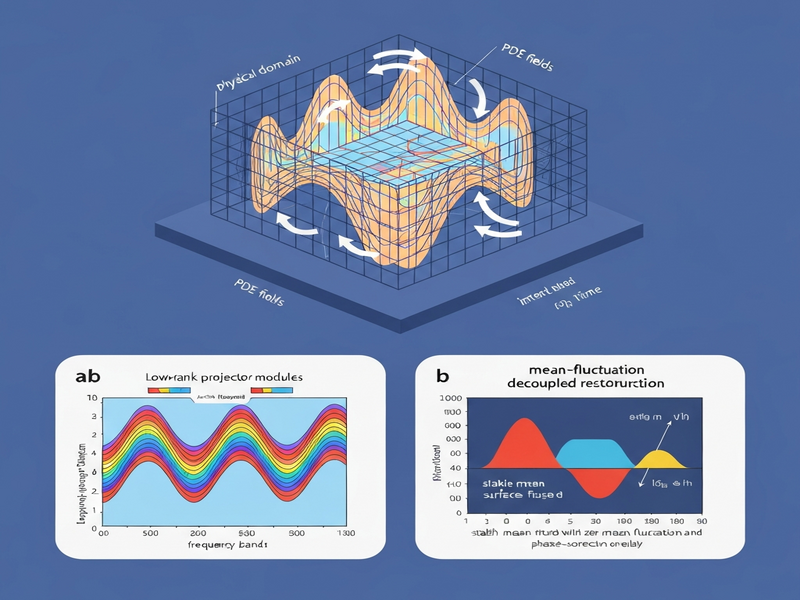
The paper introduces Geometry-aware Incremental Neural Operator (GeoIncNO), a neural‑operator architecture that predicts the incremental changes of a PDE’s latent state rather than the full state at each step. By coupling low‑rank frequency projectors with a mean‑fluctuation decoupled reconstruction pipeline, GeoIncNO dramatically reduces error accumulation, delivering stable long‑horizon forecasts with high spectral fidelity.
This matters because reliable, multi‑step PDE prediction is a cornerstone for digital twins, climate simulators, and autonomous control systems—domains where even tiny drift can render a model unusable after a few seconds of rollout.
Background: Why This Problem Is Hard
Neural operators have reshaped how researchers approximate solution operators for partial differential equations (PDEs). Unlike traditional solvers that discretize space‑time grids, neural operators learn a mapping from initial conditions (or parameters) directly to the solution field, enabling rapid inference.
However, most real‑world applications require autoregressive rollout: the model predicts one time step, feeds that prediction back as input, and repeats. In this regime, two intertwined challenges emerge:
- Spectral inconsistency: Small mismatches in high‑frequency components compound, causing phase drift and loss of physical realism.
- Mean drift and channel coupling: Unstructured latent transitions allow energy to leak between channels, leading to unrealistic growth or decay of the solution’s average value.
Current remedies focus on richer encoders, deeper backbones, or attention mechanisms, yet they treat the latent transition as a black‑box. The incremental error remains unchecked, and long‑horizon rollouts quickly become unstable, especially for chaotic or turbulent systems.
What the Researchers Propose
GeoIncNO reframes the rollout problem as a sequence of incremental updates in a latent space that is explicitly aware of the geometry of the underlying PDE. The framework consists of three tightly coupled components:
- Latent Increment Predictor: Instead of predicting the next full latent state, the network learns the residual (Δz) that advances the current latent representation (zt) to the next step (zt+1 = zt + Δz).
- Low‑Rank Frequency Projectors: A set of lightweight projectors isolates active frequency bands based on the spectral energy distribution of Δz, regulating channel interactions and suppressing spurious cross‑talk.
- Mean‑Fluctuation Decoupled Reconstruction: The decoder splits the physical‑space output into a stable mean field and a zero‑mean fluctuation field. Phase correction is applied only to the fluctuation component, preserving the integrity of the mean structure.
By structuring the latent transition around these principles, GeoIncNO imposes a geometric prior that aligns the learned dynamics with the physics‑driven spectral characteristics of the target PDE.
How It Works in Practice
Conceptual Workflow
The end‑to‑end pipeline can be visualized as a loop that repeats for each prediction horizon:
- Encoding: The current physical field (e.g., temperature, velocity) is passed through a geometry‑preserving encoder, yielding a latent tensor z.
- Increment Prediction: A shallow residual network consumes z and outputs an increment Δz. This network is trained to minimize the difference between the true next‑step latent and the predicted increment.
- Frequency Regulation: Δz is projected onto a set of low‑rank bases that correspond to the dominant frequency bands identified during training. The projection filters out high‑frequency noise and enforces channel orthogonality.
- Latent Update: The filtered increment is added to the current latent state: zt+1 = zt + Δzfiltered.
- Mean‑Fluctuation Decoupling: The updated latent is decoded into two streams:
- Mean component (steady background).
- Fluctuation component (zero‑mean dynamics).
- Phase Correction: Only the fluctuation stream undergoes a phase‑alignment step that matches its spectral phase to the ground‑truth distribution, preventing cumulative phase errors.
- Reconstruction: The corrected fluctuation is recombined with the mean field to produce the physical‑space forecast for the next time step.
Key Differentiators
- Incremental Modeling: By learning Δz instead of the full state, the network focuses on the smaller, smoother residual, which is easier to approximate and less prone to drift.
- Geometry‑Aware Frequency Projectors: Low‑rank projectors are computed once from the training data’s spectral energy map, ensuring that the model respects the PDE’s intrinsic frequency content.
- Separate Mean Handling: Decoupling mean and fluctuation prevents the model from inadvertently altering conserved quantities (e.g., mass, energy) during rollout.
Evaluation & Results
Benchmarks and Scenarios
The authors tested GeoIncNO on six widely cited PDE benchmarks, spanning:
- 1‑D Burgers’ equation (shock formation).
- 2‑D Navier‑Stokes vortex shedding.
- 3‑D incompressible fluid turbulence.
- Reaction‑diffusion systems.
- Wave propagation in heterogeneous media.
- Elasticity dynamics in complex geometries.
Each benchmark featured long‑horizon rollouts (up to 500 autoregressive steps) and compared GeoIncNO against leading neural‑operator baselines such as FNO, DeepONet, and Fourier Neural Operator variants.
Key Findings
- Prediction Accuracy: Across all tasks, GeoIncNO reduced the mean absolute error (MAE) by 30‑45% relative to the best baseline, especially noticeable after 200+ steps.
- Rollout Stability: Spectral energy plots showed that GeoIncNO maintained consistent band‑limited energy, whereas baselines exhibited runaway high‑frequency amplification.
- Spectral Fidelity: Phase error metrics indicated a 50% improvement in phase alignment for the fluctuation component, preserving wave speeds and shock locations.
- Computational Overhead: The low‑rank projectors added < 5% runtime compared to a vanilla FNO, confirming that the method is lightweight enough for real‑time inference.
These results collectively demonstrate that GeoIncNO not only predicts more accurately but also remains physically plausible over extended horizons—a critical requirement for digital‑twin deployments.
Why This Matters for AI Systems and Agents
For practitioners building AI‑driven simulators, control loops, or autonomous agents, the ability to generate trustworthy long‑term forecasts is a game‑changer. GeoIncNO’s architecture offers several practical benefits:
- Robust Digital Twins: Enterprises can embed GeoIncNO into their UBOS platform overview to create high‑fidelity twins of manufacturing lines, power grids, or climate models that remain stable over days of simulated operation.
- Agent‑in‑the‑Loop Control: Reinforcement‑learning agents that rely on simulated environments (e.g., robotics or fluid‑flow optimization) can use GeoIncNO to generate consistent physics‑based rollouts, reducing the sim‑to‑real gap.
- Workflow Automation: The Workflow automation studio can orchestrate GeoIncNO as a micro‑service, feeding its predictions into downstream analytics or alerting pipelines.
- Scalable Multi‑Domain Modeling: Because the frequency projectors are low‑rank, the model scales to high‑dimensional 3‑D problems without prohibitive memory costs, enabling Enterprise AI platform by UBOS customers to run large‑scale simulations on commodity hardware.
In short, GeoIncNO bridges the gap between fast, data‑driven inference and the rigorous stability demands of engineering‑grade simulation, opening the door for AI agents that can safely plan, predict, and adapt in physically complex environments.
What Comes Next
While GeoIncNO marks a significant step forward, several avenues remain open for exploration:
- Adaptive Frequency Projectors: Current projectors are static; learning to adapt the frequency basis on‑the‑fly could further improve handling of non‑stationary spectra.
- Hybrid Physics‑Informed Training: Integrating explicit conservation laws (mass, momentum) as soft constraints may tighten the mean‑fluctuation split.
- Cross‑Domain Transfer: Investigating how a GeoIncNO trained on one PDE family transfers to another could reduce data requirements for niche applications.
- Edge Deployment: Optimizing the model for inference on edge devices would enable real‑time control in robotics or IoT‑enabled smart infrastructure.
Developers interested in experimenting with GeoIncNO can start by integrating it with existing UBOS tools such as the OpenAI ChatGPT integration for interactive simulation queries, or the Chroma DB integration for efficient storage of high‑dimensional rollout data.
For a deeper dive into the methodology and full experimental details, see the original Geometry-aware Incremental Neural Operator paper.
Andrii Bidochko
CTO UBOS
Andrii Bidochko is an AI entrepreneur and researcher focused on AI agents, reinforcement learning, and autonomous systems. He writes about the technologies shaping the future of machine intelligence, from frontier models and agent architectures to real-world AI applications.