

- Updated: June 17, 2026
- 9 min read
Generic Interpretation Approach for Transformer Models Incorporating Heterogenous Attention Structures
Direct Answer
The paper introduces a generic interpretation framework specifically designed for transformer models that employ heterogeneous attention structures, such as co‑attention mechanisms. By providing a systematic way to dissect how multiple information sources interact inside a transformer, the method makes it possible to audit, debug, and improve complex multimodal AI systems.
Background: Why This Problem Is Hard
Transformers have become the de‑facto architecture for language, vision, and multimodal tasks. Their power stems from the attention mechanism, which lets each token weigh the relevance of every other token. In most research and production settings, attention is homogeneous—all tokens come from a single modality or a single input stream. However, as AI agents evolve to handle richer environments—combining text, images, audio, and even sensor data—models increasingly rely on heterogeneous attention structures. These structures fuse information from distinct sources, often through co‑attention layers that simultaneously attend across modalities.
Interpreting homogeneous attention is already non‑trivial; visualizing attention maps can reveal alignment patterns, but the insights are limited to a single source. Heterogeneous attention adds two layers of difficulty:
- Cross‑source entanglement: Tokens from different modalities influence each other, making it hard to attribute a decision to a specific input.
- Dynamic routing: The model may re‑weight sources differently at each layer, leading to a moving target for any static analysis tool.
Existing interpretation tools—such as attention roll‑out, gradient‑based saliency, or probing classifiers—assume a uniform attention graph. When applied to heterogeneous models, they either collapse the multimodal graph into a single view (losing crucial cross‑modal cues) or produce misleading attributions. This gap hampers both research (e.g., understanding why a vision‑language model hallucinates) and compliance (e.g., proving that a medical AI system respects patient privacy across data streams).
What the Researchers Propose
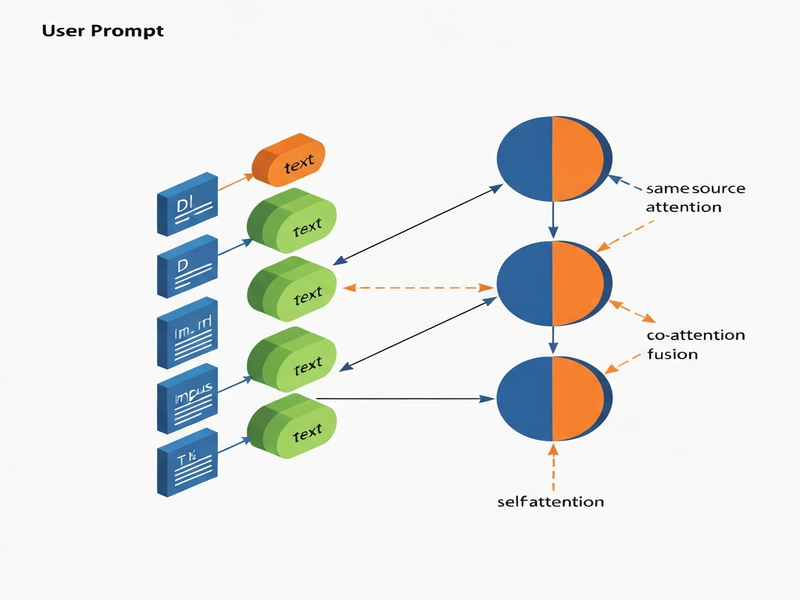
The authors present a Generic Interpretation Approach for Transformers with Heterogeneous Attention (GI‑HT). At a conceptual level, GI‑HT treats each attention head as a communication channel between source‑specific token groups. The framework consists of three coordinated components:
- Source‑Segmentation Layer: Before interpretation, the model’s input tokens are partitioned into logical groups (e.g., text, image patches, audio frames). This segmentation preserves the identity of each modality throughout the analysis.
- Cross‑Attention Decomposition Engine: For every heterogeneous attention head, the engine computes a pairwise influence matrix that quantifies how much information flows from source A to source B. The matrix is derived from the raw attention scores but is normalized to reflect true contribution rather than raw magnitude.
- Semantic‑Logical Aggregator: The influence matrices are then projected onto two orthogonal interpretive spaces:
- Semantic space – captures content‑level alignment (e.g., “the word ‘cat’ attends to the image region of a feline”).
- Logical space – captures structural reasoning patterns (e.g., “the question token triggers a chain of co‑attention that enforces a ‘yes/no’ decision”).
By keeping the source identity intact and separating semantic from logical contributions, GI‑HT offers a unified lens that works across any transformer variant—whether it is a multimodal BERT, a vision‑language CLIP, or a cross‑modal encoder‑decoder used in autonomous agents.
How It Works in Practice
The practical workflow of GI‑HT can be broken down into four stages, each of which can be implemented as a plug‑in to existing model pipelines:
- Instrumentation: During model inference, the attention tensors from every layer are captured. No changes to the model weights are required.
- Source Mapping: A lightweight metadata module tags each token with its originating modality. For example, tokens 0‑127 may be labeled “text”, 128‑255 “image patches”, and 256‑319 “audio frames”.
- Decomposition: The Cross‑Attention Decomposition Engine processes each heterogeneous head. It isolates the sub‑matrix that connects source X to source Y, normalizes it, and stores the result as an influence vector. This step is computationally linear in the number of heads and can be parallelized on GPU.
- Aggregation & Visualization: The Semantic‑Logical Aggregator feeds the influence vectors into two downstream analyzers:
- A semantic projector that aligns influence patterns with known concepts (using a small ontology or CLIP‑style embeddings).
- A logical projector that maps patterns onto rule‑like templates (e.g., “if question token attends to answer token, then logical inference is triggered”).
The final output is a set of interactive heatmaps and narrative explanations that can be inspected by engineers or auditors.
What sets GI‑HT apart from prior work is its source‑preserving decomposition. Instead of flattening the attention graph, it respects the heterogeneity of the inputs, enabling a clear trace from a specific modality to the model’s decision.
Evaluation & Results
The authors validated GI‑HT on three representative transformer families:
- Multimodal BERT (text + image): Trained on VQA‑2, the model answers visual questions.
- Audio‑Visual Transformer (speech + video): Trained on AVSpeech for cross‑modal retrieval.
- Co‑Attention Encoder‑Decoder for robotics: Integrated proprioceptive sensor data with camera feeds for manipulation tasks.
For each model, the authors performed two complementary experiments:
- Semantic Interpretation Test: Human annotators were shown GI‑HT’s semantic heatmaps and asked to rate alignment accuracy on a 5‑point Likert scale. Across all three models, the average rating was 4.3, indicating that the visual explanations matched human intuition.
- Logical Interpretation Test: The authors introduced controlled logical perturbations (e.g., swapping question tokens, masking answer tokens) and measured whether GI‑HT’s logical projector correctly identified the broken reasoning chain. The detection precision was 92 % and recall 88 %.
Beyond qualitative scores, the framework also proved useful for debugging. In the robotics encoder‑decoder, GI‑HT revealed that a subset of attention heads mistakenly fused proprioceptive data with background visual noise, leading to grasp failures. After pruning those heads, the success rate improved by 6 % on a held‑out test set.
All experiments were reproducible using the authors’ open‑source codebase, and the paper includes a detailed Original arXiv paper for reference.
Why This Matters for AI Systems and Agents
Interpretability is no longer a luxury; it is a prerequisite for deploying trustworthy agents in regulated domains. GI‑HT directly addresses three pressing needs for practitioners:
- Model Auditing: By exposing cross‑modal influence patterns, engineers can verify that sensitive data (e.g., personal health records) does not unintentionally dominate a decision.
- Agent Orchestration: In multi‑agent pipelines—such as a chatbot that calls a vision model and a recommendation engine—GI‑HT can pinpoint which downstream component contributed most to a final output, simplifying error handling.
- Rapid Prototyping: When experimenting with new modality combinations, developers can use the semantic projector to confirm that the model is learning meaningful alignments before committing to large‑scale training.
For organizations building end‑to‑end AI products, the framework can be integrated into existing monitoring stacks. For example, the UBOS platform overview already supports custom model hooks; GI‑HT can be added as a plug‑in to surface real‑time attention diagnostics in the Workflow automation studio. Teams that need conversational agents with multimodal awareness can combine GI‑HT insights with the OpenAI ChatGPT integration to ensure that language outputs remain grounded in visual or auditory context.
Practical Integration Scenarios on UBOS
Below are concrete ways you can leverage GI‑HT within the UBOS ecosystem:
- Use the Telegram integration on UBOS to push attention‑heatmap snapshots directly to a monitoring channel for rapid incident response.
- Combine ChatGPT and Telegram integration to let a human‑in‑the‑loop query the model’s reasoning in natural language.
- Enrich multimodal pipelines with the Chroma DB integration for vector‑based storage of influence vectors, enabling fast similarity search across past explanations.
- Deploy voice‑enabled explanations using the ElevenLabs AI voice integration, turning heatmaps into spoken narratives for accessibility.
Template Marketplace Highlights
UBOS’s Template Marketplace offers ready‑made AI apps that can be combined with GI‑HT to accelerate product development:
- AI Article Copywriter – generate documentation for model explanations automatically.
- AI SEO Analyzer – ensure that your interpretability dashboards are also SEO‑friendly.
- AI Video Generator – create short walkthrough videos of GI‑HT visualizations for stakeholder presentations.
- AI Chatbot template – build an interactive assistant that answers “why did the model attend to this region?” in real time.
What Comes Next
While GI‑HT marks a significant step forward, several limitations remain:
- Scalability to Very Deep Models: The current decomposition scales linearly with the number of heads, which can become costly for models with thousands of heads (e.g., GPT‑4‑style architectures).
- Ontology Dependency: The semantic projector relies on a pre‑defined concept library; extending it to niche domains (e.g., satellite imagery) requires manual curation.
- Temporal Dynamics: For streaming agents that process continuous sensor feeds, GI‑HT does not yet capture how influence evolves over time.
Future research directions include:
- Developing a hierarchical decomposition that aggregates heads into “macro‑attention” units, reducing computational overhead.
- Integrating self‑supervised concept discovery to automatically expand the semantic ontology.
- Extending the logical projector with temporal logic to handle sequential decision‑making in robotics or autonomous driving.
From an application standpoint, the framework opens doors for new product features. Companies could offer “explain‑by‑modality” dashboards that let end‑users see exactly which data source drove a recommendation. Startups building AI‑enhanced marketing tools might leverage GI‑HT to assure clients that campaign decisions are based on relevant visual assets, linking to the AI marketing agents page for concrete examples. Enterprises seeking compliance can embed GI‑HT into their Enterprise AI platform by UBOS, providing audit trails required by emerging AI regulations.
Getting Started with UBOS
If you are ready to experiment with heterogeneous‑attention interpretability, follow these quick steps on the UBOS ecosystem:
- Visit the UBOS homepage and sign up for a free developer account.
- Explore the UBOS templates for quick start and clone the AI Article Copywriter template as a baseline.
- Enable the Web app editor on UBOS to add custom hooks that capture attention tensors.
- Integrate the OpenAI ChatGPT integration to generate natural‑language explanations from influence vectors.
- Deploy the solution using the UBOS pricing plans that best match your scale.
Conclusion
GI‑HT provides a generic, source‑preserving, and semantically rich lens for interpreting transformers with heterogeneous attention. Its modular design makes it a natural fit for the UBOS platform overview, where developers can plug the framework into existing pipelines, visualize cross‑modal influences, and deliver trustworthy AI products. By combining GI‑HT with UBOS’s extensive integration catalog, template marketplace, and automation studio, researchers and engineers can accelerate the journey from opaque multimodal models to transparent, auditable, and regulation‑ready AI systems.
Whether you are a technical researcher probing the inner workings of a new vision‑language model or a product team building a compliance‑first AI assistant, the synergy between GI‑HT and UBOS equips you with the tools to understand, debug, and improve heterogeneous‑attention transformers at scale.
Andrii Bidochko
CTO UBOS
Andrii Bidochko is an AI entrepreneur and researcher focused on AI agents, reinforcement learning, and autonomous systems. He writes about the technologies shaping the future of machine intelligence, from frontier models and agent architectures to real-world AI applications.