

- Updated: July 19, 2026
- 2 min read
GenDA: Generative Data Assimilation on Complex Urban Areas via Classifier-Free Diffusion Guidance
GenDA: Generative Data Assimilation on Complex Urban Areas via Classifier‑Free Diffusion Guidance
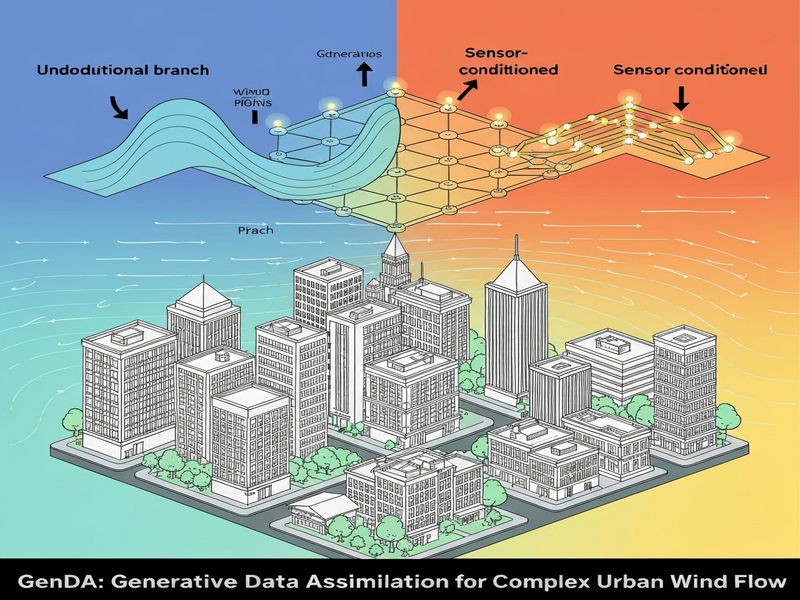
Urban wind‑flow reconstruction is a critical component for air‑quality monitoring, heat‑dispersion analysis, and pedestrian comfort assessment. The newly proposed GenDA framework delivers high‑resolution wind‑field reconstructions on unstructured meshes using limited sensor observations.
By leveraging a multiscale graph‑based diffusion architecture trained on CFD simulations, GenDA treats classifier‑free guidance as a learned posterior reconstruction mechanism. The unconditional branch learns a geometry‑aware flow prior, while the sensor‑conditioned branch injects observational constraints during sampling, enabling obstacle‑aware reconstruction and strong generalisation to unseen mesh geometries, wind directions, and sensor layouts.
Key results on a real‑world urban neighbourhood in Bristol, UK (Re≈2×10⁷) demonstrate that GenDA reduces the relative root‑mean‑square error (RRMSE) by 25‑57 % and boosts the structural similarity index (SSIM) by 23‑33 % compared to state‑of‑the‑art supervised GNN baselines and classical reduced‑order data‑assimilation methods.
For a deeper dive into the methodology, implementation details, and performance benchmarks, visit the GenDA research page on our site. Additional resources, including the full code repository and downloadable datasets, are available at Ubos Tech Resources.
Stay tuned for upcoming updates and related publications by following our blog and subscribing to the Ubos Tech newsletter.
Andrii Bidochko
CTO UBOS
Andrii Bidochko is an AI entrepreneur and researcher focused on AI agents, reinforcement learning, and autonomous systems. He writes about the technologies shaping the future of machine intelligence, from frontier models and agent architectures to real-world AI applications.