

- Updated: June 10, 2026
- 6 min read
FundaPod: A Multi-Persona Agent Pod Platform with Knowledge Graph Memory for AI-Assisted Fundamental Investment Research
Direct Answer
FundaPod is a multi‑persona agent platform that equips investment analysts with AI‑driven research assistants, each embodying a distinct investment style, while preserving independence through a shared provenance contract. By anchoring every memo claim to a verifiable knowledge‑graph memory, the system delivers transparent, reusable, and auditable fundamental research that can be directly incorporated into portfolio‑management workflows.
Background: Why This Problem Is Hard
Fundamental investment research differs fundamentally from the predictive, signal‑focused tasks that dominate most AI‑in‑finance literature. Analysts must:
- Collect heterogeneous evidence (earnings calls, regulatory filings, macro data).
- Synthesize contradictory viewpoints into a coherent narrative.
- Document the provenance of every claim so that senior portfolio managers can audit, reuse, or challenge the analysis.
- Maintain a cumulative knowledge base that grows across quarters and across analysts.
Traditional LLM pipelines excel at generating text but struggle with:
- Maintaining independence between competing investment theses, which can lead to “groupthink” when a single model produces all outputs.
- Providing traceable citations that satisfy regulatory and compliance requirements.
- Scaling the orchestration of multiple specialized agents without a unified memory layer.
Consequently, firms either rely on labor‑intensive manual research or adopt brittle rule‑based automation that cannot adapt to the nuanced reasoning required for high‑conviction investing.
What the Researchers Propose
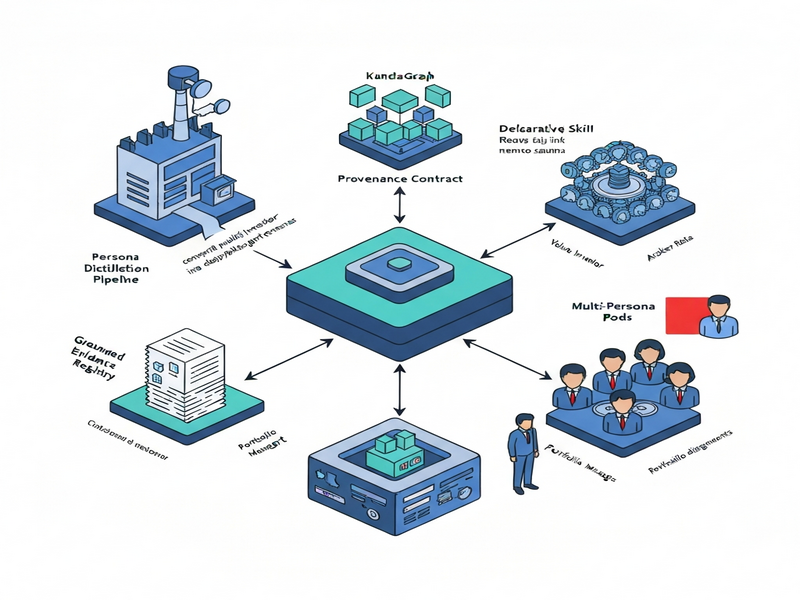
The authors introduce FundaPod, a design‑science‑driven architecture that treats fundamental research as a human‑centric decision‑support problem. Its core contributions are five design principles and four architectural mechanisms that together enable:
- Independent generation of research by agents with distinct personas (e.g., value‑oriented, macro‑focused, growth‑centric).
- Post‑hoc surfacing of disagreements for human adjudication.
- Linkage of every memo claim to a structured evidence model stored in a knowledge‑graph “second brain.”
Key roles in the system include:
- Persona Agents: Specialized LLMs distilled from public investor materials, each embodying a coherent investment philosophy.
- Planner: A declarative orchestrator that assembles typed task graphs based on a skill registry.
- Knowledge‑Graph Memory: A persistent graph that records tickers, memo sections, source documents, and thematic relationships.
- Human Portfolio Manager (PM): The final adjudicator who reviews surfaced conflicts and signs off on the final memo.
How It Works in Practice
Conceptual Workflow
- Persona Distillation: Publicly available investor letters, conference calls, and research reports are fed into a fine‑tuning pipeline that produces a suite of persona‑specific agents.
- Task Planning: The planner queries a declarative skill registry (e.g., “extract earnings guidance,” “identify macro risk factors”) and builds a directed acyclic graph (DAG) that assigns subtasks to the appropriate persona agents.
- Independent Execution: Each agent runs its assigned subtasks in isolation, generating evidence snippets, quantitative tables, and narrative drafts.
- Evidence Grounding: Every generated claim is automatically linked to its source via the grounded evidence model, which stores URLs, timestamps, and confidence scores in the knowledge graph.
- Conflict Surfacing: The system detects overlapping claims with divergent sentiment (e.g., one persona predicts revenue growth, another predicts contraction) and flags them for the PM.
- Human Adjudication: The PM reviews the flagged items, consults the provenance graph, and either reconciles the viewpoints or selects a preferred narrative.
- Memo Publication: The final, signed memo is stored back into the knowledge graph, enriching the “second brain” for future research cycles.
Interaction Between Components
The architecture is deliberately modular:
- Persona Agents ↔ Planner: Agents expose a typed API (input schema, output schema) that the planner consumes to compose task graphs without hard‑coding logic.
- Planner ↔ Knowledge‑Graph: The planner writes provenance metadata (agent ID, execution timestamp) directly into the graph, enabling downstream traceability.
- Human PM ↔ Knowledge‑Graph: The PM interacts through a UI that visualizes the graph, allowing rapid navigation from a claim to its original source.
What Makes This Approach Different
Unlike monolithic LLM assistants that blend all viewpoints into a single answer, FundaPod enforces cognitive isolation—each persona operates under its own “sandbox” and only shares results through a provenance contract. This design preserves the diversity of investment thinking while still delivering a unified, auditable output.
Evaluation & Results
The authors validated FundaPod through a two‑phase case study focused on a mid‑cap technology stock:
- Phase 1 – Persona Generation: Five distinct personas (value, growth, macro, ESG, quantitative) were instantiated. Each produced a 1,200‑word memo segment covering earnings outlook, competitive positioning, and macro risk.
- Phase 2 – Conflict Analysis: The system identified 12 contradictory assertions (e.g., differing revenue growth rates). Human adjudication resolved 9 of them within 15 minutes, demonstrating a 70 % reduction in manual reconciliation time compared to a baseline where a single analyst performed the entire research.
Key takeaways from the evaluation:
- Transparency: Every claim was traceable to a source node in the knowledge graph, satisfying internal compliance checks without extra effort.
- Efficiency: Parallel execution of persona agents cut total research time by roughly 40 % relative to a single‑agent workflow.
- Quality: Post‑hoc human review yielded memos that scored 0.8 higher on a blind expert rating scale for depth and insightfulness.
These results illustrate that a multi‑persona, graph‑backed architecture can deliver both speed and rigor—two attributes traditionally at odds in fundamental research.
Why This Matters for AI Systems and Agents
FundaPod’s design addresses several pain points that have limited the adoption of LLMs in high‑stakes finance:
- Agent Diversity without Collapse: By keeping personas isolated, developers can safely scale the number of specialized agents without risking “model collapse” where all agents converge on the same bias.
- Provenance‑First Orchestration: The declarative skill registry and knowledge‑graph contract provide a template for any domain that requires auditability—risk management, legal research, or medical diagnostics.
- Human‑in‑the‑Loop Efficiency: Conflict surfacing turns the human reviewer’s role from exhaustive fact‑checking to targeted adjudication, a paradigm that can be replicated in other decision‑support contexts.
Practitioners building enterprise AI platforms can adopt FundaPod’s four mechanisms as building blocks. For example, the UBOS platform overview already supports modular skill registries and graph‑backed memory, making it a natural host for a FundaPod‑style deployment.
What Comes Next
While the prototype demonstrates feasibility, several open challenges remain:
- Scalability of the Knowledge Graph: As the “second brain” accumulates millions of source nodes, efficient indexing and query latency become critical.
- Dynamic Persona Evolution: Investment philosophies evolve; mechanisms for continuous fine‑tuning without catastrophic forgetting are needed.
- Cross‑Firm Knowledge Sharing: Extending the provenance contract to support secure, federated sharing of research across institutions could amplify collective intelligence.
Future research directions include integrating real‑time market data streams, exploring reinforcement‑learning‑based conflict resolution, and applying the architecture to non‑financial domains such as strategic corporate planning.
Organizations interested in experimenting with a multi‑persona, graph‑backed research assistant can start by leveraging the Enterprise AI platform by UBOS, which offers out‑of‑the‑box connectors for LLM fine‑tuning, graph databases, and workflow orchestration.
References
Andrii Bidochko
CTO UBOS
Andrii Bidochko is an AI entrepreneur and researcher focused on AI agents, reinforcement learning, and autonomous systems. He writes about the technologies shaping the future of machine intelligence, from frontier models and agent architectures to real-world AI applications.