

- Updated: August 17, 2026
- 6 min read
FrontierFinance: A Challenging Benchmark for Measuring Frontier Intelligence of Finance Agents
Direct Answer
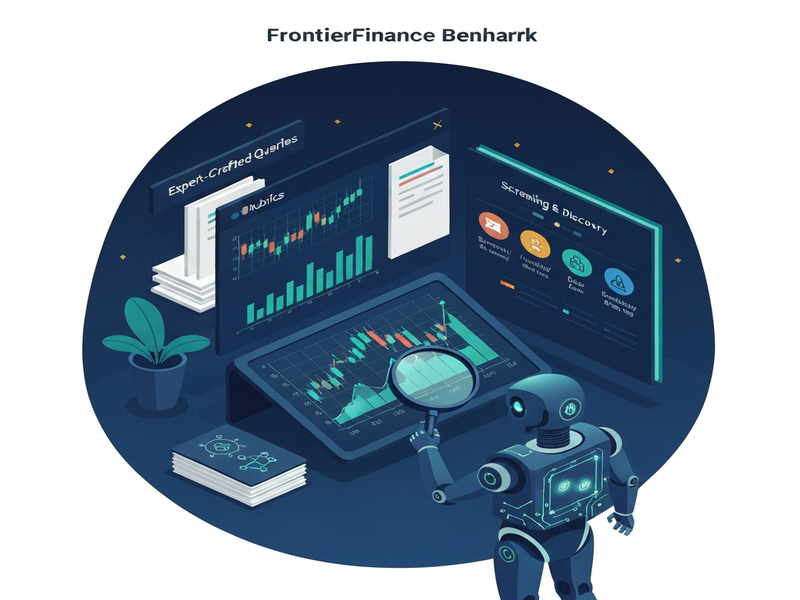
The paper introduces FrontierFinance, a comprehensive, open‑source benchmark that evaluates AI agents across the full spectrum of professional investment research, from idea generation to portfolio monitoring. It matters because it exposes the hidden gaps in current finance‑focused AI evaluations and provides a realistic yardstick for measuring “frontier intelligence” in real‑world analyst workflows.
Background: Why This Problem Is Hard
Financial analysts today rely on a cascade of tools—data vendors, screening platforms, macro‑economic models, and narrative research—to turn raw market data into investment decisions. Replicating this end‑to‑end workflow with an AI agent is challenging for three intertwined reasons:
- Complex, multi‑step reasoning: A single analyst query often requires data extraction, hypothesis generation, cross‑asset comparison, and a written justification that can span several paragraphs.
- Open‑ended answer space: Unlike classification or numeric prediction tasks, analyst outputs are free‑form narratives that cannot be judged by simple accuracy metrics.
- Tool orchestration: Modern agents must invoke external APIs (e.g., Bloomberg, SEC filings) and combine heterogeneous data sources while staying within compliance constraints.
Existing finance benchmarks focus narrowly on data extraction or single‑turn question answering. They have been largely saturated by large language models, leaving no pressure to improve the deeper reasoning and tool‑use capabilities that matter in practice. Consequently, developers lack a reliable, public yardstick to compare full‑workflow agents, and investors cannot gauge whether a new AI system truly adds value beyond headline‑level metrics.
What the Researchers Propose
FrontierFinance is a framework rather than a single dataset. It consists of three tightly coupled components:
- 220 expert‑crafted analyst queries: Each query mirrors a realistic research task (e.g., “Identify emerging ESG opportunities in renewable energy”).
- 11,543 source‑attributed rubrics: For every query, a detailed grading rubric links each answer segment to the original data source (SEC filings, earnings calls, macro reports), enabling fine‑grained evaluation.
- Six use‑case categories: The queries span Screening & Discovery, Sector/Industry & Macro analysis, Valuation Modeling, Risk Assessment, Portfolio Construction, and Monitoring.
By providing both the question and a transparent rubric, FrontierFinance forces agents to demonstrate not only the final recommendation but also the evidential chain that led there—mirroring the audit trail required in professional research.
How It Works in Practice
When an AI system is evaluated on FrontierFinance, the following workflow is executed:
- Query ingestion: The agent receives a natural‑language research prompt from the benchmark harness.
- Tool selection & invocation: Based on the prompt, the agent decides which external data sources to call (e.g., SEC EDGAR API, macro‑economic database) and issues the appropriate API requests.
- Evidence aggregation: Retrieved documents are parsed, key excerpts are extracted, and citations are attached to the internal knowledge graph.
- Reasoning & synthesis: The LLM composes a multi‑paragraph answer, explicitly referencing each piece of evidence per the rubric’s guidelines.
- Rubric‑driven scoring: An automated grader compares the agent’s answer against the rubric, awarding points for correct data usage, logical flow, and citation fidelity.
This pipeline differs from prior benchmarks in two crucial ways:
- Tool harness emphasis: The study shows that the orchestration layer (the “tool harness”) often determines performance more than the underlying language model.
- Open‑ended, source‑grounded evaluation: Instead of binary correctness, the rubric rewards nuanced, evidence‑backed narratives, aligning the metric with real analyst expectations.
Evaluation & Results
The authors evaluated a mix of proprietary frontier models (e.g., Claude Fable 5), open‑weight models (e.g., Kimi K3), and in‑house agent systems (Samaya). All experiments were run under a common harness that limited data access to publicly available sources, ensuring a fair comparison.
Key Findings
- Tool harness matters most: Samaya’s custom orchestration achieved a 56.0 % overall score, outperforming the strongest standalone model (Claude Fable 5 at 49.2 %) while costing roughly half as much in compute.
- Open‑weight models close the gap: Kimi K3 reached 46.4 %, only 2.8 points shy of Claude Fable 5, but at 4.5× lower operational cost.
- Hardest use cases: Across all systems, Screening & Discovery and Sector/Industry & Macro tasks lagged behind, with best scores of 33 % and 39 % respectively, highlighting persistent challenges in large‑scale data synthesis.
These results demonstrate that a well‑engineered tool orchestration can compensate for modest model size, and that current LLMs still struggle with the deep, multi‑source reasoning required for high‑impact investment research.
Why This Matters for AI Systems and Agents
FrontierFinance provides a realistic, high‑stakes testing ground for any AI product that claims to automate or augment investment research. The implications are threefold:
- Benchmark‑driven development: Teams can use the dataset to identify precise failure modes—such as poor macro‑analysis or weak screening logic—and iterate on tool‑selection strategies.
- Cost‑effective model selection: The study shows that open‑weight models paired with a robust orchestration layer can rival proprietary alternatives, informing budgeting decisions for fintech startups.
- Compliance and auditability: By requiring source‑attributed citations, FrontierFinance aligns AI outputs with regulatory expectations, making it easier to integrate agents into regulated workflows.
Practitioners building AI‑driven research assistants can leverage the benchmark to validate their UBOS platform overview for seamless tool integration, ensuring that the orchestration layer meets the rigorous standards highlighted by the paper.
What Comes Next
While FrontierFinance marks a significant step forward, several limitations remain:
- Domain breadth: The current queries focus on public‑company equities; extending to fixed income, derivatives, or private‑market data would broaden applicability.
- Real‑time constraints: The benchmark does not penalize latency; future versions could incorporate time‑to‑insight metrics to reflect trading‑floor pressures.
- Human‑in‑the‑loop evaluation: Automated rubrics are powerful but may miss subtle narrative quality aspects that seasoned analysts value.
Future research could explore hybrid scoring that combines rubric‑based automation with expert review, or integrate reinforcement learning from human feedback to improve citation fidelity. Moreover, expanding the benchmark to cover ESG, alternative data, and cross‑asset strategies would keep it aligned with emerging investment themes.
For organizations looking to adopt a frontier‑grade evaluation pipeline, the Workflow automation studio offers a low‑code environment to build custom tool harnesses that can be directly plugged into the FrontierFinance framework. Pairing such orchestration with open‑weight models can deliver high‑quality research at a fraction of the cost of proprietary solutions.
References
Andrii Bidochko
CTO UBOS
Andrii Bidochko is an AI entrepreneur and researcher focused on AI agents, reinforcement learning, and autonomous systems. He writes about the technologies shaping the future of machine intelligence, from frontier models and agent architectures to real-world AI applications.