

- Updated: June 13, 2026
- 2 min read
From Fact Overwriting to Knowledge Evolution: Causal Editing via On-Policy Self-Distillation
From Fact Overwriting to Knowledge Evolution: Causal Editing via On-Policy Self-Distillation
Authors: Shuaike Li, Kai Zhang, Xianquan Wang, Jiachen Liu, Shengpeng Mo
Published: May 28, 2026 | arXiv:2605.28303v1
Abstract
The rapid growth of Large Language Models (LLMs) has highlighted the need for efficient knowledge editing techniques. Traditional static fact‑overwriting approaches treat LLMs as immutable databases, often causing Epistemic Dissonance—a self‑refutation phenomenon where legacy priors clash with injected facts. This paper introduces a paradigm shift toward Causal Editing, leveraging explicit causal narratives to guide updates and dramatically reduce self‑refutation rates.
Key Contributions
- Identification of the structural flaw in static fact‑overwriting that leads to a 95.6% self‑refutation rate.
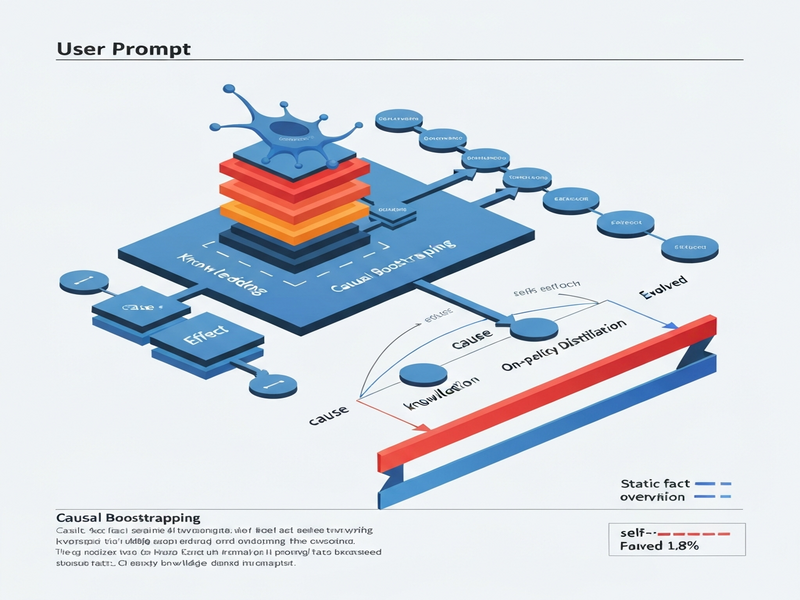
- Demonstration that causal bootstrapping lowers conflict to 6.6% and, with the proposed CODE (Causal On‑policy Distillation for Editing), further reduces it to 1.8%.
- Extensive experiments on LLaMA‑3.1 and Qwen‑2.5 showing up to 83.5% multi‑hop accuracy.
- Open‑source implementation available at GitHub.
Why Causal Editing Matters
In real‑world scenarios, knowledge evolves through cause‑effect relationships. By embedding these causal pathways directly into the model’s parametric memory, CODE enables coherent knowledge evolution rather than isolated fact injection. This approach aligns LLM updates with the underlying logical topology of the model, preserving consistency and improving downstream reasoning.
Technical Overview of CODE
CODE combines two core mechanisms:
- Causal Bootstrapping: Constructs a causal graph from the new information and existing knowledge, ensuring updates respect established dependencies.
- Asymmetric On‑Policy Distillation: Distills the causal graph into the LLM using a self‑distillation loop that emphasizes the new causal pathways while retaining prior knowledge.
Experimental Results
Across benchmark datasets, CODE consistently outperforms baseline editing methods. Notable metrics include:
- Self‑refutation rate: 1.8% (vs. 95.6% for static overwriting)
- Multi‑hop accuracy: up to 83.5%
- Parameter efficiency: comparable to baseline models with no additional inference overhead.
Implications for AI Research
Adopting causal editing paves the way for more reliable, updatable LLMs, essential for applications requiring continuous knowledge integration such as scientific assistants, dynamic knowledge bases, and adaptive chatbots.
Read More on Ubos Tech
Explore related AI research, tutorials, and implementation guides on Ubos Tech. Stay updated with the latest breakthroughs by visiting our blog section.
Andrii Bidochko
CTO UBOS
Andrii Bidochko is an AI entrepreneur and researcher focused on AI agents, reinforcement learning, and autonomous systems. He writes about the technologies shaping the future of machine intelligence, from frontier models and agent architectures to real-world AI applications.