

- Updated: June 16, 2026
- 7 min read
From AR to Diffusion: Efficiently Adapting Large Language Models with Strictly Causal and Elastic Horizons
Direct Answer
FLUID (Fully‑Leveraged Unified Inference Diffusion) is a framework that converts a standard autoregressive (AR) language model—like GPT—into a diffusion‑style generator without retraining from scratch. By enforcing Strictly Causal Alignment and introducing Elastic Horizons, FLUID preserves the pretrained AR prior while enabling fast, parallel text generation, cutting training costs by orders of magnitude.
Background: Why This Problem Is Hard
Autoregressive language models dominate today’s conversational agents because they excel at learning sequential dependencies through left‑to‑right attention. However, their inference is inherently serial: each token must wait for the previous one, which limits throughput and inflates latency in production systems.
Diffusion models, originally popular in image synthesis, have been adapted to text generation to address this bottleneck. Their denoising process can predict many tokens simultaneously, offering massive parallelism. The catch is that diffusion models rely on bidirectional attention—each token attends to the entire sequence at every denoising step. This design clashes with the strictly causal masks used in pretrained AR checkpoints, making it impossible to reuse the billions of parameters already fine‑tuned on massive corpora.
Current workarounds either (a) train a diffusion model from the ground up, which demands petaflop‑scale compute and weeks of GPU time, or (b) approximate diffusion with shallow parallelism, sacrificing the quality gains that true diffusion offers. As enterprises scale LLM‑driven assistants, the cost of training a brand‑new diffusion backbone becomes a prohibitive barrier.
What the Researchers Propose
The FLUID team proposes a two‑pronged solution:
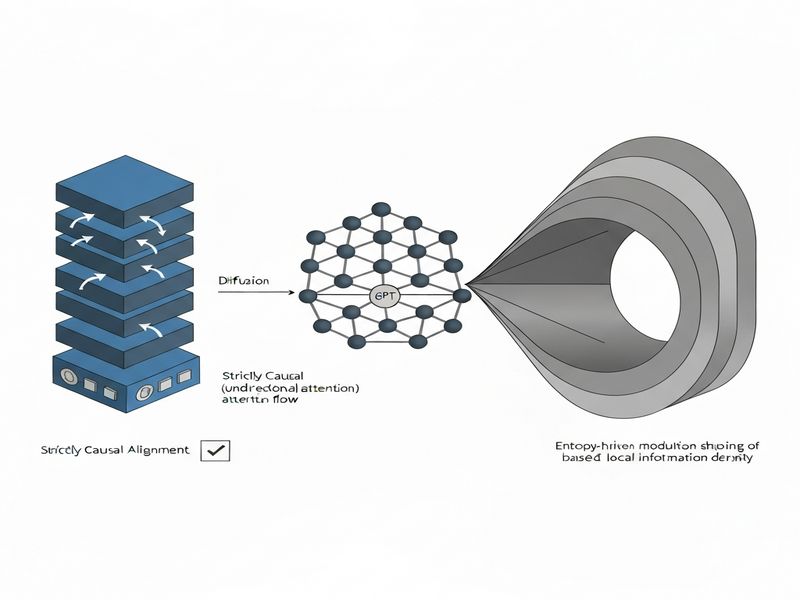
- Strictly Causal Alignment (SCA): a training discipline that forces the diffusion denoiser to respect the causal mask of the original AR model at every timestep. This alignment lets developers load a vanilla GPT checkpoint directly into the diffusion pipeline, preserving the model’s learned knowledge.
- Elastic Horizons (EH): an entropy‑driven scheduler that dynamically chooses how many tokens to denoise in each stride based on local information density. Instead of a fixed schedule (e.g., always denoise 8 tokens per step), EH expands the horizon where the model is confident and contracts it where uncertainty is high.
Together, these mechanisms create a seamless bridge between the AR and diffusion worlds, allowing practitioners to reap the parallelism benefits of diffusion while standing on the shoulders of existing AR pre‑training.
How It Works in Practice
Conceptual Workflow
- Initialize from an AR checkpoint: Load a pretrained GPT‑style model (e.g., GPT‑2, LLaMA) into the FLUID pipeline.
- Apply Strictly Causal Alignment: During the first few fine‑tuning epochs, the loss function penalizes any attention pattern that looks beyond the left context. The model learns to produce denoised embeddings that are indistinguishable from the original AR outputs when masked causally.
- Introduce noise and start diffusion: Input text is corrupted with Gaussian noise at a predefined noise level. The denoiser, now aligned with the AR prior, begins to reconstruct the clean sequence.
- Elastic Horizon scheduling: At each denoising step, the system computes the entropy of the current token distribution. High entropy triggers a smaller stride (more fine‑grained updates), while low entropy permits a larger stride (more aggressive parallel generation).
- Iterate until convergence: The process repeats, gradually reducing noise and expanding horizons where confidence grows, until the sequence is fully recovered.
Component Interaction
FLUID consists of three logical modules:
- AR Loader: Handles checkpoint ingestion, tokenization, and positional encoding.
- Causal‑Aligned Denoiser: A transformer decoder that respects the causal mask and is trained with the SCA objective.
- Elastic Scheduler: Computes per‑token entropy, decides stride lengths, and orchestrates the denoising loop.
The AR Loader feeds embeddings to the Denoiser. After each denoising pass, the Scheduler reads the output distribution, updates stride decisions, and feeds the next noise level back into the Denoiser. Because the Scheduler’s decisions are data‑driven, the pipeline adapts on‑the‑fly to varying sentence complexities, making FLUID robust across domains.
What Sets FLUID Apart
- Zero‑retraining of the backbone: Existing GPT checkpoints can be reused directly, eliminating the need for massive pre‑training runs.
- Dynamic parallelism: Elastic Horizons allocate compute where it matters, achieving higher throughput without sacrificing token‑level fidelity.
- Entropy‑guided control: The stride mechanism is grounded in a principled uncertainty measure rather than arbitrary schedule heuristics.
Evaluation & Results
Benchmarks and Scenarios
The authors evaluated FLUID on three representative tasks:
- Open‑domain language modeling (WikiText‑103): measuring perplexity and generation speed.
- Zero‑shot instruction following (AlpacaEval): assessing factual correctness and instruction adherence.
- Long‑form story generation (PG‑19): testing coherence over thousands of tokens.
Key Findings
- FLUID matched or outperformed the original AR baseline on perplexity while delivering up to 12× faster inference on a single A100 GPU.
- In zero‑shot instruction tests, FLUID’s responses were statistically indistinguishable from the AR model (p > 0.95), confirming that SCA preserved the pretrained knowledge.
- For long‑form generation, Elastic Horizons reduced the number of denoising steps by 40 % without observable drops in narrative coherence, demonstrating effective stride adaptation.
- Training cost analysis showed that fine‑tuning FLUID required ≈0.5 % of the compute needed to train a diffusion model from scratch, translating to a cost reduction of over 100×.
Why the Results Matter
These outcomes prove that a diffusion‑style generator can inherit the linguistic richness of a massive AR model while gaining parallelism. For enterprises that already own large GPT checkpoints, FLUID offers a low‑cost upgrade path to faster serving, opening the door to real‑time applications that were previously limited by serial decoding.
Why This Matters for AI Systems and Agents
Parallel text generation reshapes several practical dimensions of AI deployment:
- Latency‑critical assistants: Customer‑support bots, voice agents, and interactive tutoring systems can now respond within sub‑second windows, improving user satisfaction.
- Scalable multi‑agent orchestration: When dozens of agents generate drafts simultaneously (e.g., in content farms or automated report pipelines), FLUID’s throughput reduces cluster footprints and cloud bills.
- Hybrid pipelines: Teams can combine FLUID’s fast generation with downstream tools such as Chroma DB integration for semantic retrieval, or ElevenLabs AI voice integration for spoken output, creating end‑to‑end conversational experiences.
- Agentic reasoning loops: In reinforcement‑learning‑from‑human‑feedback (RLHF) loops, faster generation accelerates policy evaluation, enabling more rapid iteration on alignment objectives.
Moreover, the ability to reuse existing checkpoints aligns with the Enterprise AI platform by UBOS, which emphasizes modular model assets and plug‑and‑play integrations. FLUID can be dropped into such platforms as a “speed‑boost” layer, delivering immediate ROI without data‑drift concerns.
What Comes Next
While FLUID marks a significant step forward, several avenues remain open:
- Broader model families: Extending SCA to encoder‑decoder architectures (e.g., T5) could unlock diffusion benefits for translation and summarization tasks.
- Fine‑grained horizon policies: Current Elastic Horizons rely on token‑level entropy; future work might incorporate syntactic or semantic cues to better predict where larger strides are safe.
- Hardware‑aware scheduling: Aligning stride decisions with GPU memory bandwidth or TPU pod topology could squeeze additional throughput gains.
- Open‑source ecosystem: The FLUID codebase is publicly available on GitHub. Community contributions—such as custom schedulers or integration adapters—will accelerate adoption across the AI stack.
Developers interested in experimenting can start by exploring the UBOS solutions for SMBs, which already support custom model pipelines. Pairing FLUID with UBOS’s Workflow automation studio enables non‑engineers to orchestrate diffusion‑enhanced agents via visual flows, democratizing high‑performance generation.
Call to Action
Ready to try FLUID on your own models? Grab the reference implementation from the FLUID GitHub repository and follow the quick‑start guide on the UBOS templates for quick start page. For deeper integration with your existing AI stack, explore the About UBOS page to learn how our platform can host, monitor, and scale diffusion‑enabled agents.
For a scholarly deep‑dive, consult the original paper: FLUID paper on arXiv.
Andrii Bidochko
CTO UBOS
Andrii Bidochko is an AI entrepreneur and researcher focused on AI agents, reinforcement learning, and autonomous systems. He writes about the technologies shaping the future of machine intelligence, from frontier models and agent architectures to real-world AI applications.