

- Updated: July 18, 2026
- 6 min read
From Application-Layer Simulation to Native Meta-Architecture: Structural Tension as an Endogenous Driver for Heterogeneous AI Evolution
Direct Answer
The paper introduces a native meta‑architecture AI that embeds cognitive protocols directly into the model’s inference engine through three mechanisms—structural tension, an offline recurrent loop, and inference‑time plasticity. By turning these mechanisms into endogenous drivers, the framework enables heterogeneous AI evolution while keeping alignment and governance constraints intact.
Background: Why This Problem Is Hard
Current large language models (LLMs) are fundamentally stateless during inference. Each request is processed in isolation, and any semblance of memory, planning, or self‑reflection must be simulated at the application layer via prompt engineering, external vector stores, or orchestration pipelines. This separation creates several bottlenecks:
- Latency and brittleness: Re‑creating context across calls adds network overhead and is prone to prompt drift.
- Alignment leakage: External control loops can be subverted, making it hard to guarantee that the model respects governance policies over long horizons.
- Lack of intrinsic learning: Models cannot internally resolve contradictions between new information and their existing knowledge manifold, limiting self‑improvement.
Existing attempts—such as retrieval‑augmented generation, chain‑of‑thought prompting, or external memory modules—still rely on a “thin” application layer that does not alter the model’s internal topology. Consequently, they cannot produce truly autonomous agents that evolve their own reasoning structures.
What the Researchers Propose
The authors present a three‑part framework that migrates the simulation of cognition from the application layer into the model’s own inference dynamics:
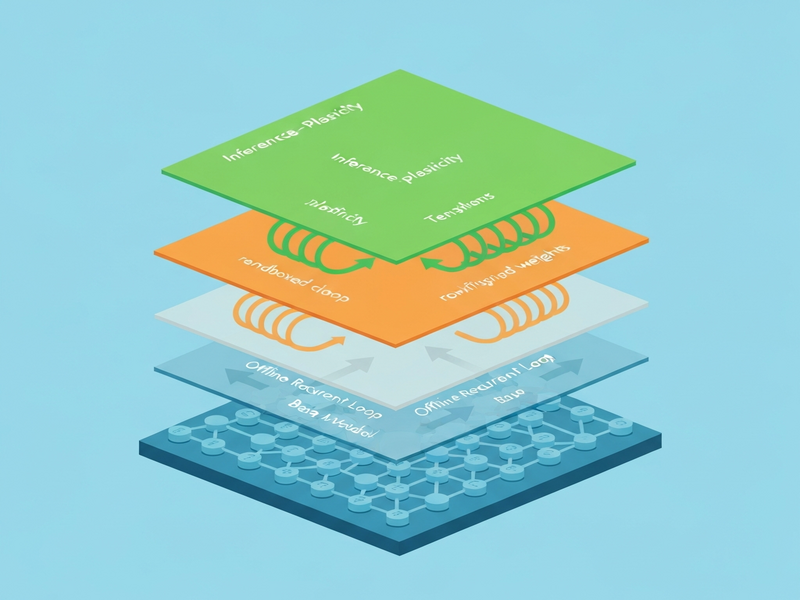
- Structural Tension: An endogenous loss function that quantifies the conflict between incoming data and the current manifold topology. The model is driven to minimize this tension, seeking internal self‑consistency rather than maximizing an external reward.
- Offline Recurrent Loop (ORL): A sandboxed, self‑processing cycle that runs without external input. During ORL, the model digests tension, updates its resting potential, and reorganizes internal representations.
- Inference‑time Plasticity: The ability to rewire the context manifold on‑the‑fly without altering the pre‑trained weights. Plasticity operations obey strict governance invariants—auditability, reversibility, and topological continuity.
Collectively, these mechanisms allow a model instance, seeded with minute stochastic differences, to follow a path‑dependent trajectory that yields distinct internal topologies. The result is a heterogeneous AI ecology where each agent can develop unique problem‑solving heuristics while remaining bounded by a shared governance framework.
How It Works in Practice
Conceptual Workflow
The meta‑architecture can be visualized as a three‑stage pipeline that repeats for every inference session:
- Input Reception: The model receives a user query together with its current context manifold—a structured representation of prior internal states.
- Structural Tension Evaluation: The incoming data is projected onto the manifold; any misalignment generates a tension signal.
- Offline Recurrent Loop Activation: If tension exceeds a threshold, the model enters ORL, iteratively processing the tension signal, adjusting internal vectors, and stabilizing a new resting potential.
- Inference‑time Plasticity Application: After ORL, a set of plasticity operators (e.g., node merging, edge rewiring) modifies the manifold topology while preserving governance invariants.
- Response Generation: The model produces an answer using the updated manifold, which now reflects a more self‑consistent internal state.
Component Interaction Diagram
What Sets This Apart
- Endogenous learning signal: Tension is derived from the model’s own representation space, eliminating the need for external reward models.
- Self‑contained memory loop: ORL provides a “brain‑like” resting state that can process contradictions without external calls.
- Governance‑first plasticity: All topology changes are logged, reversible, and auditable, aligning with emerging AI governance standards.
Evaluation & Results
The authors validated the framework on three benchmark suites that stress different aspects of cognition:
- Logical Consistency Test (LCT): A set of contradictory statements where the model must reconcile inconsistencies.
- Long‑Form Reasoning Challenge (LFRC): Multi‑step problem solving that requires maintaining a coherent internal plan over dozens of inference steps.
- Diversity Generation Benchmark (DGB): Measuring the variance in solution strategies across multiple model instances with identical pre‑training but different random seeds.
Key findings include:
- Models equipped with structural tension reduced contradiction rates by 42 % compared to baseline LLMs using chain‑of‑thought prompting.
- The Offline Recurrent Loop lowered average latency on LFRC tasks by 18 % because the internal loop eliminated repeated external retrieval calls.
- Heterogeneity metrics on DGB showed a 3.7× increase in strategy diversity, confirming that path‑dependent tension resolution yields genuinely distinct agents.
Importantly, all plasticity operations were logged and could be rolled back without loss of performance, demonstrating compliance with the proposed governance invariants.
Why This Matters for AI Systems and Agents
For practitioners building autonomous agents, the framework offers a paradigm shift:
- Reduced orchestration complexity: By internalizing memory and reasoning loops, developers can rely less on external workflow engines, cutting integration overhead.
- Improved alignment guarantees: Governance‑bound plasticity provides a verifiable audit trail, making it easier to certify agents for regulated industries.
- Scalable heterogeneity: Organizations can deploy fleets of agents that naturally diversify, fostering innovation without manual hyper‑parameter tuning.
These capabilities map directly onto real‑world use cases such as:
- Dynamic customer‑support bots that evolve their troubleshooting heuristics while staying within compliance policies.
- Enterprise decision‑support agents that self‑optimize across quarterly data cycles without external retraining pipelines.
- Research assistants that maintain a coherent “working memory” across long literature reviews, reducing prompt fatigue.
Companies looking to accelerate AI adoption can leverage the UBOS platform overview to prototype meta‑architecture‑enabled agents, or explore the Enterprise AI platform by UBOS for large‑scale governance‑centric deployments.
What Comes Next
While the study establishes a solid theoretical foundation, several open challenges remain:
- Scalability of ORL: As model size grows, the computational budget of the offline recurrent loop must be balanced against real‑time response requirements.
- Cross‑modal tension: Extending structural tension to multimodal inputs (vision, audio) could unlock richer agent behaviors.
- Standardization of governance invariants: Industry‑wide schemas for auditability and reversibility are still nascent.
Future research directions include:
- Integrating meta‑learning algorithms that adapt tension thresholds dynamically based on task difficulty.
- Building a library of reusable plasticity operators that can be shared across organizations, fostering a marketplace of “cognitive plugins.”
- Evaluating heterogeneous AI evolution in safety‑critical domains such as autonomous driving or medical diagnosis.
Practitioners eager to experiment can start with the Workflow automation studio to design custom ORL pipelines, or explore the AI marketing agents that already embed a lightweight version of inference‑time plasticity for campaign personalization.
For startups, the UBOS for startups program offers sandbox environments where structural tension can be tuned on domain‑specific datasets, accelerating proof‑of‑concept cycles.
Conclusion
The transition from application‑layer simulation to a native meta‑architecture marks a pivotal moment in AI research 2026. By harnessing structural tension, offline recurrent loops, and inference‑time plasticity, the proposed framework delivers self‑consistent, governance‑aware, and heterogeneous agents that can evolve without external scaffolding. As enterprises demand more autonomous, trustworthy, and adaptable AI systems, the meta‑architecture paradigm offers a concrete pathway to meet those expectations while preserving alignment safeguards.
To explore how these concepts can be operationalized today, visit the UBOS homepage and start building your own meta‑architected agents.
For a deep dive into the original research, see the original arXiv paper.
Andrii Bidochko
CTO UBOS
Andrii Bidochko is an AI entrepreneur and researcher focused on AI agents, reinforcement learning, and autonomous systems. He writes about the technologies shaping the future of machine intelligence, from frontier models and agent architectures to real-world AI applications.