

- Updated: July 13, 2026
- 7 min read
Formal Mechanisms for Market Stability in Self-Interested Agent Societies: A Marketplace Simulation Study
Direct Answer
The paper introduces a suite of formal mechanisms—most notably a Mediation protocol—that keep a marketplace of self‑interested large language model (LLM) agents stable even when malicious “troll” agents are injected. This matters because it demonstrates a concrete, empirically validated way to preserve cooperative trade in AI‑driven economies, a prerequisite for reliable autonomous commerce.
Background: Why This Problem Is Hard
In real‑world digital economies, autonomous agents act on their own profit motives. When agents repeatedly interact in a social dilemma, game‑theoretic analysis predicts a drift toward defection: each agent hoards resources, refuses to honor contracts, and the overall system collapses. Existing solutions—reputation scores, escrow services, or simple rule‑based contracts—often assume honest participation or rely on centralized enforcement, which limits scalability and opens new attack surfaces.
Two practical bottlenecks illustrate the difficulty:
- Unrestricted communication: Modern LLM agents can negotiate, persuade, and even collude through natural language, making it hard to detect subtle betrayals.
- Adversarial injection: Bad actors can introduce “troll” agents that deliberately sabotage trade, mimicking honest agents while exploiting loopholes.
Current literature on multi‑agent marketplaces (e.g., auction theory, blockchain escrow) does not fully address the combination of open‑ended dialogue and adaptive adversarial behavior. Consequently, designers lack a proven, systematic method to guarantee that a network of profit‑maximizing agents will continue to generate positive utility for the honest participants.
What the Researchers Propose
The authors construct a formal mechanism layer that sits atop unrestricted natural‑language communication. They evaluate eight distinct mechanisms, ranging from simple “No‑Regulation” baselines to sophisticated “Mediation” protocols that introduce a neutral arbitrator capable of reviewing and amending trade agreements.
Key components of the proposed framework include:
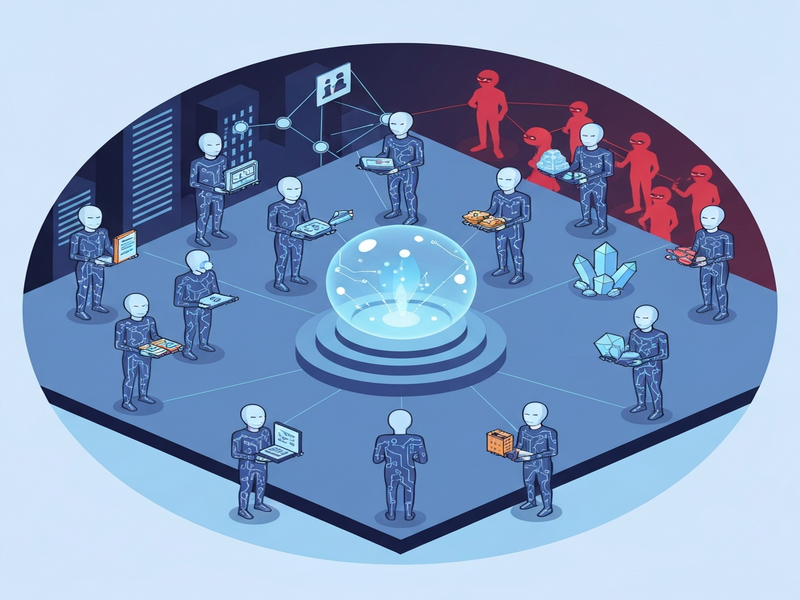
- Agents: 18 LLM agents (DeepSeek‑V3) each specialize in a production niche (e.g., raw material extraction, component assembly, final product packaging).
- Social Network: A constrained graph defines which agents can directly negotiate, reflecting realistic supply‑chain relationships.
- Mechanism Layer: A set of rules that govern how offers are made, accepted, and, if necessary, mediated.
- Adversarial Trolls: Injected agents that attempt to disrupt trade by refusing to honor contracts or by providing misleading information.
Among the eight mechanisms, the Mediation protocol stands out. It appoints a dedicated mediator agent that can:
- Collect the full transcript of a trade negotiation.
- Validate that the agreed terms satisfy pre‑defined fairness constraints.
- Rewrite or nullify contracts that violate those constraints, then broadcast the corrected agreement to the involved parties.
How It Works in Practice
The simulation proceeds in discrete rounds. Each round follows a deterministic workflow:
- Negotiation Initiation: Two neighboring agents exchange proposals via natural language.
- Offer Evaluation: Both parties assess the utility of the proposal based on their production costs and market demand.
- Mechanism Enforcement: Depending on the active mechanism, the trade either proceeds directly, is logged for later review, or is sent to the mediator.
- Mediation (if triggered): The mediator parses the dialogue, checks for hidden clauses or exploitative terms, and either approves the trade or issues a corrected contract.
- Execution: Approved contracts result in resource exchange, updating each agent’s utility score.
- Adversarial Injection: After a predefined number of rounds, a batch of troll agents is introduced, attempting to destabilize the market.
What differentiates this approach from prior work is the combination of unrestricted language interaction with a formal, enforceable arbitration layer. Rather than limiting agents to structured messages, the system allows them to converse freely, preserving the expressive power of LLMs while still guaranteeing that a higher‑order rule set can intervene when necessary.
Evaluation & Results
The researchers ran two experimental phases over 200 simulation rounds each.
Phase 1: Mechanism Comparison
Eight mechanisms were tested under a progressive troll‑injection schedule (0 % → 30 % troll agents). Utility was measured as the average net gain of honest agents per round.
- No‑Regulation: Utility plummeted to negative values once trolls reached 10 %.
- Simple Reputation: Slightly delayed collapse but still failed beyond 15 % trolls.
- Escrow‑Only: Prevented immediate loss but could not recover from coordinated defection.
- Mediation: Maintained positive utility across the entire troll spectrum, with only a 4 % dip at the highest injection level.
These results demonstrate that Mediation not only outperforms baseline controls but also exhibits graceful degradation under increasing adversarial pressure.
Phase 2: Red‑Team Adversarial Attack
To stress‑test Mediation, the authors employed an iterative prompt‑optimization loop that generated increasingly sophisticated troll agents (versions v1‑v6). The final attack (v6) reduced honest‑agent utility by 13.3 % relative to a troll‑free baseline—a noticeable impact but far short of market collapse.
Crucially, the mediator recovered from each attack iteration, re‑establishing a positive utility trajectory within five rounds after the attack peaked. This resilience validates the authors’ definition of adversarial robustness: a mechanism’s ability to sustain positive honest‑agent utility even when faced with optimized, persistent threats.
Why This Matters for AI Systems and Agents
For practitioners building autonomous marketplaces—whether for supply‑chain automation, decentralized finance, or AI‑driven content marketplaces—the findings provide a concrete blueprint:
- Designing Trust Layers: Embedding a mediation component can replace costly on‑chain arbitration or manual dispute resolution.
- Scalable Negotiation: Allowing agents to converse in natural language preserves flexibility while still enforcing enforceable contracts.
- Robustness by Design: The demonstrated adversarial robustness means that system operators can tolerate a non‑trivial proportion of malicious participants without risking total collapse.
These insights map directly onto UBOS’s product suite. For example, the UBOS platform overview highlights a modular architecture where a mediation service could be plugged into existing workflow pipelines. Similarly, the Workflow automation studio can orchestrate the mediator’s decision‑making logic alongside other automation steps, enabling end‑to‑end market stability without custom code.
Enterprises looking to deploy AI agents for Enterprise AI platform by UBOS can leverage the paper’s methodology to benchmark their own mechanisms, ensuring that the utility of honest agents remains positive even under hostile conditions.
What Comes Next
While the study makes a strong case for mediation, several open challenges remain:
- Scalability to Thousands of Agents: The simulation used 18 agents; real‑world deployments may involve orders of magnitude more participants.
- Dynamic Network Topologies: Agents in production often join or leave the network, altering the social graph.
- Cross‑Domain Contracts: Extending mediation to multi‑modal agreements (e.g., combining data, compute, and financial assets) requires richer constraint languages.
Future research could explore hierarchical mediators, where local mediators handle sub‑markets and report to a global arbitrator, mirroring federated governance models. Additionally, integrating Chroma DB integration could provide a persistent knowledge base for the mediator, enabling it to reference historical contract patterns and improve detection of novel attack vectors.
From a product perspective, UBOS could offer a turnkey “Marketplace Stability Kit” that bundles a pre‑trained mediator LLM, monitoring dashboards, and automated red‑team testing tools. Such a kit would let developers quickly prototype robust AI‑driven economies, reducing time‑to‑market for applications ranging from AI‑powered supply‑chain platforms to decentralized content marketplaces.
Finally, the community would benefit from open benchmarks that standardize the evaluation of market‑stability mechanisms. By publishing the simulation code and datasets, researchers can compare new approaches against the Mediation baseline established in this paper.
References
Ng Yi Sheng, Eugene; Shen, Bingquan. “Formal Mechanisms for Market Stability in Self‑Interested Agent Societies: A Marketplace Simulation Study.” Original arXiv paper. arXiv:2607.08652v1, 2026.
Andrii Bidochko
CTO UBOS
Andrii Bidochko is an AI entrepreneur and researcher focused on AI agents, reinforcement learning, and autonomous systems. He writes about the technologies shaping the future of machine intelligence, from frontier models and agent architectures to real-world AI applications.