

- Updated: July 5, 2026
- 8 min read
FiLM-Coordinated Dual-Branch Transformer for Global-Local Dependency Modeling in Language Modeling
Direct Answer
The paper introduces a FiLM‑coordinated dual‑branch Transformer that separates global‑range reasoning from local pattern extraction within each layer, and uses feature‑wise linear modulation (FiLM) to let the two branches dynamically influence one another. This design improves language‑modeling performance on small‑scale datasets while keeping the model lightweight, addressing the long‑standing tension between capturing long‑range dependencies and learning fine‑grained token details.
Background: Why This Problem Is Hard
Standard Transformer architectures rely on a single self‑attention pathway that must simultaneously learn two very different kinds of relationships:
- Global dependencies: long‑range syntactic and semantic structures that span entire sentences or documents.
- Local patterns: short‑range token interactions such as morphology, collocations, and punctuation cues.
When a single attention matrix tries to serve both purposes, it often compromises one for the other. In practice, this manifests as:
- Reduced ability to model hierarchical language structures, especially in low‑resource settings.
- Excessive computational overhead when scaling attention heads to capture fine‑grained details.
- Training instability because the same parameters receive conflicting gradient signals from global and local objectives.
Researchers have attempted to mitigate these issues with techniques such as hierarchical Transformers, convolution‑augmented attention, or widened single‑branch models. However, most of these solutions either add heavy token‑level interactions (which increase memory footprints) or rely on static architectural tricks that cannot adapt to the specific content of each input sequence. The problem remains acute for applications that demand both high‑quality language modeling and strict latency or parameter budgets—think on‑device assistants, real‑time chatbots, or embedded analytics.
What the Researchers Propose
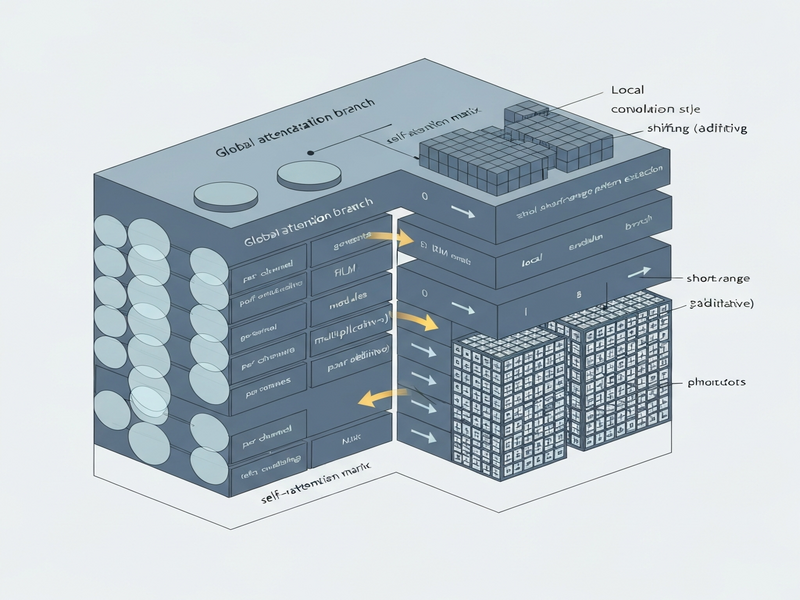
The authors present a dual‑branch architecture where each Transformer layer contains two parallel processing streams:
- Global branch: a conventional self‑attention module that aggregates information across the entire sequence, preserving long‑range context.
- Local branch: a lightweight convolution‑like or restricted‑window attention module that focuses on neighboring tokens, capturing fine‑grained patterns.
Rather than merging the two branches with a simple concatenation or addition, the paper leverages Feature‑wise Linear Modulation (FiLM). Each branch generates per‑channel scaling (γ) and shifting (β) parameters that are applied to the other branch’s activations. This bidirectional FiLM module enables dynamic, input‑dependent calibration of the two views without incurring the token‑level cost of full attention cross‑talk.
Key components:
- Bidirectional FiLM layer: computes γ and β from the global branch to modulate the local branch, and vice‑versa.
- Channel‑wise coordination: modulation occurs at the feature‑channel level, which is computationally cheap and aligns naturally with the way Transformers already process hidden dimensions.
- Lightweight design: both branches retain the same width as a standard single‑branch Transformer, ensuring a fair comparison in parameter count.
How It Works in Practice
The workflow of a single dual‑branch layer can be broken down into three conceptual steps:
- Parallel processing: The input token embeddings are fed simultaneously into the global self‑attention module and the local pattern module. Each produces a hidden representation of identical dimensionality.
- FiLM generation: From the global output, a small feed‑forward network predicts a set of scaling (γg→l) and shifting (βg→l) vectors. The local branch does the same, yielding γl→g and βl→g.
- Cross‑modulation: The local representation is multiplied by γg→l and added to βg→l, while the global representation receives the complementary modulation from the local branch. The modulated tensors are then summed (or concatenated, depending on implementation) and passed through a standard feed‑forward network and residual connection.
This process repeats for every layer in the stack, allowing each level to refine its view of the sequence based on the complementary perspective from the other branch. Because FiLM operates channel‑wise, the overhead is limited to a few additional linear projections per layer, which is negligible compared to the quadratic cost of full self‑attention.
What sets this approach apart from earlier multi‑branch designs is the dynamic nature of the coordination. Instead of a static weighting scheme, the model learns to amplify or suppress specific channels in response to the content of the current sentence, effectively “telling” the local branch which patterns matter for the current global context, and vice versa.
Evaluation & Results
The authors evaluated the dual‑branch FiLM model on two well‑known small‑scale language‑modeling benchmarks:
- TinyShakespeare: a 1‑M‑character corpus derived from Shakespeare’s works, commonly used to test character‑level models.
- 1M‑character subset of WikiText‑2: a curated slice of Wikipedia articles that preserves a realistic distribution of topics and vocabularies.
Experimental settings kept the total number of parameters constant across baselines, ensuring a fair comparison between:
- Standard single‑branch Transformers of the same width.
- Widened single‑branch Transformers matched for parameter count.
- Dual‑branch variants without FiLM (simple addition or concatenation).
- The proposed FiLM‑coordinated dual‑branch model.
Key findings:
- The FiLM‑enabled dual‑branch consistently outperformed the single‑branch baselines on both datasets, achieving lower perplexity scores while using the same compute budget.
- When the dual‑branch architecture was stripped of FiLM (i.e., static merging), performance dropped close to the single‑branch level, highlighting the importance of dynamic cross‑modulation.
- Multi‑seed experiments (five random initializations) showed low variance, indicating that the gains are stable and not a product of lucky initialization.
- Mechanistic analyses revealed that FiLM parameters vary with input length, layer depth, and channel identity, confirming that the model learns nuanced, context‑dependent modulation patterns.
These results demonstrate that separating global and local processing, while allowing them to influence each other through FiLM, yields a more expressive yet efficient language model—particularly valuable when scaling up is not an option.
Why This Matters for AI Systems and Agents
For practitioners building AI agents, chatbots, or any system that relies on language generation, the dual‑branch FiLM design offers several practical advantages:
- Improved token‑level fidelity: Local branches preserve morphological and punctuation nuances that are often lost in overly global attention patterns, leading to more natural‑sounding outputs.
- Better long‑range coherence: The global branch maintains discourse‑level consistency, reducing the risk of contradictory statements in multi‑turn conversations.
- Parameter‑efficient scaling: Because the model achieves higher quality without increasing width, developers can deploy stronger language models on edge devices or within strict latency budgets.
- Modular integration: The FiLM coordination layer can be inserted into existing Transformer stacks with minimal code changes, making it a drop‑in upgrade for platforms that already support custom layers.
These benefits translate directly into more reliable AI assistants, higher conversion rates for AI marketing agents, and smoother user experiences in real‑time chat interfaces. Moreover, the channel‑wise modulation aligns well with modern UBOS platform overview services that expose fine‑grained control over model pipelines, enabling developers to experiment with global‑local trade‑offs without rebuilding the entire stack.
What Comes Next
While the FiLM‑coordinated dual‑branch Transformer marks a clear step forward, several open challenges remain:
- Parameter efficiency: The paper’s own ablations show that a widened single‑branch model can approach the dual‑branch performance when given enough parameters. Future work could explore more aggressive parameter sharing or sparsity techniques to close this gap.
- Generalization to larger corpora: Experiments were limited to sub‑million‑character datasets. Scaling the architecture to full‑size language models (e.g., billions of tokens) will test whether the FiLM dynamics remain stable.
- Alternative modulation strategies: FiLM is one way to exchange information channel‑wise. Researchers might investigate attention‑based cross‑branch gating, dynamic routing, or even reinforcement‑learning‑driven coordination.
- Integration with retrieval‑augmented generation: Combining the dual‑branch approach with external knowledge bases (e.g., Chroma DB integration) could further boost factual accuracy while preserving local fluency.
- Tooling and observability: Providing developers with visual dashboards to monitor FiLM scaling and shifting patterns in production would aid debugging and fine‑tuning.
Potential applications extend beyond pure language modeling. For instance, the architecture could be adapted for multimodal transformers where visual and textual streams require distinct yet coordinated processing, or for reinforcement‑learning agents that need to balance strategic planning (global) with immediate reaction (local). The modular nature of FiLM also makes it a natural fit for Workflow automation studio, where different workflow stages could be treated as “branches” that dynamically influence each other.
Developers interested in experimenting with the model can start by cloning the authors’ repository (linked in the paper) and swapping the standard attention block with the dual‑branch FiLM module. The Openclaw (Clawdbot, MoltBot) suite already supports custom transformer layers, offering a ready‑made sandbox for rapid prototyping.
For a deeper dive into the original research, see the FiLM‑Coordinated Dual‑Branch Transformer paper.
Andrii Bidochko
CTO UBOS
Andrii Bidochko is an AI entrepreneur and researcher focused on AI agents, reinforcement learning, and autonomous systems. He writes about the technologies shaping the future of machine intelligence, from frontier models and agent architectures to real-world AI applications.