

- Updated: July 22, 2026
- 2 min read
Fictional Worldbuilding: Multi-Agent LLM Collaboration with Hierarchical Context Compression and Iterative Review
Fictional Worldbuilding: Multi‑Agent LLM Collaboration with Hierarchical Context Compression and Iterative Review
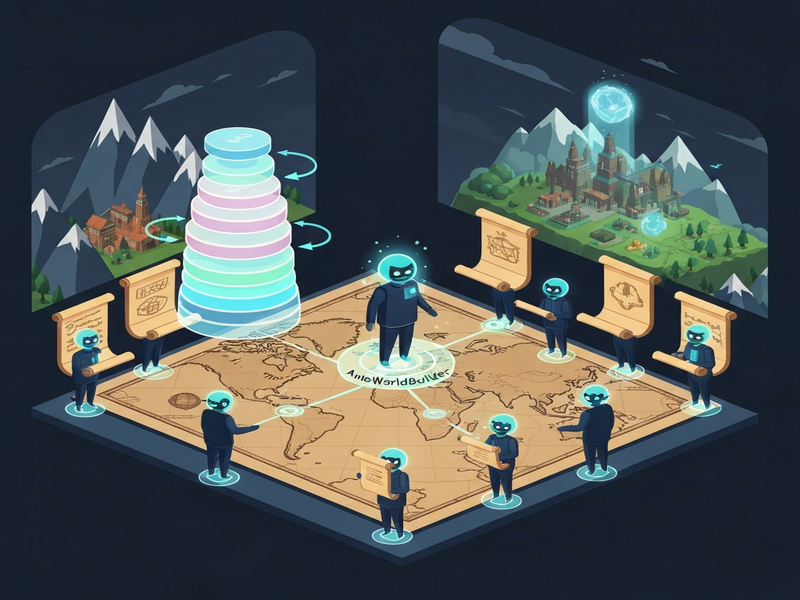
Worldbuilding is a core activity in game design, storytelling, and immersive media. Recent advances in large language models (LLMs) open new possibilities for automated content generation, yet three major challenges remain:
- Context explosion – the amount of information grows linearly as the world expands.
- Balancing creative diversity with narrative consistency.
- Lack of automated quality‑assurance mechanisms.
The paper AutoWorldBuilder introduces a multi‑agent collaborative system that tackles these issues through five integrated components:
- Structured concept network with conflict detection – ensures logical coherence across generated concepts.
- DAG‑based hybrid batch scheduler – groups tasks by semantic locality to limit token growth.
- Four‑layer context compression – reduces token usage by ~90 % without sacrificing detail.
- Iterative review system – specialized Auditor agents raise proposal pass rates from 42 % to over 85 %.
- Skill‑driven agent architecture – supports zero‑code extensions and differentiated temperature settings for creativity control.
Experimental Validation
Two experiments covering 20 diverse worldbuilding tasks were conducted using GPT‑OSS 120B and DeepSeek v3.2 as back‑ends. Results demonstrate a 95 % overall success rate, generating 56‑103 self‑consistent concepts per world within 18‑31 minutes and delivering zero‑conflict outputs.
Implications and Future Work
The architectural patterns—layer‑as‑budget compression, semantic‑locality scheduling, and separation of generation and review—are transferable to a broad class of knowledge‑intensive, multi‑agent LLM applications. Ongoing research will explore real‑time user interaction, cross‑modal content generation, and adaptive auditing strategies.
For a deeper dive into the methodology and results, read the full paper on arXiv. Stay tuned to Ubos.Tech for more insights on cutting‑edge AI research.
Andrii Bidochko
CTO UBOS
Andrii Bidochko is an AI entrepreneur and researcher focused on AI agents, reinforcement learning, and autonomous systems. He writes about the technologies shaping the future of machine intelligence, from frontier models and agent architectures to real-world AI applications.