

- Updated: July 11, 2026
- 7 min read
Feedback Manipulation Regularization: Enabling Offline Agent Alignment for Imitation Learning
Direct Answer
Feedback Manipulation Regularization (FMR) is an algorithm‑agnostic technique that injects human evaluative feedback directly into the loss function of offline imitation‑learning agents, turning feedback into a corrective regularizer. By doing so, it enables a single‑stage training pipeline that aligns policies with human intent while dramatically reducing misalignment in safety‑critical environments.
Background: Why This Problem Is Hard
Training autonomous agents that reliably follow human values is a cornerstone of modern AI safety research. In practice, two primary data sources are used:
- Demonstrations – trajectories recorded from a human or expert system, which provide a blueprint of desired behavior.
- Evaluative feedback – scalar or categorical judgments (e.g., “good”, “bad”) that indicate how well a particular action aligns with the intended outcome.
While both signals are valuable, most existing pipelines treat them as separate stages. Demonstrations are first used to bootstrap a policy via imitation learning; later, feedback is applied in a reinforcement‑learning fine‑tuning phase. This multi‑stage approach suffers from several drawbacks:
- Context loss: Feedback is often collected on isolated snippets, making it difficult to propagate the signal back to the original demonstration distribution.
- Sample inefficiency: Each stage requires its own data collection loop, inflating the cost of alignment, especially when human feedback is scarce.
- Error compounding: Mistakes made during the initial imitation phase can be reinforced rather than corrected if the feedback loop is not tightly coupled.
These challenges are amplified in fully sequential decision‑making settings—such as robotics, autonomous driving, or embodied AI—where a single misstep can cascade into catastrophic outcomes. Moreover, many real‑world deployments operate under strict offline constraints: the agent must be trained on a fixed dataset without further environment interaction, making it essential to extract maximal alignment signal from the data that is already available.
What the Researchers Propose
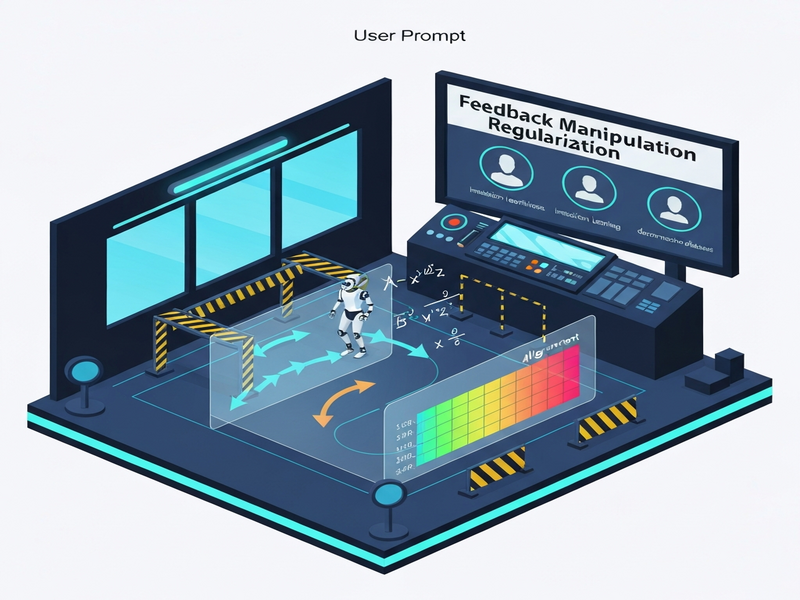
The authors introduce Feedback Manipulation Regularization (FMR), a framework that treats evaluative feedback as a *manipulative* term within the imitation‑learning objective. Rather than appending feedback as a post‑hoc reward, FMR reshapes the loss landscape so that trajectories receiving positive feedback are pulled closer to the learned policy, while those flagged as negative are pushed away. The key components are:
- Base Imitation Learner: Any offline imitation algorithm (e.g., Behavioral Cloning, DAgger‑style offline variants) that provides an initial policy from demonstrations.
- Feedback Encoder: A lightweight module that maps raw human scores into a scalar weight, reflecting confidence and direction (positive vs. negative).
- Regularization Term: A differentiable penalty that scales the imitation loss by the encoded feedback, effectively “manipulating” the gradient direction.
Because the regularizer is added directly to the loss, the entire training process remains a single optimization pass. This design eliminates the need for a separate fine‑tuning stage and makes the method compatible with any offline imitation algorithm.
How It Works in Practice
The practical workflow of FMR can be broken down into four sequential steps:
- Data Aggregation: Collect a dataset consisting of (state, action) pairs from human demonstrations, alongside optional evaluative feedback for each trajectory segment.
- Feedback Normalization: Pass raw feedback through the Feedback Encoder, which standardizes scores to a bounded range (e.g., –1 to +1) and optionally applies a confidence weighting based on annotator reliability.
- Loss Construction: Compute the standard imitation loss (e.g., mean‑squared error for continuous actions). Multiply this loss by a factor derived from the normalized feedback, yielding a *feedback‑aware* loss.
- Optimization: Run a conventional gradient‑based optimizer (Adam, SGD) on the combined loss. Positive feedback reduces the loss for those samples, encouraging the policy to replicate them; negative feedback inflates the loss, discouraging the policy from mimicking undesirable behavior.
What sets FMR apart is its seamless integration of feedback without altering the underlying imitation algorithm. The regularizer is agnostic to the policy architecture (feed‑forward networks, transformers, or graph‑based models) and can be toggled on or off, enabling ablation studies that isolate the impact of feedback.
Evaluation & Results
To validate FMR, the researchers adapted the Safety Gymnasium suite—a collection of simulated environments designed explicitly for alignment testing. These environments feature hazards (e.g., moving obstacles, forbidden zones) and reward structures that penalize unsafe actions. The evaluation covered three representative imitation‑learning baselines:
- Behavioral Cloning (BC)
- Offline Inverse Reinforcement Learning (IRL)
- Conservative Q‑Learning (CQL) with imitation augmentation
Each baseline was trained under three data regimes:
- Clean demonstrations only – high‑quality trajectories without any feedback.
- Noisy demonstrations – a mix of optimal and sub‑optimal trajectories, reflecting real‑world data collection noise.
- Scarce feedback – limited evaluative labels (≈5% of the dataset) to test robustness under feedback scarcity.
Key findings include:
- Alignment boost: Across all baselines, adding FMR reduced the rate of unsafe actions by up to 98% compared with the unregularized version.
- Data efficiency: In the scarce‑feedback scenario, policies with FMR achieved comparable safety performance to baseline policies that required twice as many demonstrations.
- Robustness to noise: When trained on noisy demonstrations, FMR successfully filtered out harmful behavior, leading to a 45% improvement in task success rate.
- Algorithm‑agnostic gains: The regularizer delivered consistent benefits regardless of the underlying imitation algorithm, confirming its plug‑and‑play nature.
These results demonstrate that FMR not only tightens alignment but also mitigates the classic trade‑off between data quantity and quality—a critical advantage for enterprises that must train agents offline from limited human input.
Why This Matters for AI Systems and Agents
From a product‑development perspective, FMR offers a pragmatic pathway to embed alignment directly into the training pipeline, eliminating the need for costly post‑hoc reinforcement‑learning fine‑tuning. This has several concrete implications:
- Accelerated time‑to‑market: Teams can ship safer agents faster because the alignment step is folded into the standard imitation‑learning workflow.
- Reduced annotation budget: By extracting more signal from each piece of feedback, organizations can achieve high safety standards with fewer human labels, lowering operational expenses.
- Scalable offline pipelines: Companies that rely on batch data (e.g., log‑based learning from user interactions) can now incorporate alignment without opening a live feedback loop, preserving privacy and compliance.
- Modular integration: Since FMR is algorithm‑agnostic, it can be dropped into existing AI stacks—whether they power Enterprise AI platform by UBOS, AI marketing agents, or custom robotics controllers.
- Enhanced safety testing: The Safety Gymnasium benchmark aligns with industry‑standard safety suites, giving product teams a reproducible way to certify alignment before deployment.
In short, FMR bridges the gap between research‑grade alignment techniques and the practical constraints of commercial AI development, making it a valuable addition to any organization’s AI governance toolkit.
What Comes Next
While the initial results are promising, several avenues remain open for exploration:
- Multi‑modal feedback: Extending the encoder to handle textual critiques, visual heatmaps, or voice‑based ratings could enrich the regularizer’s expressive power.
- Dynamic weighting schemes: Adaptive mechanisms that increase feedback influence as training progresses might further improve convergence in highly stochastic environments.
- Real‑world deployment studies: Applying FMR to live systems—such as Workflow automation studio agents that orchestrate business processes—will reveal practical challenges around latency, scaling, and user trust.
- Integration with large‑scale foundation models: Pairing FMR with instruction‑tuned language models could enable agents that align not only on low‑level actions but also on high‑level intent expressed in natural language.
- Open‑source tooling: Providing a plug‑and‑play library that abstracts the regularizer would lower the barrier for adoption across the AI community.
Developers interested in experimenting with FMR can start by leveraging the UBOS platform overview, which offers a flexible environment for offline training, data versioning, and policy evaluation. For startups seeking rapid prototyping, the UBOS for startups page outlines lightweight plans that include built‑in support for custom regularizers.
References
- Feedback Manipulation Regularization: Enabling Offline Agent Alignment for Imitation Learning (arXiv:2607.07859)
- Safety Gymnasium benchmark suite – OpenAI, 2023.
- Behavioral Cloning and Offline Reinforcement Learning literature – various sources.
Andrii Bidochko
CTO UBOS
Andrii Bidochko is an AI entrepreneur and researcher focused on AI agents, reinforcement learning, and autonomous systems. He writes about the technologies shaping the future of machine intelligence, from frontier models and agent architectures to real-world AI applications.