

- Updated: July 12, 2026
- 7 min read
FedOPAL: One-Shot Federated Learning via Analytic Visual Prompt Tuning
Direct Answer
FedOPAL introduces a one‑shot federated learning framework that uses analytic visual prompt tuning to align heterogeneous edge data without any server‑side training. By turning visual prompts into lightweight feature rectifiers, it eliminates the communication bottleneck while preserving model accuracy, opening a practical path for large‑scale collaboration of foundation models on resource‑constrained devices.
Background: Why This Problem Is Hard
Edge intelligence has exploded in the past few years, with smartphones, IoT sensors, and autonomous drones all running powerful vision models locally. The promise of federated learning (FL) is to let these devices improve a shared model without exposing raw data. In practice, two intertwined challenges have stalled widespread adoption:
- Communication bandwidth. Traditional FL requires dozens or hundreds of round‑trips, each transmitting millions of model parameters. On cellular or satellite links, this quickly becomes infeasible.
- Statistical heterogeneity. Edge devices collect data that are non‑independent and non‑identically distributed (non‑IID). When data distributions diverge, the aggregated model drifts, and convergence slows dramatically.
Existing one‑shot or “single‑round” FL methods try to sidestep the bandwidth issue by sending a single model update. Most of them rely on iterative fine‑tuning or knowledge distillation on the server, which re‑introduces heavy computation and hyper‑parameter sensitivity. Analytic FL approaches, which solve a closed‑form least‑squares problem, avoid gradient calculations but assume a static, linearly separable feature space—an assumption that collapses under non‑IID data, leading to severe performance loss.
What the Researchers Propose
The FedOPAL framework reframes visual prompts—not as mere task‑specific tokens—but as adaptive “feature rectifiers.” These prompts are learned locally on each device under a proximal constraint that keeps them close to a shared global prompt. The key ideas are:
- Prompt‑driven feature alignment. Each client injects a small visual prompt into its input pipeline, effectively shifting the raw feature distribution toward a common, linearly separable manifold.
- Local proximal regularization. Clients solve a lightweight least‑squares problem that balances two goals: (a) fitting their own data after prompt correction, and (b) staying near the global prompt to guarantee analytic aggregation.
- Zero‑cost server aggregation. Because the transformed features satisfy the analytic FL assumptions, the server can aggregate client updates with a single closed‑form matrix inversion—no back‑propagation, no GPU cycles.
In essence, FedOPAL turns the heterogeneity problem into a controllable linear algebra problem, allowing the server to remain a passive aggregator while each edge device performs a one‑shot, prompt‑guided adaptation.
How It Works in Practice
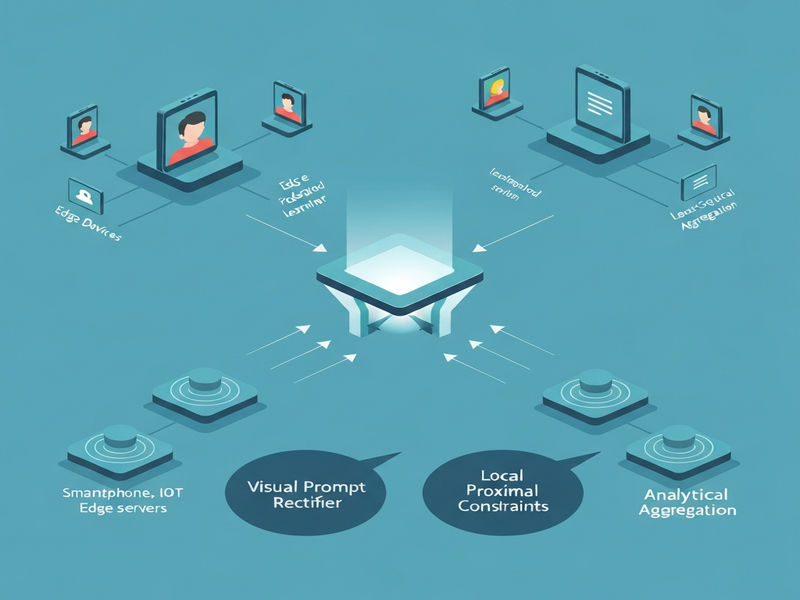
The operational workflow of FedOPAL can be broken down into three distinct phases that repeat only once per training cycle:
1. Global Prompt Initialization
The central server broadcasts an initial visual prompt vector—typically a random or pretrained embedding—along with the base vision model (e.g., a ResNet or ViT). This prompt is small (a few hundred parameters) and therefore cheap to transmit.
2. Local Prompt Tuning with Proximal Constraint
Each edge client performs the following steps:
- Insert the received global prompt into its data preprocessing pipeline, effectively augmenting every input image.
- Run a closed‑form least‑squares solver that minimizes the classification loss on its local dataset while penalizing deviation from the global prompt (the proximal term).
- Output two items: the locally tuned prompt and a lightweight summary matrix that captures the transformed feature statistics.
Because the solver is analytic, the computation reduces to matrix multiplications and a single inversion—operations that run comfortably on modern mobile CPUs.
3. Server‑Side Analytic Aggregation
The server collects the tuned prompts and summary matrices from all participants. Using the analytic federated learning formula, it computes a global prompt that best aligns the aggregated feature space. No gradient descent, no epoch loops, and no GPU are required. The updated global prompt is then broadcast back to the clients for the next round (or for deployment).
The entire cycle completes in a single communication round, making FedOPAL uniquely suited for bandwidth‑starved environments.
Evaluation & Results
To validate the approach, the authors conducted experiments on three widely used visual benchmarks that simulate edge heterogeneity:
- DomainNet. Ten distinct visual domains (e.g., clipart, sketch) with severe distribution shift.
- Office‑Home. Four office environments with varying lighting and object arrangements.
- FedCIFAR‑10. A federated split of CIFAR‑10 where each client receives a biased class subset.
Each dataset was partitioned across 20 simulated edge devices. The evaluation compared FedOPAL against three baselines:
- Standard analytic FL (no prompt tuning).
- One‑shot knowledge distillation.
- Iterative FedAvg with five communication rounds.
Key findings include:
- Accuracy boost. FedOPAL closed the gap between analytic FL and full‑round FedAvg, achieving within 1–2 % of the iterative baseline on all three benchmarks.
- Communication savings. Because only prompts (≈0.1 % of model size) and summary matrices were transmitted, total bandwidth usage dropped by more than 95 % compared to FedAvg.
- Zero server compute. The server’s aggregation step completed in under 200 ms on a standard CPU, confirming the claim of “zero server‑side training cost.”
- Robustness to non‑IID. Even when each client held data from a single domain, FedOPAL’s prompt alignment restored linear separability, preventing the catastrophic collapse observed in vanilla analytic FL.
These results demonstrate that FedOPAL delivers the practical benefits of one‑shot FL without sacrificing the predictive power of multi‑round methods.
Why This Matters for AI Systems and Agents
For practitioners building AI agents that must operate at the edge—such as autonomous drones, retail checkout cameras, or personalized recommendation bots—FedOPAL offers a concrete engineering advantage:
- Scalable collaboration. Large foundation models can be fine‑tuned across thousands of devices without overwhelming cellular networks.
- Predictable latency. With a single communication round, system designers can guarantee response times, a critical factor for real‑time agents.
- Reduced operational cost. Zero server‑side training eliminates the need for expensive GPU clusters, aligning with budget constraints of many enterprises.
- Privacy‑preserving updates. Only prompts and summary statistics leave the device, keeping raw images and labels strictly local.
These capabilities map directly onto the UBOS platform overview, where developers can orchestrate prompt‑driven federated pipelines alongside existing workflow automation tools. For example, a retailer could attach a Telegram integration on UBOS to receive real‑time alerts when a visual prompt fails to align, enabling rapid human‑in‑the‑loop correction.
What Comes Next
While FedOPAL marks a significant step forward, several open challenges remain:
- Prompt size vs. expressiveness. Finding the sweet spot between a tiny prompt (for bandwidth) and a rich enough representation to handle extreme domain shifts is an active research area.
- Cross‑modal extensions. Applying the same analytic prompt‑tuning principle to audio or multimodal data could broaden the framework’s applicability.
- Security considerations. Malicious clients might craft prompts that poison the global model; robust aggregation rules are needed.
- Dynamic environments. In scenarios where data distributions evolve rapidly, mechanisms for incremental prompt updates without full re‑initialization will be essential.
Future work could explore integrating FedOPAL with Enterprise AI platform by UBOS to provide out‑of‑the‑box monitoring, versioning, and compliance features for large‑scale deployments. Combining analytic prompt tuning with the platform’s Workflow automation studio would let engineers define end‑to‑end federated pipelines that automatically trigger re‑training when drift is detected.
For a deeper dive into the technical details, readers can consult the original FedOPAL paper.
Andrii Bidochko
CTO UBOS
Andrii Bidochko is an AI entrepreneur and researcher focused on AI agents, reinforcement learning, and autonomous systems. He writes about the technologies shaping the future of machine intelligence, from frontier models and agent architectures to real-world AI applications.