

- Updated: June 21, 2026
- 7 min read
Extracting Small Translation Specialists from LLMs by Aggressively Pruning Experts
Direct Answer
The paper Extracting Small Translation Specialists from LLMs by Aggressively Pruning Experts presents a training‑free, routing‑aware pruning pipeline that isolates the handful of experts in a mixture‑of‑experts (MoE) LLM that actually drive multilingual translation. By discarding up to 90 % of the experts while keeping BLEU loss under 2 %, the method turns a massive, universal LLM into a lightweight, cost‑effective translation specialist suitable for cloud, edge, or on‑device deployment.
Why Translation‑Specialized LLMs Matter
Enterprises increasingly rely on AI‑powered translation to reach global audiences in real time. Yet most state‑of‑the‑art models (e.g., GPT‑4, PaLM‑2) are trained as universal language engines, embedding knowledge for dozens of tasks. When such a model is used solely for translation, the majority of its parameters sit idle, inflating memory, compute, and cost. For AI researchers, machine‑learning engineers, and product managers, extracting a lean translation core is a strategic lever for scaling multilingual services without sacrificing quality.
The Over‑Parameterization Challenge in MoE Models
Mixture‑of‑Experts architectures achieve impressive performance by routing each token to a subset of “experts” – feed‑forward sub‑networks that specialize in narrow linguistic patterns. While this sparsity reduces per‑token compute, the overall model still stores billions of parameters across all experts. Three intertwined pain points arise:
- Memory footprint: A 30‑B‑parameter MoE can require > 80 GB VRAM, far beyond most production GPUs.
- Inference latency: Even with sparse routing, the runtime overhead of loading and scoring many experts slows down real‑time translation.
- Deployment barriers: Large footprints prevent edge deployment, limiting privacy‑preserving or offline translation use‑cases.
Conventional compression (quantization, knowledge distillation, uniform pruning) either needs extensive retraining or degrades translation metrics noticeably. Moreover, they treat the model as a monolith, ignoring the modular nature of MoE layers where only a subset of experts is truly relevant for translation.
Aggressive, Training‑Free Pruning: How It Works
The authors propose a three‑stage pipeline that leverages the MoE’s own routing signals:
- Profiling: Run a modest bilingual validation set (≈ 5 k sentence pairs) through the model and log per‑expert activation frequencies.
- Selection: Compute the mean routing weight for each expert; experts below a configurable prune‑ratio (e.g., 0.05) are flagged for removal.
- Pruning & optional fine‑tuning: Physically excise the flagged experts from the graph. A brief supervised‑fine‑tuning (SFT) pass (≈ 200 steps) can recover any residual quality loss.
This approach requires no gradient updates for the bulk of the process, making it fast enough to run on a single V100 GPU. The key insight is that routing probabilities already encode task relevance, so low‑activation experts are effectively “translation‑agnostic.”
Visualizing the Pruning Workflow
The end‑to‑end pipeline can be broken into four logical steps, each of which can be orchestrated in the Workflow automation studio. Below is a schematic illustration of the process:
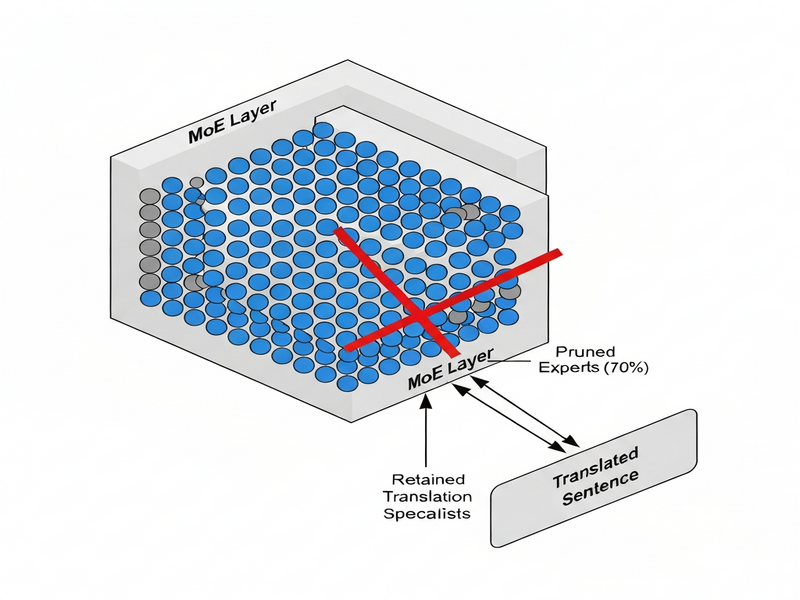
- Data preparation: Curate a representative bilingual corpus covering high‑ and low‑resource languages.
- Routing audit: Feed the corpus through the MoE, capturing softmax routing scores per expert.
- Thresholding logic: Rank experts by average routing weight and apply the prune‑ratio.
- Model surgery: Remove low‑impact experts, re‑wire the remaining graph, and optionally run a short SFT.
Because the pipeline is fully declarative, it can be saved as a reusable template in the UBOS templates for quick start library, enabling teams to repeat the process across different base models.
Performance vs. Compression: What the Numbers Say
The authors evaluated two multilingual MoE backbones (12 B and 30 B parameters) across 12 language pairs (English‑German, English‑Swahili, etc.). Metrics included BLEU, chrF, inference latency on a V100, and GPU VRAM consumption.
| Pruning Level | BLEU Δ (vs. baseline) | Latency Reduction | VRAM Savings |
|---|---|---|---|
| 50 % experts removed | −0.2 % (negligible) | ≈ 30 % faster | ≈ 45 % less |
| 70 % experts removed | −0.6 % (minor) | ≈ 55 % faster | ≈ 70 % less |
| 75 % + 200‑step SFT | ≈ 0 % (baseline recovered) | ≈ 60 % faster | ≈ 75 % less |
| 90 % + SFT | −1.5 % (still acceptable) | ≈ 80 % faster | ≈ 90 % less |
These results confirm that translation quality is remarkably robust to aggressive expert removal. The modest SFT step consistently bridges the tiny quality gap, making the approach viable for production‑grade services.
Real‑World Benefits for AI Deployment
From a systems‑engineering perspective, the ability to shrink a multilingual MoE unlocks several tangible advantages:
- Cost‑effective scaling: More concurrent translation sessions per GPU lower per‑token pricing for SaaS platforms.
- Edge readiness: The compressed specialist can run on on‑device accelerators (smartphones, IoT gateways), enabling offline translation and preserving user privacy.
- Agent orchestration: Multi‑modal AI agents can embed the lightweight translator as a sub‑module, freeing compute for reasoning, retrieval, or generation tasks.
- Rapid prototyping: Teams can experiment with new language pairs by pruning a base MoE, then fine‑tune only the retained experts, dramatically shortening development cycles.
All of these align with the capabilities of the UBOS platform overview, which supports modular model deployment, dynamic scaling, and API‑first access. Moreover, the AI marketing agents can now incorporate a dedicated translation specialist without inflating their overall compute budget.
For organizations concerned about budgeting, the UBOS pricing plans offer tiered options that reflect the reduced resource footprint after pruning.
Where the Research Goes Next
While the current study proves the feasibility of static expert pruning, several open research avenues remain:
- Dynamic expert selection: Can the routing network learn to activate only the necessary experts at inference time, eliminating the need for a one‑time pruning step?
- Cross‑task sharing: Investigate whether experts pruned from translation can be repurposed for related tasks (summarization, sentiment analysis) to create a shared specialist pool.
- Domain robustness: Evaluate the pruned specialist on out‑of‑domain corpora (medical, legal) and explore lightweight domain‑adaptation fine‑tuning.
- Hardware‑aware pruning: Tailor prune‑ratios to specific edge accelerators (e.g., Apple Neural Engine, Qualcomm Hexagon) to balance latency, power, and accuracy.
Developers eager to experiment can leverage the UBOS for startups sandbox, which provides a ready‑made environment for uploading MoE checkpoints, running the pruning pipeline, and benchmarking results against custom datasets. Larger enterprises may prefer the Enterprise AI platform by UBOS, which adds monitoring, automated roll‑outs, and compliance reporting.
Take the Next Step
If you’re looking to accelerate multilingual AI initiatives, consider combining the pruning workflow with other UBOS capabilities:
- Deploy the trimmed model via the Web app editor on UBOS for instant API exposure.
- Enrich translation output with voice using the ElevenLabs AI voice integration.
- Store and retrieve multilingual embeddings with the Chroma DB integration.
- Build a conversational front‑end that combines translation with ChatGPT via the OpenAI ChatGPT integration.
- Leverage ready‑made templates such as the AI SEO Analyzer or the AI Article Copywriter to generate multilingual content at scale.
Explore more research‑driven guides on the UBOS homepage and subscribe to our blog for the latest breakthroughs in efficient AI.
UBOS partner program
UBOS portfolio examples
UBOS solutions for SMBs
Telegram integration on UBOS
ChatGPT and Telegram integration
Talk with Claude AI app
Your Speaking Avatar template
Before-After-Bridge copywriting template
AI YouTube Comment Analysis tool
Image to Text AI service
AI Survey Generator
Web Scraping with Generative AI
AIDA Marketing Template
Elevate Your Brand with AI
AI Video Generator
AI Audio Transcription and Analysis
Generative AI Text-to-Video
Know Your Target Audience
AI LinkedIn Post Optimization
Image Generation with Stable Diffusion
AI Chatbot template
Customer Support with ChatGPT API
Multi-language AI Translator
Translate Natural Language to SQL
Factual Answering AI with ChatGPT API
Grammar Correction AI
Summarize for a 2nd Grader
AI Language Model Tutorial Chatbot
JavaScript Helper AI Chatbot
Movie to Emoji AI Application
Sarcastic AI Chat Bot
Unstructured Data AI Parser
Product Name Generator AI
Python Bug Fixer AI
Airport Code Extractor
Custom Interview Questions with AI
Create Study Notes with AI
AI Restaurant Review App
AI for Turn-by-Turn Directions
AI Chat App with ChatGPT API
AI Recipe Creator
AI-Powered Essay Outline Generator
AI-Powered VR Fitness Idea Generator
AI App with Text-to-Command
Calculate Time Complexity with ChatGPT
Keywords Extraction with ChatGPT
AI Voice Assistant
Extract Contact Information AI
AI File Manager
GPT-Powered Telegram Bot
Video AI Chat Bot
Pharmacy Admin Panel
Help Me Write AI
Text-to-Speech Google AI
AI Image Generator
AI Email Marketing
Andrii Bidochko
CTO UBOS
Andrii Bidochko is an AI entrepreneur and researcher focused on AI agents, reinforcement learning, and autonomous systems. He writes about the technologies shaping the future of machine intelligence, from frontier models and agent architectures to real-world AI applications.