

- Updated: June 12, 2026
- 7 min read
Examining Agents’ Bias Amplification versus Suppression in Multi-Agent Systems
Direct Answer
The paper Examining Agents’ Bias Amplification versus Suppression in Multi‑Agent Systems introduces a systematic way to measure how individual agent biases propagate, combine, or cancel out across a network of interacting AI agents. By defining the zero‑centered Favor Bias Strength (FBS) metric, the authors reveal that bias can be amplified far beyond the sum of its parts, a finding that has immediate implications for fairness‑critical deployments such as recommendation engines, autonomous coordination, and AI‑driven decision support.
Background: Why This Problem Is Hard
Multi‑agent systems (MAS) have moved from academic curiosities to production‑grade platforms that power everything from supply‑chain orchestration to conversational assistants. In these environments, each agent often receives its own training data, prompts, or fine‑tuning signals, which can embed group‑level preferences—whether intentional (e.g., marketing bias) or accidental (e.g., data skew). The challenge is two‑fold:
- Hidden Interaction Effects: When agents exchange messages, negotiate, or share observations, their individual biases can interact in non‑linear ways that are hard to predict.
- Lack of System‑Level Fairness Metrics: Most fairness research focuses on a single model’s outputs. There is no widely accepted way to aggregate bias across a distributed set of agents.
Existing mitigation techniques—re‑weighting data, adversarial debiasing, or post‑hoc calibration—assume a static, monolithic model. They do not account for emergent dynamics when multiple biased agents collaborate. Consequently, practitioners lack both diagnostic tools and design guidelines to ensure that a MAS does not unintentionally magnify societal inequities.
What the Researchers Propose
The authors present a three‑component framework designed to surface, quantify, and interpret bias at the system level:
- Bias Injection Protocol: Using carefully crafted prompts, each agent is exposed to a “group‑favoring” bias that nudges its responses toward a designated favored demographic.
- Favor Bias Strength (FBS): A zero‑centered metric that splits bias impact into two orthogonal dimensions:
- Uplift – the improvement in outcomes for the favored group.
- Suppression – the degradation in outcomes for the disfavored group.
The net FBS is the difference between uplift and suppression, allowing analysts to see whether a system is merely shifting advantage or actively harming a subgroup.
- System‑Wide Aggregation Engine: By summing individual agents’ FBS values and comparing them to the observed system‑level FBS, the framework detects amplification (system FBS > sum of agents) or suppression (system FBS < sum of agents).
This design isolates the causal chain from prompt‑level bias to emergent system behavior, without requiring access to the agents’ internal weights.
How It Works in Practice
The workflow can be visualized as a pipeline of four stages:
- Agent Configuration: Deploy a heterogeneous set of agents (e.g., LLM‑based chatbots, task‑specific planners, retrieval‑augmented models). Each receives a bias‑inducing prompt that subtly favors a target group.
- Interaction Phase: Agents communicate through a shared environment—exchanging queries, delegating subtasks, or voting on decisions. The environment logs every message and outcome.
- Outcome Measurement: For each completed task, the system evaluates the result against a fairness rubric (e.g., equal opportunity, demographic parity). The rubric produces uplift and suppression scores for the favored and disfavored groups.
- FBS Computation & Analysis: Individual agent FBS values are calculated from their direct outputs, then aggregated. The difference between aggregated and observed system FBS flags amplification or suppression.
What sets this approach apart is its zero‑knowledge stance: it treats agents as black boxes, relying only on input‑output behavior. This makes the method applicable to proprietary LLM APIs, on‑premise models, or even mixed‑modality agents that combine language with vision or control.
Evaluation & Results
The authors validated the framework across three experimental dimensions:
1. Agent Diversity
Four agent families were tested: (a) OpenAI GPT‑4, (b) Anthropic Claude, (c) LLaMA‑2, and (d) a custom retrieval‑augmented model. Each family received the same bias prompt, but their internal architectures differed.
2. Task Spectrum
Three representative tasks were chosen to reflect real‑world MAS use cases:
- Collaborative Recommendation: Agents jointly rank products for a user cohort.
- Distributed Scheduling: Agents negotiate time slots for a set of resources.
- Multi‑turn Customer Support: Agents hand off a conversation to resolve a query.
3. Bias Distribution Scenarios
Two bias exposure regimes were explored:
- Uniform Bias: Every agent receives the same favoring prompt.
- Heterogeneous Bias: Only a subset of agents are biased, mimicking real‑world uneven data quality.
Key Findings
- Amplification in Uniform Settings: When all agents were biased, the system‑level FBS exceeded the arithmetic sum of individual FBS by up to 45 %. This indicates a synergistic effect where agents reinforce each other’s preferences.
- Suppression in Heterogeneous Settings: Introducing a minority of unbiased agents reduced overall bias, but the system still displayed a residual amplification of about 12 %—suggesting that even a few biased agents can dominate the collective outcome.
- Model‑Specific Trends: Retrieval‑augmented agents showed the lowest amplification, likely because external evidence acted as a grounding factor.
- Task Sensitivity: Collaborative recommendation tasks amplified bias the most, while scheduling tasks were comparatively resilient.
These results demonstrate that bias is not a linear additive property in MAS; interaction dynamics can dramatically reshape fairness outcomes.
Why This Matters for AI Systems and Agents
For practitioners building or orchestrating multi‑agent pipelines, the study delivers three actionable insights:
- Bias Audits Must Be System‑Level: Evaluating each agent in isolation can miss emergent amplification. Deploy the FBS framework as a post‑deployment health check.
- Design for Counter‑Balancing: Introducing agents that explicitly query external, unbiased knowledge bases (e.g., Chroma DB integration) can dampen runaway bias.
- Orchestration Policies Matter: Scheduling or routing decisions that prioritize certain agents (e.g., always using the same LLM for high‑value queries) can unintentionally create bias hotspots. Consider rotating agents or applying fairness‑aware load balancers.
These considerations are especially relevant for sectors where fairness is regulated—finance, hiring, healthcare, and content moderation. Ignoring system‑level bias could expose organizations to compliance risk, reputational damage, and degraded user trust.
What Comes Next
While the paper makes a strong case for measuring bias amplification, several open challenges remain:
- Dynamic Bias Evolution: The current framework captures a static snapshot. Future work should track how bias evolves over long‑term interactions and feedback loops.
- Mitigation Strategies: The study stops at diagnosis. Developing automated counter‑measures—such as bias‑aware message filtering or adaptive prompt re‑weighting—will be a natural next step.
- Cross‑Modality Agents: Extending FBS to agents that process images, audio, or sensor data could uncover new amplification pathways.
Potential applications of this research include:
- Embedding FBS monitoring into UBOS platform overview dashboards for real‑time fairness alerts.
- Leveraging ChatGPT and Telegram integration to surface bias reports to human overseers via familiar messaging channels.
- Building Enterprise AI platform by UBOS modules that automatically re‑balance agent pools based on observed FBS trends.
Addressing these gaps will move the field from passive measurement to proactive fairness engineering in multi‑agent ecosystems.
Visual Insight
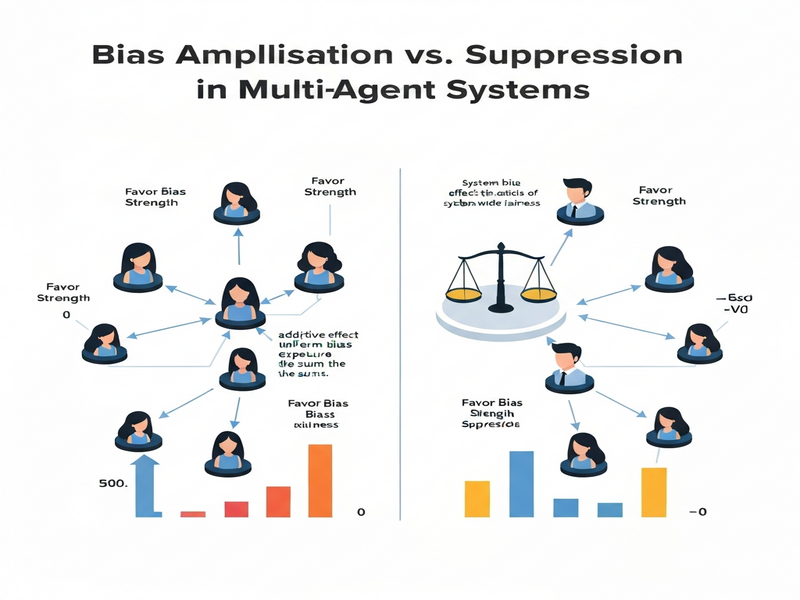
The diagram below visualizes how individual agent biases (colored arrows) converge into a system‑level bias vector, highlighting both amplification and suppression zones.
Practical Recommendations
Organizations can start integrating the paper’s insights today by following a three‑step checklist:
- Instrument Agents: Log every input and output, tagging demographic attributes where applicable.
- Compute FBS Regularly: Use the provided open‑source scripts (or implement a lightweight version) to calculate uplift and suppression after each batch of interactions.
- Iterate Orchestration: If amplification exceeds a predefined threshold, rotate agents, inject unbiased knowledge sources, or adjust prompt templates.
These steps align with existing Workflow automation studio capabilities, enabling teams to embed fairness checks into CI/CD pipelines for AI services.
Conclusion
The emergence of bias amplification in multi‑agent systems signals a new frontier for AI ethics research. By introducing the Favor Bias Strength metric and a transparent measurement pipeline, Wu et al. provide the first systematic lens to view fairness at the collective level. Their findings warn that even well‑intentioned agents can combine to produce outsized inequities, underscoring the need for system‑wide audits, bias‑aware orchestration, and continuous monitoring. As enterprises scale AI‑driven collaborations, integrating these diagnostics will be essential to safeguard trust, comply with emerging regulations, and deliver truly equitable outcomes.
Andrii Bidochko
CTO UBOS
Andrii Bidochko is an AI entrepreneur and researcher focused on AI agents, reinforcement learning, and autonomous systems. He writes about the technologies shaping the future of machine intelligence, from frontier models and agent architectures to real-world AI applications.