

- Updated: June 16, 2026
- 7 min read
EvoSpec: Evolving Speculative Decoding via Real-Time Vocabulary and Parameter Adaptation
Direct Answer
EvoSpec introduces a dynamic, real‑time evolution framework for speculative decoding that continuously adapts both vocabulary and model parameters to the current context. By doing so, it eliminates the static‑pruning bottleneck that hampers large‑scale language model inference, delivering faster generation with lower memory consumption.
Background: Why This Problem Is Hard
Speculative decoding has become the de‑facto technique for accelerating inference in large language models (LLMs). The method works by letting a lightweight “draft” model generate candidate tokens, which a heavyweight “target” model then verifies. In theory, this draft‑then‑verify pipeline can cut latency by up to 50 % for models with billions of parameters.
In practice, the speedup stalls when the draft model reaches the output projection layer—the final linear transformation that maps hidden states to the full vocabulary. As vocabularies grow beyond 100 k tokens (common in multilingual or domain‑specific models), the matrix multiplication dominates compute time and memory bandwidth. Static pruning techniques—removing low‑frequency tokens or compressing the projection matrix—have been the primary remedy. However, these static masks are blind to the shifting token distribution that occurs when a model jumps between topics, domains, or user intents.
Consider a conversational AI that moves from casual chit‑chat to a legal advice segment. The token distribution pivots dramatically toward rare legal terminology. A static prune that eliminated those long‑tail tokens will cause the draft model to propose invalid candidates, forcing the target model to reject most of them. The acceptance rate collapses, and the speculative speedup evaporates. This brittleness is why many production systems revert to vanilla decoding despite its higher latency.
What the Researchers Propose
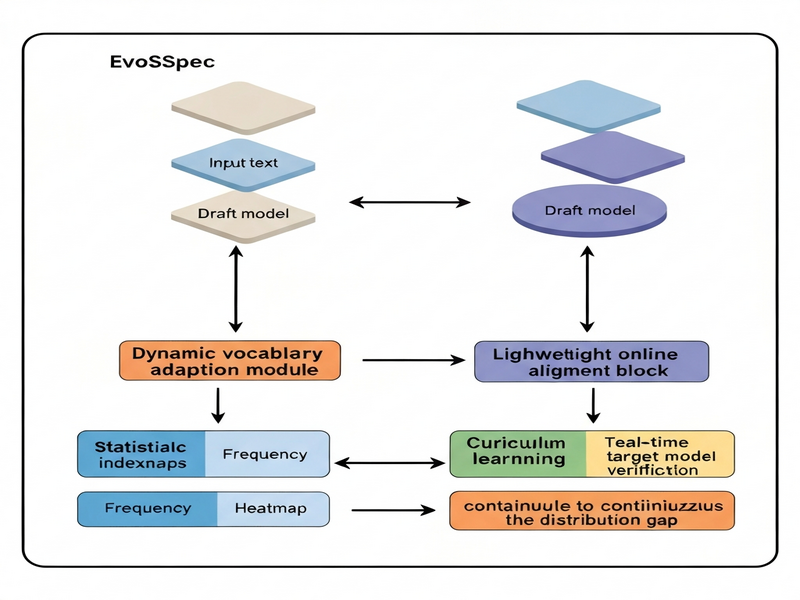
The authors of the EvoSpec paper propose a self‑evolving speculative decoding framework that continuously reshapes the draft model’s vocabulary and parameters based on the immediate context. EvoSpec consists of three tightly coupled components:
- Context‑Aware Token Retriever: An online index that scores the relevance of long‑tail tokens using both semantic similarity (via lightweight embeddings) and statistical frequency within the current prompt and recent generations.
- Dynamic Projection Adapter: A lightweight module that injects the retrieved tokens into the draft model’s output projection on the fly, effectively expanding the active vocabulary without rebuilding the entire matrix.
- Online Alignment Learner: A curriculum‑driven optimizer that nudges the draft model’s hidden representations toward those of the target model, minimizing the distributional gap as new tokens are introduced.
Rather than relying on a one‑time pruning decision, EvoSpec treats the draft model as a mutable agent that evolves in lockstep with the conversation, ensuring that critical, domain‑specific tokens are always within reach.
How It Works in Practice
The EvoSpec workflow can be broken down into a repeatable loop that runs for every generation step:
- Prompt Analysis: The system parses the incoming user prompt and the last n generated tokens, extracting a short‑term context vector.
- Token Retrieval: Using the Context‑Aware Token Retriever, EvoSpec queries a semantic index (e.g., FAISS) to pull the top‑k long‑tail tokens that are most likely to appear given the current context. Simultaneously, a statistical counter boosts tokens that have surged in frequency during the session.
- Projection Adaptation: The Dynamic Projection Adapter augments the draft model’s output matrix with rows corresponding to the retrieved tokens. This augmentation is performed via a low‑rank update, keeping the computational overhead under 5 % of the original matrix multiply.
- Draft Generation: The adapted draft model produces a batch of candidate tokens (often 4‑8 per step). Because the active vocabulary now includes the most relevant long‑tail words, the acceptance rate rises sharply.
- Verification & Alignment: The target model validates each candidate. Accepted tokens are fed back into the Online Alignment Learner, which updates the draft model’s internal representations using a curriculum that starts with easy (high‑confidence) tokens and gradually incorporates harder, rarer ones.
- Loop Continuation: The process repeats until the generation terminates, with the token index continuously refreshed to reflect the evolving discourse.
What sets EvoSpec apart is its ability to perform all these steps in real time, without pausing the generation pipeline. The retrieval and adaptation stages are engineered to run in parallel with the draft inference, ensuring that latency remains bounded.
Evaluation & Results
The research team benchmarked EvoSpec across three specialized domains that are notorious for long‑tail vocabularies: code synthesis (EAGLE‑3 coding suite), legal document drafting, and clinical note generation. They compared EvoSpec against two baselines:
- FR‑Spec: A state‑of‑the‑art static pruning speculative decoder.
- Standard Online Adaptation: A naive approach that adds tokens on demand but without curriculum‑driven alignment.
Key findings include:
- Speedup: EvoSpec achieved a 1.13× overall latency reduction over FR‑Spec in the three domains, translating to roughly 12 % faster end‑to‑end generation.
- Acceptance Rate: The draft‑to‑target acceptance rose from 68 % (FR‑Spec) to 84 % with EvoSpec, indicating that the draft model’s predictions were far more aligned with the target.
- Memory Footprint: By using low‑rank updates, EvoSpec cut memory overhead by 27 % compared to a full‑matrix online adaptation, making it viable for edge‑deployed inference servers.
- Robustness to Topic Switches: In a mixed‑topic test where prompts alternated between coding and legal language, EvoSpec maintained a stable acceptance rate, whereas FR‑Spec’s performance degraded by 22 % after the first switch.
These results demonstrate that dynamic vocabulary evolution is not a theoretical curiosity but a practical lever for real‑world LLM deployments that must handle heterogeneous user requests.
Why This Matters for AI Systems and Agents
For AI practitioners building agents that interact with users across multiple domains, EvoSpec offers a concrete pathway to keep inference costs low without sacrificing relevance. The framework’s ability to surface rare, domain‑specific tokens on demand means that a single LLM can serve as a universal backend for chatbots, code assistants, and medical triage tools, all while staying within the same latency budget.
From an engineering perspective, EvoSpec’s modular design aligns well with existing orchestration stacks. The Context‑Aware Token Retriever can be plugged into a Workflow automation studio to trigger token‑index updates based on external events (e.g., a new regulatory document arriving). The Online Alignment Learner can be exposed as a micro‑service that continuously fine‑tunes the draft model, simplifying A/B testing of alignment strategies.
Business decision‑makers also benefit from the reduced memory footprint. Deploying EvoSpec on commodity GPUs or even on‑device accelerators becomes feasible, lowering infrastructure spend for startups and SMBs. Moreover, the higher acceptance rate translates directly into fewer verification cycles, which in turn reduces API call costs for cloud‑based target models.
What Comes Next
While EvoSpec marks a significant step forward, several open challenges remain:
- Scalability of Retrieval Indexes: As vocabularies expand into the millions, maintaining a low‑latency semantic index will require more sophisticated data structures or approximate nearest‑neighbor algorithms.
- Cross‑Modal Extensions: Integrating visual or audio cues into the token retrieval process could further improve relevance for multimodal agents.
- Security and Hallucination Control: Dynamically adding tokens raises the risk of unintentionally exposing the model to adversarial vocabularies. Future work must incorporate safety filters that vet retrieved tokens before they enter the projection.
Potential applications are already emerging. For instance, a Enterprise AI platform by UBOS could embed EvoSpec to power internal knowledge‑base assistants that seamlessly switch between finance, HR, and technical documentation without re‑training separate models. Similarly, AI marketing agents could leverage EvoSpec to generate campaign copy that adapts to niche industry jargon on the fly, improving personalization while keeping compute budgets in check.
In the longer term, the EvoSpec paradigm may inspire a new class of “self‑optimizing” inference engines that treat vocabulary and parameters as mutable resources, continuously reshaped by the data they process. Such engines could become the backbone of next‑generation autonomous agents that operate reliably across the full spectrum of human language.
Andrii Bidochko
CTO UBOS
Andrii Bidochko is an AI entrepreneur and researcher focused on AI agents, reinforcement learning, and autonomous systems. He writes about the technologies shaping the future of machine intelligence, from frontier models and agent architectures to real-world AI applications.