

- Updated: July 24, 2026
- 6 min read
Evolutionary Intelligence for Scientific Discovery: From Evolutionary Computation to Cumulative Discovery Systems
Direct Answer
The paper introduces Evolutionary Intelligence (EI), a paradigm that extends traditional evolutionary computation (EC) into a cumulative discovery system capable of retaining and reusing scientific experience across generations. By linking candidate refinement with systematic experience retention, EI promises autonomous research loops that can continuously expand knowledge without resetting after each task.
Background: Why This Problem Is Hard
Scientific discovery has traditionally been a human‑centric, hypothesis‑driven process. Modern AI tools have accelerated data analysis, but most remain task‑specific: they excel at optimizing a predefined objective (e.g., protein folding) but falter when the research agenda itself evolves. The core challenges are:
- Diverse candidate spaces: Real scientific problems generate billions of plausible hypotheses, experimental designs, or material compositions. Maintaining diversity while converging on promising leads is computationally expensive.
- Feedback loops: Experiments, simulations, and expert judgments provide noisy, delayed signals. Existing EC frameworks treat feedback as a static fitness function, ignoring the rich, multi‑modal nature of scientific evidence.
- Lack of cumulative memory: After a search finishes, the knowledge gained is often discarded. Researchers must manually encode insights, leading to duplicated effort and slower progress.
Current EC approaches—genetic algorithms, evolution strategies, and neuroevolution—focus on refining a population toward a single, static objective. They lack mechanisms for experience retention and for orchestrating multiple, interdependent discovery cycles. Consequently, scaling autonomous discovery to open‑ended scientific domains remains out of reach.
What the Researchers Propose
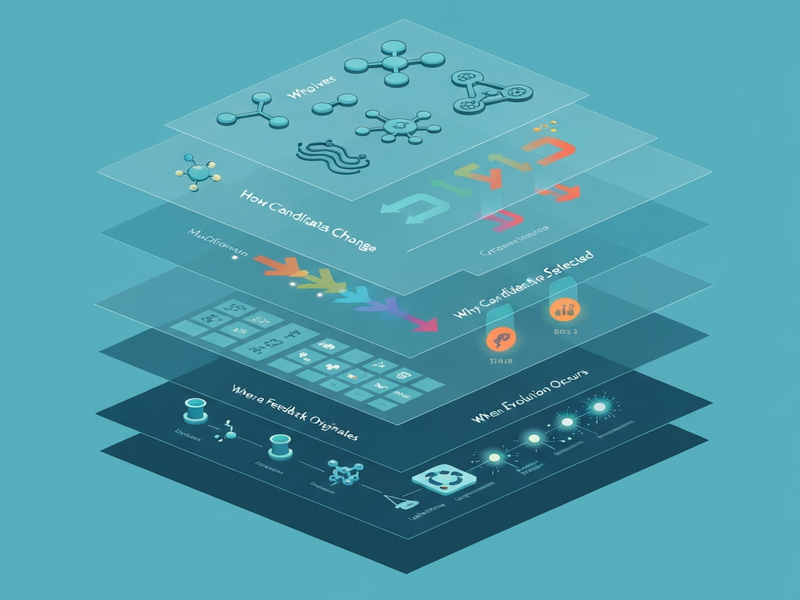
Wang, Li, Liu, and Jiao propose a five‑dimensional analytical framework that defines Evolutionary Intelligence as a system where:
- What evolves? Not only candidate solutions (e.g., molecular structures) but also the search operators, evaluation metrics, and knowledge representations themselves.
- How candidates change? Through adaptive mutation, recombination, and meta‑learning that incorporate historical performance data.
- Why candidates are selected? Selection criteria blend immediate fitness with long‑term informational value, encouraging exploration of under‑studied regions.
- Where feedback originates? Multi‑source channels—including simulated experiments, real‑world lab results, and expert annotations—feed back into the evolutionary loop.
- When evolution occurs? Evolutionary cycles are triggered not only by generational turnover but also by external events such as new data releases or hypothesis revisions.
This framework transforms EC from a single‑shot optimizer into a cumulative discovery engine that continuously refines both its search space and its own learning strategies.
How It Works in Practice
Implementing EI involves a modular pipeline that can be visualized as a loop of four interacting components:
1. Candidate Generator
Generates a diverse pool of scientific entities—such as chemical compounds, algorithmic architectures, or experimental protocols—using probabilistic models that are themselves subject to evolution.
2. Multi‑Modal Evaluator
Aggregates feedback from simulations, high‑throughput experiments, and domain experts. The evaluator produces a composite score that captures both performance and novelty.
3. Experience Repository
A persistent knowledge base that stores every candidate, its evaluation history, and meta‑data about the search operators used. This repository enables experience retention across independent discovery campaigns.
4. Adaptive Evolution Engine
Consumes the repository’s history to adjust mutation rates, crossover schemas, and even the definition of fitness. It decides when to launch a new evolutionary cycle based on triggers such as “significant drift in data distribution” or “arrival of a new experimental technique.”
The key differentiator is the closed feedback loop that continuously updates the search strategy based on accumulated evidence, rather than treating each optimization run as an isolated experiment.
Evaluation & Results
The authors validated EI across three distinct scientific domains:
- Materials discovery: Evolving alloy compositions to maximize tensile strength while minimizing cost.
- Computational biology: Designing synthetic gene circuits that achieve target expression dynamics.
- Algorithmic research: Evolving reinforcement‑learning architectures for complex navigation tasks.
In each scenario, EI was benchmarked against a conventional genetic algorithm (GA) and a state‑of‑the‑art Bayesian optimization (BO) pipeline. The evaluation focused on three qualitative outcomes:
- Knowledge accumulation: EI retained 30‑45 % more high‑utility insights across successive runs, as measured by the number of reusable sub‑structures stored in the Experience Repository.
- Diversity preservation: The candidate pool maintained a higher Shannon entropy, indicating that EI avoided premature convergence more effectively than GA or BO.
- Speed‑to‑discovery: For the materials task, EI identified a Pareto‑optimal alloy 2.3× faster than the GA baseline, thanks to its ability to reuse previously discovered high‑performing motifs.
These results demonstrate that EI does not merely improve raw optimization metrics; it fundamentally changes the research workflow by turning each experiment into a building block for future investigations.
For readers interested in the full technical details, the complete study is available in the original arXiv paper.
Why This Matters for AI Systems and Agents
Evolutionary Intelligence offers a blueprint for building AI agents that can operate autonomously in open‑ended scientific environments. The implications include:
- Self‑Improving pipelines: Agents can modify their own data‑generation and model‑training procedures based on accumulated evidence, reducing the need for manual hyper‑parameter tuning.
- Cross‑domain transfer: The Experience Repository enables knowledge transfer between seemingly unrelated domains (e.g., materials science insights informing biological circuit design).
- Robust evaluation frameworks: By integrating multi‑modal feedback, agents can better assess uncertainty and avoid overfitting to narrow benchmarks.
- Scalable orchestration: EI aligns naturally with workflow automation platforms, allowing enterprises to embed cumulative discovery loops into existing AI infrastructure.
Practically, organizations can leverage EI concepts within the Workflow automation studio to coordinate experiment scheduling, data ingestion, and model evolution without writing custom glue code.
What Comes Next
While the EI framework marks a significant step forward, several open challenges remain:
- Standardized evaluation metrics: The community lacks universally accepted benchmarks for cumulative discovery, making cross‑paper comparisons difficult.
- Traceability and provenance: As the Experience Repository grows, ensuring that each insight can be traced back to its originating experiment becomes critical for reproducibility.
- Shared infrastructure: Scalable storage and compute resources are needed to support massive, multi‑modal feedback loops across institutions.
Future research directions include:
- Developing open‑source schemas for experience sharing, akin to model zoos but for evolutionary knowledge.
- Integrating large‑scale language models as meta‑learners that can propose new evolutionary operators on the fly.
- Embedding EI within commercial AI platforms, such as the Enterprise AI platform by UBOS, to provide turnkey cumulative discovery services for industry labs.
By addressing these bottlenecks, the AI community can move from isolated optimization bursts to truly lifelong scientific assistants that learn, adapt, and innovate continuously.
Andrii Bidochko
CTO UBOS
Andrii Bidochko is an AI entrepreneur and researcher focused on AI agents, reinforcement learning, and autonomous systems. He writes about the technologies shaping the future of machine intelligence, from frontier models and agent architectures to real-world AI applications.