

- Updated: July 11, 2026
- 6 min read
Evaluating the Effect of Frame Rate in Sequence-Based Classification of Autism-Related Self-Stimulatory Hand Idiosyncrasies
Direct Answer
The paper introduces a systematic study that pinpoints the optimal neural‑network architecture, frame‑sampling rate, and data‑augmentation recipe for classifying autism‑related self‑stimulatory hand movements from video. By demonstrating that a GRU model sampled every 15 frames can reach near‑perfect accuracy, the work offers a concrete blueprint for building reliable, low‑resource video‑based screening tools.
Background: Why This Problem Is Hard
Autism spectrum disorder (ASD) affects more than 75 million people worldwide, yet early detection still relies heavily on in‑person clinical observation. Remote, video‑based screening promises scalability, but three technical bottlenecks have kept it from mainstream adoption:
- Behavioral sparsity: Self‑stimulatory hand idiosyncrasies are brief, subtle, and highly individualized, making them difficult to capture with generic computer‑vision pipelines.
- Data scarcity: Ethical and privacy constraints limit the size of publicly available ASD video datasets, which in turn hampers the training of deep models that typically require thousands of examples.
- Temporal resolution trade‑offs: High frame rates preserve motion detail but inflate computational cost and exacerbate over‑fitting on small datasets; low frame rates reduce noise but risk discarding critical cues.
Existing approaches—most notably convolutional neural networks (CNNs) applied frame‑by‑frame—have plateaued around 60‑75 % accuracy on the Self‑Stimulatory Behavior Diagnosis (SSBD) dataset. These methods treat each frame as an independent image, ignoring the sequential nature of motor patterns that is essential for distinguishing stereotyped hand motions from background activity.
What the Researchers Propose
The authors present a two‑pronged framework that tackles both the architectural and data‑augmentation challenges:
- Sequence‑based recurrent models: Long Short‑Term Memory (LSTM) and Gated Recurrent Unit (GRU) networks ingest pose‑derived keypoints over time, allowing the model to learn motion dynamics directly.
- Systematic frame‑rate exploration: Videos are down‑sampled at six intervals (1, 5, 15, 30, 45, 90 frames) to identify the sweet spot where temporal fidelity meets computational efficiency.
- Augmentation pipeline for scarce data: Ten video‑level transformations—including horizontal flip, rotation, color jitter, and temporal up‑sampling—are evaluated within an Inflated 3D ConvNet (I3D) transfer‑learning setting.
By treating the problem as a sequence classification task and rigorously testing sampling strategies, the study isolates the conditions under which a small behavioral dataset can still yield high‑performing models.
How It Works in Practice
Conceptual Workflow
The end‑to‑end pipeline can be broken down into four logical stages:
- Video ingestion & pose extraction: Raw video clips are processed by a lightweight pose estimator (e.g., OpenPose) to produce a time‑series of 2‑D joint coordinates for each hand.
- Temporal sampling: The coordinate series is sub‑sampled according to a predefined interval (e.g., every 15th frame). This reduces sequence length while preserving the rhythm of the hand movement.
- Sequence modeling: The sampled series feeds into either an LSTM or GRU layer. The recurrent unit aggregates temporal context and outputs a fixed‑length representation.
- Classification & post‑processing: A dense layer maps the representation to a binary label (self‑stimulatory vs. non‑stimulatory). For personalized models, the same subject’s video is split temporally into training and test segments, ensuring that the classifier learns subject‑specific patterns.
Interaction Between Components
Each component is deliberately decoupled:
- The pose extractor can be swapped without retraining the recurrent core, enabling rapid experimentation with higher‑resolution keypoints.
- Sampling intervals are configurable at inference time, allowing deployment on edge devices where bandwidth or compute is limited.
- The augmentation module operates upstream of the I3D transfer‑learning stage, enriching the limited video pool with synthetic variations that improve generalization.
What sets this approach apart from prior CNN‑centric pipelines is the explicit focus on temporal dynamics and the empirical validation of how many frames are truly needed to capture the diagnostic signal.
Evaluation & Results
Test Scenarios
The researchers evaluated two families of models on the SSBD dataset:
- Recurrent models (LSTM, GRU): Trained on pose sequences at each sampling interval.
- I3D with augmentation: A pre‑trained video model fine‑tuned on the same dataset, with each of the ten augmentation techniques applied individually and in combination.
Key Findings
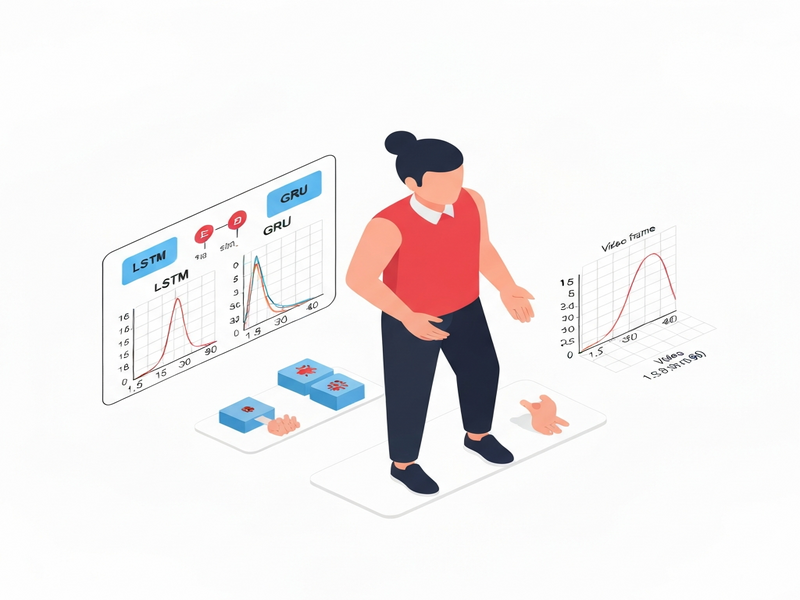
- Sampling sweet spot: Both LSTM and GRU achieved their highest accuracies when frames were sampled every 15 frames (approximately 2 fps for a 30 fps source). The GRU peaked at 98.75 % accuracy, marginally outperforming the LSTM’s 97.5 %.
- Recurrent superiority: Across all intervals, recurrent models consistently outperformed the CNN baseline (62‑76 % accuracy), confirming that motion context is essential for this task.
- Augmentation impact: Horizontal flipping alone lifted I3D accuracy to 48.78 %, the best single‑technique gain. However, removing up‑sampling from the full augmentation suite caused the steepest drop, highlighting its role in compensating for the limited number of original clips.
- Personalized modeling: Training per‑subject models on temporally split segments yielded a stable mean loss of 1.84 (SD 0.79), demonstrating that even with minimal data, subject‑specific classifiers can be reliable.
Collectively, these results prove that a carefully tuned GRU with a modest frame‑rate can rival, and even surpass, heavyweight 3‑D CNNs while demanding far less computational power.
Why This Matters for AI Systems and Agents
For developers building AI‑driven health assistants, the study offers three actionable takeaways:
- Efficient edge deployment: A GRU model processing a 2 fps stream fits comfortably on smartphones or low‑cost IoT devices, enabling on‑device screening without constant cloud connectivity.
- Modular pipeline design: By separating pose extraction, sampling, and sequence modeling, system architects can replace or upgrade individual modules (e.g., swapping OpenPose for MediaPipe) without retraining the entire stack.
- Data‑augmentation as a safety net: In clinical settings where new video recordings are scarce, the augmentation recipes act as a low‑cost method to expand the training set, reducing the risk of over‑fitting and improving model robustness.
These insights align with the capabilities of the UBOS platform overview, which supports modular AI workflows, and can be combined with the Workflow automation studio to orchestrate pose extraction, sampling, and model inference in a single, reproducible pipeline.
What Comes Next
While the paper establishes a strong baseline, several avenues remain open for exploration:
- Multimodal fusion: Integrating audio cues (e.g., vocalizations) or physiological signals could further improve diagnostic confidence.
- Cross‑dataset generalization: Testing the GRU‑15‑frame configuration on other behavioral datasets would validate its universality.
- Explainability tools: Visualizing attention weights or saliency maps could help clinicians understand why a particular motion was flagged, fostering trust.
- Regulatory pathways: Embedding the model within a HIPAA‑compliant pipeline and conducting prospective clinical trials will be essential before real‑world deployment.
Practitioners interested in rapid prototyping can leverage the Enterprise AI platform by UBOS to spin up a secure, compliant environment for these next‑step experiments. For startups aiming to bring AI‑enabled autism screening to market, the UBOS for startups offering provides pre‑built integrations—such as the ChatGPT and Telegram integration—that accelerate user onboarding and feedback collection.
Ultimately, the study underscores that with the right combination of temporal sampling, recurrent modeling, and thoughtful augmentation, high‑accuracy behavioral classification is achievable even in data‑constrained clinical domains.
References
For a complete technical description, see the original arXiv paper by Raunak Mondal and Peter Washington (2026).
Andrii Bidochko
CTO UBOS
Andrii Bidochko is an AI entrepreneur and researcher focused on AI agents, reinforcement learning, and autonomous systems. He writes about the technologies shaping the future of machine intelligence, from frontier models and agent architectures to real-world AI applications.