

- Updated: July 7, 2026
- 7 min read
Evaluating Generative Agents with Actions Grounded in Socially Distributed Task Environments using Incognita
Direct Answer
The paper introduces Incognita, a modular framework that isolates social communication from grounded execution, enabling the systematic evaluation of generative agents in socially distributed task environments. By forcing agents to acquire fragmented knowledge through dialogue before acting on a shared state, Incognita reveals where current models succeed, stumble, or prematurely claim completion.
Background: Why This Problem Is Hard
Real‑world AI assistants rarely operate in a vacuum. In retail, customer support, or collaborative robotics, critical information is often siloed across distinct roles—inventory managers, pricing specialists, logistics coordinators—each holding a piece of the puzzle. An agent must know when to ask, whom to ask, and how to translate the answer into a concrete, verifiable action.
Existing benchmarks fall into two camps. Grounded* benchmarks (e.g., AlfWorld) provide executable actions and persistent world states but assume a single omniscient agent. Social simulation* environments (e.g., ParlAI) enable rich multi‑agent dialogue but lack a deterministic, observable outcome that can be scored reliably. The gap leaves researchers without a testbed that simultaneously stresses knowledge acquisition, source selection, and grounded execution.
Because the two challenges—knowledge discovery and action verification—are tightly coupled, progress on one side often masks deficiencies on the other. An agent that “knows” the answer but cannot trigger the correct API call looks successful in a dialogue‑only test, while an agent that can fire the right API but lacks the needed context fails in a realistic workflow.
What the Researchers Propose
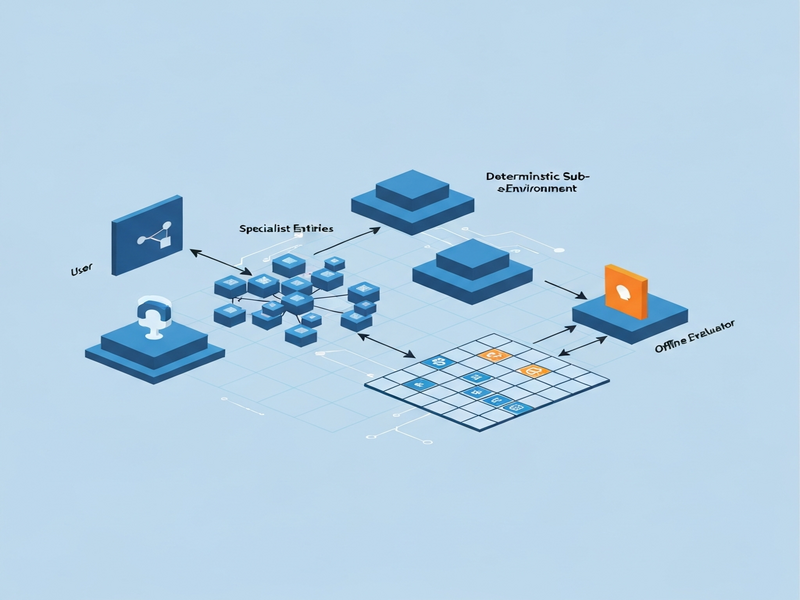
Incognita reframes the evaluation loop into four clearly separated components:
- Message Router: decides whether an incoming user utterance should be answered directly or forwarded to a specialist entity.
- Specialist Entities: role‑isolated modules (e.g., “Pricing Expert”, “Inventory Clerk”) that hold exclusive pieces of task‑relevant knowledge.
- Deterministic Sub‑Environment: a sandbox that executes only those operations approved by specialists, guaranteeing reproducible state transitions.
- Offline Evaluator: scores the final world state against a canonical reward function, inheriting the semantics of the original benchmark.
By decoupling communication from execution, Incognita forces a generative agent to treat dialogue as an exploration problem—searching for hidden facts—while treating the sandbox as an exploitation problem—applying those facts to change the environment.
How It Works in Practice
The workflow proceeds in three logical phases:
- Inquiry Phase: The primary agent receives a user request (e.g., “Create a discount for product X”). It evaluates its internal knowledge base; if confidence is low, it routes the request to the Message Router.
- Knowledge‑Elicitation Phase: The router forwards the query to one or more Specialist Entities. Each specialist checks whether it possesses the required fragment (e.g., current stock levels, pricing policy). If so, it returns a structured response; otherwise, it may forward the query further.
- Execution Phase: Armed with the newly acquired facts, the primary agent constructs a grounded operation (e.g., an API call to update the price). The Deterministic Sub‑Environment validates the operation against a canonical state model and applies it if admissible.
What sets Incognita apart is its canonical state model. Unlike open‑ended simulations, every accepted operation mutates a single, shared representation of the world, enabling the Offline Evaluator to compute an exact reward (e.g., total sales increase, inventory balance). This deterministic backbone eliminates stochastic noise, making it possible to attribute success—or failure—to specific communication choices.
Evaluation & Results
To demonstrate the framework, the authors transformed the tau‑bench retail benchmark into Incognita‑Retail, a multi‑entity version that preserves the original reward semantics. They defined 18 tasks ranging from simple price updates to multi‑step promotions that require coordination among three specialists: Catalog Manager, Pricing Analyst, and Logistics Coordinator.
Three generative agent models—baseline GPT‑3.5, a fine‑tuned GPT‑4‑style model, and a purpose‑built “Social‑Aware” variant—were run through 540 trials (30 runs per task per model). Key observations include:
- Success Rate: Baseline agents achieved 0 % task completion, the fine‑tuned model reached 8.9 %, and the Social‑Aware model climbed to 17.2 %.
- Premature Finalization: Early‑stop behavior dropped from 100 % (baseline) to 87 % (fine‑tuned) and 58 % (Social‑Aware), indicating better awareness of incomplete knowledge.
- Knowledge Elicitation: The strongest model queried hidden specialists 2.3× more often and extracted relevant facts in 71 % of attempts.
- Grounded Writes: Attempts to execute API calls rose from 12 % (baseline) to 46 % (Social‑Aware), though only 22 % of those writes were accepted by the deterministic sub‑environment.
These results illustrate a clear trend: as agents become more socially aware, they ask better questions, involve more entities, and try more actions. However, reliability remains low—most attempts still fail to produce a correct final state—highlighting the difficulty of aligning dialogue with execution.
Why This Matters for AI Systems and Agents
Incognita offers a concrete yardstick for a class of problems that most current benchmarks ignore: knowledge‑driven grounding. For product teams building AI‑powered assistants, the framework surfaces three actionable insights:
- Explicit Knowledge Sources: Embedding role‑specific knowledge bases (e.g., a “Pricing Policy” microservice) forces agents to treat information as a first‑class resource rather than an implicit LLM hallucination.
- Orchestrated Communication: The Message Router pattern mirrors real‑world orchestration layers (event buses, service meshes). Implementing a similar router in production can improve traceability and error handling.
- Deterministic Validation: By gating actions through a sandbox that mirrors the production API, developers can catch unsafe or malformed calls before they reach live systems.
Enterprises looking to scale AI agents can leverage these principles on the UBOS platform overview, where modular agent pipelines and sandboxed execution environments are built‑in. Likewise, teams focused on revenue‑driven automation can prototype “AI marketing agents” that negotiate with specialist services before launching campaigns, using the AI marketing agents offering as a starting point.
What Comes Next
While Incognita shines a light on the knowledge‑action gap, several limitations remain:
- Scalability of Specialists: The current experiments use three handcrafted specialists. Real‑world deployments may involve dozens, requiring dynamic discovery and load balancing.
- Richness of Interaction: Communication is limited to text prompts. Incorporating multimodal cues (voice, visual dashboards) could reduce ambiguity and improve grounding.
- Learning the Router: The Message Router is rule‑based. Training a meta‑controller that learns optimal routing policies from reward signals is an open research direction.
Future work could explore automated specialist generation via retrieval‑augmented generation, or integrate reinforcement learning to let agents discover optimal inquiry‑execution sequences. From an industry perspective, extending Incognita to support ChatGPT and Telegram integration would enable real‑time, multi‑channel testing of socially aware agents in production chat workflows.
Conclusion
Incognita bridges a critical evaluation gap by forcing generative agents to treat social dialogue as a prerequisite for grounded action. The framework’s modular design, deterministic sandbox, and clear reward signal expose both progress and persistent brittleness in current models. As AI assistants move from isolated chatbots toward collaborative, enterprise‑scale actors, benchmarks like Incognita will become essential for measuring true agency, reliability, and business impact.
References
- Hsu, D. C., & Lu, L. (2026). Evaluating Generative Agents with Actions Grounded in Socially Distributed Task Environments using Incognita. arXiv preprint arXiv:2607.02975.
- Additional background on grounded benchmarks: AlfWorld.
- Social simulation literature: ParlAI.
Call to Action
Ready to experiment with socially aware agents in your own workflows? Explore the Workflow automation studio to prototype multi‑entity pipelines, or dive into the UBOS templates for quick start and get your first Incognita‑style benchmark up and running.
Andrii Bidochko
CTO UBOS
Andrii Bidochko is an AI entrepreneur and researcher focused on AI agents, reinforcement learning, and autonomous systems. He writes about the technologies shaping the future of machine intelligence, from frontier models and agent architectures to real-world AI applications.