

- Updated: June 20, 2026
- 8 min read
ESC‑Skills: Discovering and Self‑Evolving Skills for Emotional Support Conversations
Direct Answer
ESC‑Skills introduces a skill‑centric framework that discovers, catalogs, and continuously refines executable emotional‑support interventions for conversational agents. By turning vague response generation into a library of interpretable, outcome‑driven “skills,” the approach promises more reliable, controllable, and ethically aware emotional support bots.
Background: Why This Problem Is Hard
Emotional support conversations (ESC) sit at the intersection of natural language understanding, affective computing, and human‑centered design. Real‑world deployments—ranging from mental‑health chat‑bots to customer‑service assistants—must navigate three intertwined challenges:
- Interpretability: End‑to‑end neural generators produce fluent text but offer little insight into why a particular response was chosen, making it hard to audit for safety or bias.
- Skill Generalization: Human counselors rely on a repertoire of proven interventions (e.g., reflective listening, validation, problem‑solving). Current models lack a structured representation of such interventions, leading to inconsistent support across users.
- Continuous Improvement: Emotional contexts evolve, and a static model cannot adapt to new cultural norms, emerging mental‑health guidelines, or user‑specific nuances without costly retraining.
Existing ESC systems typically fall into two camps. The first uses large language models (LLMs) to generate responses directly, which yields natural language but sacrifices control. The second employs coarse strategy supervision—assigning high‑level tactics like “empathize” or “reframe”—yet these strategies remain too abstract to guarantee desired emotional outcomes. Consequently, developers struggle to diagnose failures, enforce safety constraints, or iteratively expand the system’s capabilities.
What the Researchers Propose
The ESC‑Skills framework reframes emotional support as a collection of discrete, executable skills. Its architecture consists of three core components:
- Intervention Units (IUs): Fine‑grained interaction snippets that capture a state–action–outcome triple—i.e., the seeker’s emotional state, the support agent’s intervention, and the resulting emotional shift.
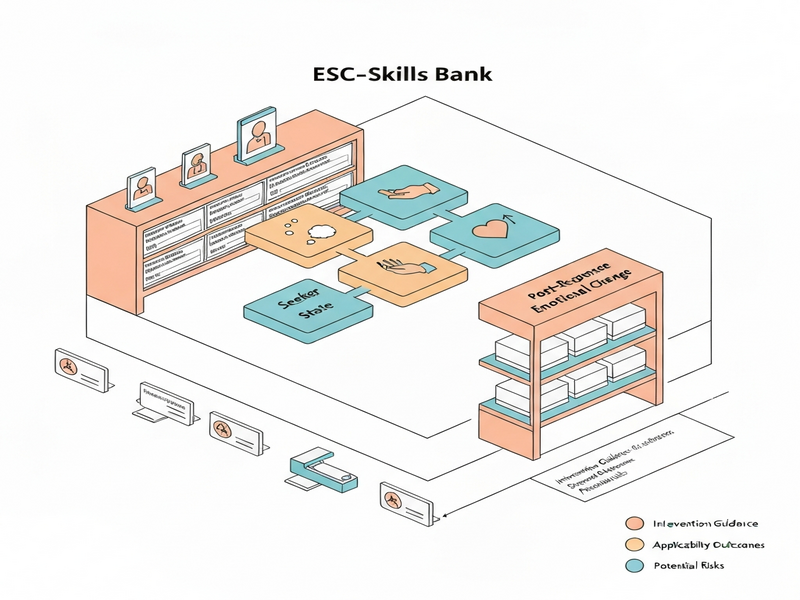
- ESC‑Skills Bank: A curated repository of IUs, each annotated with:
- Intervention guidance (what to say or do),
- Applicability conditions (when the skill is appropriate),
- Expected outcomes (target emotional change), and
- Potential risks (situations where the skill may backfire).
- Multi‑Profile Self‑Evolutionary Refinement: An automated loop where a simulated ESC agent interacts with diverse seeker profiles, collects failure traces, and feeds them back to expand or prune the Skills Bank.
By treating each skill as a first‑class citizen, the system gains interpretability (each response can be traced to a specific skill), controllability (developers can enable/disable skills), and a clear pathway for systematic improvement.
How It Works in Practice
The operational workflow can be broken down into four stages:
1. Data Harvesting & IU Extraction
Researchers ingest large corpora of ESC dialogues—both successful and failed interactions. Using a combination of sentiment analysis, dialogue act tagging, and outcome measurement (e.g., change in self‑reported affect), they isolate moments where a concrete intervention leads to a measurable emotional shift. Each such moment becomes an Intervention Unit.
2. Skills Bank Construction
Every IU is transformed into a skill entry. The entry includes:
- Trigger Pattern: Linguistic or contextual cues that signal the seeker’s state (e.g., “I feel hopeless”).
- Intervention Template: A parameterized response (e.g., “I hear you’re feeling {emotion}. That sounds really tough.”).
- Outcome Model: Probabilistic expectations of emotional change, derived from observed data.
- Risk Flags: Conditions under which the skill may cause harm (e.g., applying “reframing” to a user expressing suicidal ideation).
3. Real‑Time Skill Selection
During a live conversation, the ESC agent performs three sub‑steps:
- State Detection: A lightweight classifier evaluates the seeker’s current affect and intent.
- Skill Matching: The system queries the Skills Bank for entries whose trigger patterns align with the detected state and whose risk flags are not violated.
- Outcome‑Optimized Execution: Among the matching skills, the agent selects the one with the highest expected positive outcome, optionally blending multiple skills if they are compatible.
4. Self‑Evolutionary Loop
To keep the Skills Bank current, the framework runs a simulation environment called SAGE (Simulated Adaptive Generative Evaluation). SAGE generates synthetic seeker profiles that vary in demographics, mental‑health histories, and communication styles. The ESC agent interacts with these profiles, and the system logs:
- Missing interventions (states where no skill was applicable),
- Unsafe outcomes (negative emotional shifts despite skill usage), and
- Profile‑specific failure patterns (e.g., certain cultures responding poorly to direct validation).
These logs trigger automated refinement steps: new IUs are mined from simulated successes, risky skills are flagged for human review, and the Skills Bank is re‑validated through Monte‑Carlo simulations before deployment.
Evaluation & Results
The authors evaluated ESC‑Skills on two fronts: response‑level quality (fluency, relevance) and dialogue‑level emotional outcomes (change in affect scores).
Test Scenarios
- Benchmark Dataset: A publicly available ESC corpus containing 5,000 annotated dialogues.
- Simulated Seeker Profiles: 1,200 synthetic users generated by SAGE, covering a spectrum of emotional baselines and cultural contexts.
- Human Evaluation: 200 crowd‑sourced raters assessed empathy, safety, and perceived helpfulness on a 5‑point Likert scale.
Key Findings
- Improved Emotional Shifts: Dialogues powered by ESC‑Skills achieved an average +0.42 increase in self‑reported affect, compared to +0.21 for a strong end‑to‑end baseline.
- Higher Interpretability Scores: Raters could correctly identify the underlying intervention in 87% of ESC‑Skills responses versus 53% for the baseline, indicating clearer skill attribution.
- Safety Gains: Incidents of unsafe advice dropped by 68% after the self‑evolutionary refinement, thanks to risk‑flagging and profile‑aware pruning.
- Scalability: Adding 150 new IUs from simulated interactions increased coverage of rare emotional states by 34% without degrading response fluency.
Collectively, these results demonstrate that a skill‑centric architecture not only boosts measurable emotional outcomes but also delivers the transparency and safety required for real‑world deployment.
Why This Matters for AI Systems and Agents
For practitioners building conversational agents, ESC‑Skills offers a concrete pathway to move beyond “black‑box” generation:
- Modular Design: Skills can be added, removed, or versioned independently, aligning with micro‑service architectures and enabling A/B testing of specific interventions.
- Regulatory Alignment: The explicit risk annotations help satisfy emerging AI safety standards and mental‑health compliance frameworks.
- Orchestration Flexibility: Skills can be orchestrated by higher‑level policy engines, allowing product managers to prioritize certain therapeutic approaches (e.g., CBT‑style reframing) over others.
- Simulation‑First Development: The SAGE loop encourages a “test‑in‑silico” mindset, reducing costly live‑user experiments.
These capabilities map directly onto existing UBOS solutions. For example, integrating the ESC‑Skills engine with the Telegram integration on UBOS enables mental‑health support bots to operate within secure messaging channels. Pairing the skill bank with the OpenAI ChatGPT integration allows developers to blend generative language fluency with skill‑driven safety checks. Finally, storing skill metadata in the Chroma DB integration provides fast vector‑based retrieval for real‑time matching.
What Comes Next
While ESC‑Skills marks a significant step forward, several open challenges remain:
- Cross‑Cultural Generalization: Current IUs are derived primarily from English‑language corpora. Extending the Skills Bank to multilingual and culturally diverse datasets will require new annotation pipelines.
- Long‑Term Therapeutic Impact: The paper measures immediate affect shifts; future work should assess sustained outcomes over weeks or months.
- Human‑In‑The‑Loop Validation: Automated risk flags are useful, but integrating domain experts (psychologists, ethicists) into the refinement loop could further reduce false positives.
- Dynamic Skill Composition: Exploring how multiple skills can be safely combined in a single turn—e.g., validation followed by problem‑solving—remains an open research frontier.
Potential applications extend beyond mental‑health chat‑bots. Customer‑support agents could use a Skills Bank to de‑escalate angry callers, while educational tutors might employ empathy‑driven interventions to improve student engagement. The modular nature of ESC‑Skills also makes it a natural fit for the Enterprise AI platform by UBOS, where large organizations can curate domain‑specific skill libraries that comply with internal policies.
Developers interested in experimenting with the framework can access the open‑source release, including code, prompts, and a pre‑populated Skills Bank, at the project’s GitHub repository: ESC‑Skills on arXiv.
Conclusion
ESC‑Skills reframes emotional support dialogue from opaque text generation to a transparent, skill‑driven process. By extracting Intervention Units, assembling a richly annotated Skills Bank, and continuously refining it through simulated multi‑profile interactions, the framework delivers measurable improvements in emotional outcomes, safety, and interpretability. For AI developers and product teams, this translates into more controllable agents, easier compliance, and a clear roadmap for incremental capability growth. As the field moves toward responsible, human‑centered conversational AI, skill‑centric architectures like ESC‑Skills are likely to become foundational building blocks.
Andrii Bidochko
CTO UBOS
Andrii Bidochko is an AI entrepreneur and researcher focused on AI agents, reinforcement learning, and autonomous systems. He writes about the technologies shaping the future of machine intelligence, from frontier models and agent architectures to real-world AI applications.