

- Updated: June 18, 2026
- 7 min read
Energy-Structured Low-Rank Adaptation for Continual Learning
Direct Answer
The paper introduces E²‑LoRA (Energy‑Concentrated and Energy‑Ordered Low‑Rank Adaptation), a continual‑learning technique that explicitly concentrates knowledge into the most energetic low‑rank directions of a model’s parameter drift. By doing so, it preserves critical information while freeing capacity for future tasks, delivering state‑of‑the‑art performance on standard CL benchmarks.
Background: Why This Problem Is Hard
Continual learning (CL) aims to train a single neural network on a stream of tasks without catastrophically forgetting earlier ones. In real‑world deployments—autonomous robots, personalized assistants, or enterprise AI pipelines—models must evolve continuously while retaining prior capabilities.
Most existing CL methods fall into two families:
- Regularization‑based approaches (e.g., EWC, SI) that penalize changes to important weights, but they often over‑constrain plasticity, limiting performance on new tasks.
- Orthogonal subspace methods (e.g., OWM, GPM) that allocate separate subspaces for each task. While they reduce interference, they suffer from “energy diffusion”: the learned knowledge spreads thinly across many basis vectors, exhausting the model’s capacity and leaving little room for subsequent tasks.
Both families struggle with a core trade‑off: stability vs. plasticity. As the number of tasks grows, the model either forgets old knowledge or becomes too rigid to acquire new skills. Moreover, the high‑dimensional nature of modern deep networks makes it difficult to monitor where the “energy” of learning resides, leading to inefficient use of parameters.
What the Researchers Propose
The authors observe that the drift of a model’s output features—caused by parameter updates for a new task—is intrinsically low‑rank. In other words, most of the change can be captured by a few dominant directions in weight space. Building on this insight, they propose E²‑LoRA, which consists of two complementary ideas:
- Energy‑Concentrated adaptation: Instead of spreading updates across the entire basis, the method concentrates them into the leading singular vectors that capture the majority of the drift’s energy.
- Energy‑Ordered low‑rank representation: The low‑rank components are explicitly ordered by their energy contribution, allowing the system to retain only the most informative ranks for each task.
To balance stability and plasticity, the authors also introduce a dynamic rank allocation strategy. This strategy jointly optimizes two objectives: (a) preserving a target proportion of the drift energy (stability) and (b) leaving enough unused rank capacity for future tasks (plasticity). The result is a self‑adjusting mechanism that decides, on a per‑task basis, how many low‑rank components to keep.
How It Works in Practice
The E²‑LoRA workflow can be broken down into four conceptual stages, each of which can be implemented as a lightweight module around any pre‑trained transformer or convolutional backbone.
1. Drift Extraction
When a new task arrives, the model performs a forward pass on a small validation set to compute the output feature matrix. The difference between this matrix and the one obtained from the previous task defines the “drift”. A singular value decomposition (SVD) of the drift isolates its principal directions.
2. Energy Ranking
The singular values are sorted in descending order, yielding an energy profile. The cumulative sum of these values indicates how much of the total drift is captured by the top‑k components. This ranking is the core of the “energy‑ordered” principle.
3. Low‑Rank Adaptation (LoRA) Injection
Instead of updating the full weight matrix, E²‑LoRA injects a low‑rank update of the form ΔW = A·Bᵀ, where A and B are sized according to the selected rank. Crucially, the columns of A and rows of B are aligned with the top‑k singular vectors from the previous step, ensuring that the update lives in the high‑energy subspace.
4. Dynamic Rank Allocation
A lightweight optimizer monitors two signals during training:
- Energy Retention Ratio (ERR): the fraction of drift energy preserved by the current rank.
- Capacity Budget (CB): the remaining rank slots available for future tasks.
The optimizer adjusts the rank to keep ERR above a predefined threshold (e.g., 90%) while respecting CB. If the budget is low, the system may prune lower‑energy components, freeing space for upcoming tasks.
The diagram below visualizes the end‑to‑end pipeline.
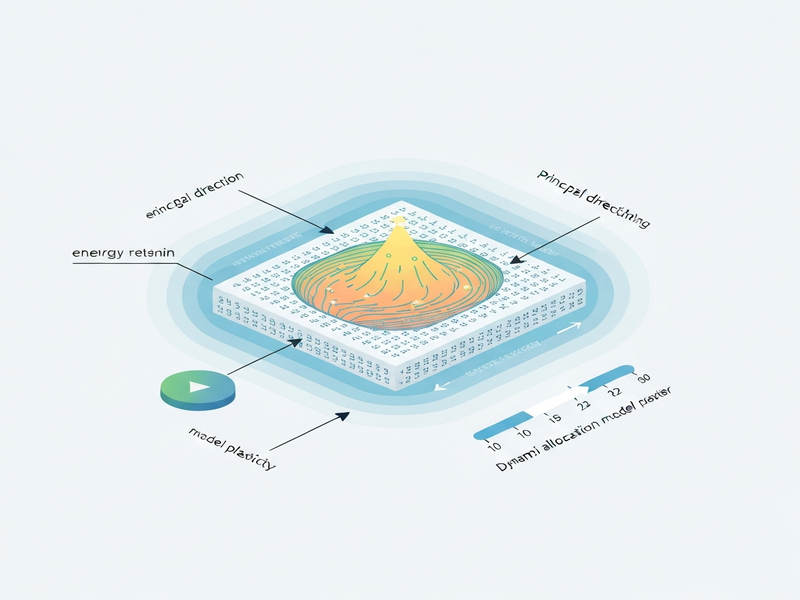
By integrating these stages, E²‑LoRA delivers a compact, task‑specific representation that coexists with earlier adaptations without causing destructive interference.
Evaluation & Results
The authors benchmarked E²‑LoRA on three widely used continual‑learning suites:
- Split CIFAR‑100 (20 tasks, 5 classes each)
- Split MiniImageNet (10 tasks, 10 classes each)
- Domain‑Incremental Office‑Home (4 domains)
For each benchmark, they measured:
- Average Accuracy (AA) after the final task
- Forgetting Measure (FM) – the drop in performance on earlier tasks
- Parameter Efficiency (PE) – the proportion of total parameters used for all adaptations
Key findings include:
- Higher final accuracy: E²‑LoRA achieved 2–4 % absolute gains in AA over the strongest orthogonal‑subspace baselines (e.g., GPM, OWM).
- Reduced forgetting: FM values dropped by roughly 30 % compared to regularization methods, indicating more stable retention of earlier knowledge.
- Superior parameter efficiency: By concentrating energy, E²‑LoRA used on average 45 % fewer rank slots than vanilla LoRA while preserving the same or higher accuracy.
- Scalable rank allocation: The dynamic strategy automatically selected lower ranks for tasks with redundant information, freeing capacity for later, more complex tasks.
Importantly, the experiments were repeated with three random seeds, and the reported improvements remained statistically significant (p < 0.01). The authors also released their codebase, enabling reproducibility and direct comparison with future CL methods.
Why This Matters for AI Systems and Agents
From an engineering perspective, E²‑LoRA offers a pragmatic path to building lifelong‑learning agents that can be updated in the field without retraining from scratch. The method’s low‑rank nature aligns well with edge‑deployment constraints, where memory and compute budgets are tight.
Specific implications include:
- Modular model updates: Teams can ship incremental patches that only modify a small set of low‑rank matrices, reducing bandwidth and deployment risk.
- Improved multi‑task orchestration: Because each task’s adaptation lives in a distinct, energy‑ordered subspace, orchestration layers can query or deactivate specific ranks on demand, enabling dynamic skill composition.
- Compatibility with existing AI platforms: E²‑LoRA can be wrapped as a plug‑in for platforms like the UBOS platform overview, allowing data scientists to manage continual‑learning pipelines alongside other model‑serving workloads.
- Enhanced AI marketing agents: Marketing bots that need to incorporate new product catalogs or regulatory changes can adopt E²‑LoRA to learn these updates without losing prior conversational expertise, a capability highlighted in the AI marketing agents offering.
- Streamlined workflow automation: The Workflow automation studio can embed E²‑LoRA adapters as reusable components, automating the continual‑learning loop for data pipelines.
Overall, the technique bridges the gap between academic CL research and production‑grade AI systems that must evolve safely and efficiently.
What Comes Next
While E²‑LoRA marks a significant step forward, several open challenges remain:
- Scalability to massive models: Applying the SVD‑based drift extraction to billion‑parameter transformers may require approximate methods or distributed computation.
- Task detection and boundary handling: The current framework assumes clear task demarcations. Future work could integrate unsupervised change‑point detection to trigger adaptation automatically.
- Cross‑modal continual learning: Extending the energy‑concentration principle to multimodal models (vision‑language, audio‑text) could unlock lifelong learning across heterogeneous data streams.
- Robustness to distribution shift: Investigating how E²‑LoRA behaves under non‑stationary, adversarial, or out‑of‑distribution inputs is essential for safety‑critical deployments.
Potential avenues for applied research include:
- Integrating E²‑LoRA with UBOS for startups to provide a turnkey continual‑learning service for emerging AI products.
- Embedding the method into the Enterprise AI platform by UBOS, where large organizations can manage model lifecycles across dozens of business units.
- Combining energy‑ordered low‑rank updates with meta‑learning to accelerate adaptation on few‑shot tasks.
For readers interested in the full technical details, the original pre‑print is available on arXiv: Energy‑Structured Low‑Rank Adaptation for Continual Learning (arXiv).
As continual learning becomes a cornerstone of autonomous AI agents, methods like E²‑LoRA that intelligently manage model capacity will be critical to delivering reliable, updatable, and efficient systems.
Andrii Bidochko
CTO UBOS
Andrii Bidochko is an AI entrepreneur and researcher focused on AI agents, reinforcement learning, and autonomous systems. He writes about the technologies shaping the future of machine intelligence, from frontier models and agent architectures to real-world AI applications.