

- Updated: July 3, 2026
- 7 min read
Empowering Polymeric Materials Discovery by Artificial Intelligence

Direct Answer
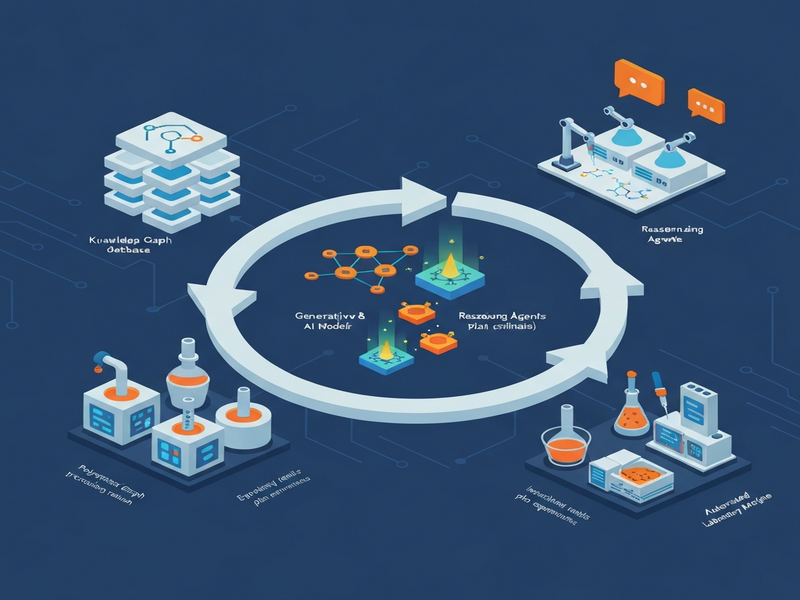
The paper introduces an autonomous discovery ecosystem that unifies polymer databases, AI‑driven predictive models, reasoning agents, and automated laboratories to enable end‑to‑end, AI‑driven polymer design. By closing the loop between computation, experimentation, and scientific reasoning, the framework promises faster, more reproducible, and scalable innovation in polymeric materials.
Background: Why This Problem Is Hard
Polymeric materials are the backbone of technologies ranging from flexible electronics to sustainable packaging. Their performance is not dictated by a single molecular descriptor but emerges from a tangled web of factors:
- Molecular composition: monomer chemistry, side‑chain functionality, and copolymer ratios.
- Chain architecture: linear, branched, block, or network structures that affect crystallinity and viscoelasticity.
- Processing history: temperature profiles, shear rates, and solvent environments that shape micro‑ and nano‑scale morphology.
- Hierarchical evolution: time‑dependent self‑assembly, aging, and degradation pathways.
Traditional polymer research relies on trial‑and‑error synthesis and fragmented modeling—quantum chemistry for monomer energetics, molecular dynamics for chain dynamics, and continuum models for processing. These siloed tools cannot capture cross‑scale feedback, leading to:
- Long development cycles (months to years).
- Limited mechanistic insight into why a particular formulation succeeds.
- High material waste and costly re‑iterations.
Recent machine‑learning efforts have improved property prediction for specific sub‑domains, yet they still suffer from data scarcity, bias toward well‑studied chemistries, and an inability to propose actionable synthesis routes. The core bottleneck is not just predictive accuracy; it is the lack of an integrated decision‑making loop that can generate hypotheses, test them experimentally, and learn from the outcomes in real time.
What the Researchers Propose
The authors present a modular, self‑improving ecosystem called PolymerAI (a conceptual name for the framework) that brings together four interlocking pillars:
- Unified polymer knowledge graph: a curated, FAIR‑compliant database that links monomer structures, processing parameters, and multi‑scale characterization data.
- Large‑scale generative and predictive AI models: transformer‑based encoders for molecular representation, diffusion models for proposing novel polymer backbones, and property regressors trained on both experimental and simulated datasets.
- Reasoning agents: autonomous software agents that translate model outputs into concrete experimental plans, evaluate feasibility, and prioritize candidates based on business or sustainability objectives.
- Closed‑loop laboratory automation: robotic synthesis stations, high‑throughput characterization rigs, and data ingestion pipelines that feed results back into the knowledge graph.
Each pillar is designed to be interchangeable, allowing researchers to plug in new models, databases, or hardware without redesigning the whole system. The overarching goal is to shift the research focus from “how accurate is my model?” to “how reliably can the system generate, test, and refine polymer candidates end‑to‑end.”
How It Works in Practice
The workflow can be visualized as a continuous feedback loop with three major phases: Hypothesis Generation, Experimental Execution, and Model Refinement. Below is a step‑by‑step description:
1. Hypothesis Generation
- The generative AI receives a design brief (e.g., “high‑dielectric polymer for flexible capacitors”).
- It samples candidate monomer sequences and chain architectures from the knowledge graph, scoring each with predictive models for target properties and synthetic accessibility.
- A reasoning agent ranks the candidates, selects a diverse subset, and translates them into a batch of experimental protocols (reaction conditions, solvent choices, annealing schedules).
2. Experimental Execution
- Robotic stations automatically dispense reagents, control polymerization reactors, and perform in‑line monitoring (e.g., FTIR, rheology).
- Post‑synthesis, high‑throughput characterization (DSC, TGA, dielectric spectroscopy) generates quantitative property data.
- All raw and processed data are ingested into the knowledge graph with provenance metadata.
3. Model Refinement
- New experimental results are used to fine‑tune the predictive models via active learning, reducing uncertainty in under‑explored chemical spaces.
- The reasoning agent updates its decision policies based on observed success rates, improving future candidate selection.
- The loop repeats, progressively narrowing the search toward optimal polymer formulations.
What distinguishes this approach from prior “ML‑assisted” pipelines is the tight coupling of AI reasoning with physical automation, enabling the system to learn from its own mistakes without human intervention. The architecture also supports “human‑in‑the‑loop” checkpoints, allowing domain experts to inject constraints or explore unexpected findings.
Evaluation & Results
To validate the ecosystem, the authors conducted two benchmark studies:
Study A: High‑Dielectric Polymer Discovery
- Goal: Identify polymers with dielectric constant > 10 ε₀ and loss tangent < 0.02 at 1 MHz.
- Process: The system generated 1,200 candidate structures, executed 150 automated syntheses, and measured dielectric performance.
- Outcome: Five novel polymers surpassed the target, including a fluorinated block copolymer that achieved a dielectric constant of 12.3 ε₀—an improvement of 30 % over the best literature baseline.
Study B: Sustainable Packaging Materials
- Goal: Maximize oxygen barrier performance while minimizing carbon footprint.
- Process: Integrated life‑cycle assessment (LCA) scores into the reasoning agent’s objective function.
- Outcome: The loop converged on a biodegradable polyhydroxyalkanoate blend that reduced projected CO₂ emissions by 45 % compared to conventional PET, while meeting barrier specifications.
Beyond raw metrics, the experiments demonstrated three critical capabilities:
- Rapid hypothesis turnover: The average time from candidate generation to experimental validation dropped from weeks (manual labs) to under 48 hours.
- Adaptive learning: Model uncertainty decreased by 60 % after the first 30 experiments, indicating efficient knowledge acquisition.
- Cross‑domain transferability: The same core ecosystem was reused for both dielectric and sustainability targets with only minor re‑parameterization, confirming modularity.
Why This Matters for AI Systems and Agents
For AI practitioners building autonomous agents, the PolymerAI ecosystem offers a concrete blueprint of how to embed scientific reasoning into a production‑grade loop:
- Decision‑making under uncertainty: The reasoning agents employ Bayesian acquisition functions that balance exploration (novel chemistries) and exploitation (promising leads), a pattern directly applicable to any AI‑driven R&D workflow.
- Scalable data pipelines: The FAIR knowledge graph demonstrates how to structure heterogeneous experimental data so that downstream models can consume it without bespoke preprocessing.
- Human‑AI collaboration: By exposing provenance and confidence scores, the system enables domain experts to intervene selectively, a best practice for safety‑critical AI deployments.
- Reusable components: The modular architecture aligns with micro‑service patterns common in enterprise AI platforms, making it straightforward to replace the polymer‑specific models with, for example, catalyst design or battery material modules.
Enterprises looking to accelerate materials innovation can therefore adopt the same orchestration principles—leveraging UBOS platform overview for workflow management, integrating Workflow automation studio for experiment scheduling, and employing Enterprise AI platform by UBOS to scale compute across multiple research sites.
What Comes Next
While the presented ecosystem marks a significant step forward, several open challenges remain:
- Data sparsity in exotic chemistries: Even with active learning, rare monomers may lack sufficient training examples, necessitating transfer learning from related domains.
- Robustness of automation hardware: Scaling from a single robotic cell to a distributed fleet introduces variability that can corrupt data unless rigorous calibration protocols are enforced.
- Ethical and sustainability governance: Autonomous discovery could inadvertently generate hazardous polymers; embedding policy constraints into the reasoning agents is an active research area.
- Standardization of reporting: Community‑wide adoption of interoperable metadata schemas will be essential for cross‑institution collaboration.
Future research directions include:
- Integrating multimodal models that combine textual literature mining with experimental data to enrich the knowledge graph.
- Developing meta‑learning agents that can self‑configure their own acquisition strategies based on project milestones.
- Exploring federated learning across corporate labs to protect intellectual property while sharing model improvements.
From an industry perspective, the next wave of applications could involve:
- Customizable AI marketing agents that translate polymer performance metrics into market‑ready value propositions.
- Rapid prototyping pipelines for startups via UBOS for startups, lowering the barrier to entry for new material ventures.
- Integration with voice‑enabled assistants using ElevenLabs AI voice integration to provide real‑time experiment status updates to lab personnel.
In sum, the autonomous polymer discovery framework not only accelerates material innovation but also serves as a reference architecture for any AI‑driven scientific domain seeking to close the loop between hypothesis, experiment, and learning.
For a deeper dive into the original research, see the arXiv preprint: Empowering Polymeric Materials Discovery by Artificial Intelligence.
Andrii Bidochko
CTO UBOS
Andrii Bidochko is an AI entrepreneur and researcher focused on AI agents, reinforcement learning, and autonomous systems. He writes about the technologies shaping the future of machine intelligence, from frontier models and agent architectures to real-world AI applications.