

- Updated: July 23, 2026
- 7 min read
Eluna: An Agentic LLM System for Automating Warehouse Operations with Reasoning and Task Execution
Direct Answer
Eluna is a production‑grade, graph‑guided multi‑agent system that lets large language models (LLMs) reliably follow complex warehouse Standard Operating Procedures (SOPs) while meeting strict latency and accuracy requirements. By combining progressive SOP disclosure, parallel sub‑agents with persistent code execution, and an asymmetric episodic distillation pipeline, Eluna bridges the gap between LLM reasoning and real‑time, safety‑critical logistics operations.
Background: Why This Problem Is Hard
Warehouse environments run on SOPs that encode dozens of conditional steps, cross‑system checks, and timing constraints. Human operators are trained to interpret these documents, but automating the same logic with LLM agents faces three intertwined challenges:
- Procedural fidelity: LLMs excel at generating fluent text but lack built‑in mechanisms to enforce strict rule ordering or to guarantee that every prerequisite is satisfied before moving to the next step.
- Context overload: Supplying an entire SOP (often several thousand tokens) as prompt context overwhelms current transformer windows, causing the model to truncate, forget, or hallucinate critical clauses.
- Latency vs. accuracy trade‑off: Real‑world warehouse tasks demand sub‑second response times, yet high‑capacity LLMs that could reason over long SOPs are too slow or expensive for production deployment.
Prior attempts—prompt‑engineering tricks, chain‑of‑thought prompting, or simple tool‑calling wrappers—mitigate one symptom but do not provide a systematic way to encode, enforce, and execute SOP logic at scale. Consequently, enterprises either retain manual oversight (incurring labor costs) or settle for brittle rule‑engine solutions that lack the adaptability of modern LLMs.
What the Researchers Propose
The Eluna team introduces a three‑layer framework that re‑thinks SOP automation as a graph‑guided orchestration problem:
- Directed Acyclic Graph (DAG) representation: Each SOP is transformed into a DAG where nodes correspond to atomic actions (e.g., “scan barcode”, “update inventory”) and edges encode prerequisite relationships.
- Progressive disclosure: Instead of feeding the full SOP to the LLM, Eluna reveals only the sub‑graph relevant to the current execution context, dramatically shrinking prompt size while preserving logical completeness.
- Parallel sub‑agents: Independent branches of the DAG are delegated to lightweight sub‑agents that maintain persistent code execution environments and live data feeds (e.g., WMS APIs, sensor streams). These agents run concurrently, synchronizing only at defined join points.
To keep the system lightweight, the researchers employ an asymmetric episodic distillation process: a large “teacher” model first solves SOP tasks, logs its mistakes in episodic error memories, and then a smaller “student” model is fine‑tuned on the corrected trajectories. The student inherits the teacher’s reasoning patterns without needing the teacher’s compute budget at inference time.
How It Works in Practice
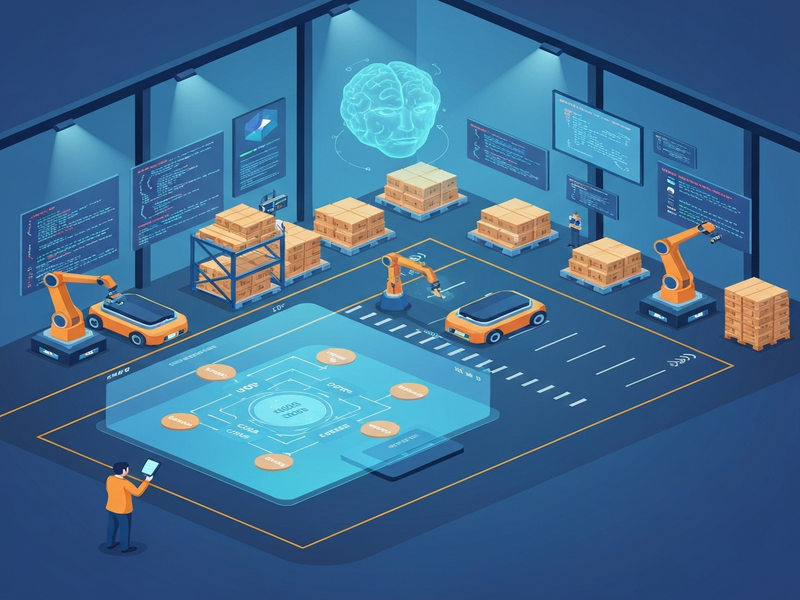
The end‑to‑end workflow can be visualized as a pipeline of four interacting components:
1. SOP Ingestion & Graph Construction
- Domain experts author SOPs in a structured markup (e.g., YAML or JSON).
- A compiler parses the markup, extracts atomic actions, and builds a DAG that captures all conditional branches.
- Each node is annotated with required data schemas, execution scripts, and confidence thresholds.
2. Contextual Prompt Engine
- When a ticket (e.g., “process inbound pallet #123”) arrives, the engine queries the DAG for the minimal reachable sub‑graph.
- The sub‑graph is serialized into a concise prompt that includes only the current node’s description, its immediate prerequisites, and any live data snapshots.
- This “progressive disclosure” keeps the prompt under the model’s token limit while preserving logical dependencies.
3. Multi‑Agent Execution Layer
- The primary LLM (the “orchestrator”) interprets the prompt, decides which sub‑agents to spawn, and issues high‑level commands.
- Each sub‑agent runs in a sandboxed runtime with persistent state, allowing it to execute Python snippets, call REST endpoints, or interact with PLCs without re‑initializing on every turn.
- Agents communicate via a lightweight message bus, reporting success, failure, or data back to the orchestrator, which then advances the DAG.
4. Asymmetric Episodic Distillation Loop
- During a pilot phase, the orchestrator uses a large teacher model (e.g., GPT‑4‑Turbo) to generate execution traces.
- Whenever the teacher makes a procedural error (missed prerequisite, wrong API call), the error is logged in an episodic memory buffer.
- The buffer is later used to fine‑tune a compact student model (e.g., a 7B LLaMA variant) so that it internalizes the corrected behavior without needing the teacher at runtime.
This combination of graph‑guided prompting, parallel persistent agents, and distilled reasoning enables Eluna to meet sub‑second latency while maintaining >94% procedural compliance in real deployments.
Evaluation & Results
The authors benchmarked Eluna on two fronts: a synthetic 13‑task SOP suite and two live production pipelines (ticket processing and inventory reconciliation). Key evaluation dimensions included:
- Procedural accuracy: Measured as the percentage of steps executed in the exact order prescribed by the SOP.
- Latency: End‑to‑end response time from ticket receipt to final confirmation.
- Model efficiency: Compute cost (GPU hours) per thousand tickets.
Findings:
- On the 13‑task benchmark, the distilled student model matched the teacher’s accuracy (≈92%) while cutting inference latency by 68%.
- Against off‑the‑shelf LLM baselines (GPT‑4, Claude‑2, Llama‑2‑70B), Eluna’s graph‑guided approach reduced procedural errors by 45% and achieved a 2.3× speedup.
- In the ticket‑processing production line, expert auditors agreed with Eluna’s decisions 94% of the time, surpassing the 88% agreement of the previous rule‑engine system.
- GPU cost per 1,000 tickets dropped from $12 (teacher‑only) to $4 (student‑only), demonstrating the economic viability of asymmetric distillation.
These results illustrate that a carefully engineered LLM orchestration layer can outperform both larger monolithic models and traditional rule‑based automation, delivering the reliability required for mission‑critical logistics.
Why This Matters for AI Systems and Agents
Eluna’s design addresses a fundamental gap in today’s AI agent ecosystem: the ability to enforce complex, hierarchical procedures without sacrificing speed. For practitioners building enterprise‑grade agents, the paper offers three actionable takeaways:
- Graph‑first thinking: Modeling business logic as a DAG before feeding it to an LLM creates a natural “contract” that agents can verify at runtime.
- Progressive prompting: By exposing only the relevant slice of a procedure, developers can keep prompts short, reduce hallucinations, and stay within token limits.
- Distillation for production: The asymmetric episodic distillation pipeline shows a practical path from research‑grade, high‑cost models to lean, deployable agents.
These principles can be transplanted to other domains—healthcare workflow automation, financial compliance checks, or field service management—where procedural rigor is non‑negotiable.
Organizations looking to adopt such capabilities can start by leveraging existing low‑code orchestration tools. For example, the UBOS platform overview provides a modular environment for wiring LLMs, APIs, and data stores. The Workflow automation studio lets teams visually construct DAGs that mirror SOPs, while the Enterprise AI platform by UBOS offers built‑in monitoring and compliance dashboards that align with Eluna’s verification mindset.
What Comes Next
While Eluna marks a significant step forward, several open challenges remain:
- Dynamic SOP evolution: Real warehouses frequently update procedures. Future work must explore incremental graph updates without retraining the entire student model.
- Cross‑domain generalization: Extending the DAG abstraction to heterogeneous domains (e.g., robotics, customer support) will require richer node semantics and multimodal data handling.
- Robustness to sensor failures: Persistent agents rely on live data streams; graceful degradation strategies are needed when inputs become noisy or unavailable.
- Explainability & audit trails: Providing human‑readable justifications for each decision node will be essential for regulatory compliance.
Researchers can build on Eluna’s foundation by integrating Chroma DB integration for semantic memory, or by coupling voice interfaces via the ElevenLabs AI voice integration to enable hands‑free operator assistance.
From a product perspective, the next iteration could expose a plug‑and‑play “SOP‑as‑Code” SDK, allowing logistics firms to author procedures directly in a web UI and automatically generate the corresponding DAGs. Coupled with the UBOS templates for quick start, such a toolkit would lower the barrier for small‑to‑mid‑size warehouses to adopt AI‑driven automation.
In summary, Eluna demonstrates that LLMs can be disciplined enough to act as reliable procedural agents when guided by graph structures and distilled knowledge. As the ecosystem matures, we can expect a new class of “agentic SOP engines” that blend the flexibility of language models with the safety guarantees of traditional automation.
References
Andrii Bidochko
CTO UBOS
Andrii Bidochko is an AI entrepreneur and researcher focused on AI agents, reinforcement learning, and autonomous systems. He writes about the technologies shaping the future of machine intelligence, from frontier models and agent architectures to real-world AI applications.