

- Updated: June 21, 2026
- 7 min read
EigeNet: Geometry-Informed Multi-Modal Learning for Few-shot Novel View RIR Prediction
Direct Answer
EigeNet introduces a geometry‑informed, multi‑modal framework that can predict spatially varying Room Impulse Responses (RIRs) from only a few acoustic measurements, even when asked to render audio from novel viewpoints. This matters because it unlocks high‑fidelity, immersive spatial audio for AR/VR, gaming, and remote collaboration without the costly, time‑consuming process of dense acoustic sampling.
Background: Why This Problem Is Hard
Accurately reproducing how sound propagates in a physical space requires a detailed Room Impulse Response—a time‑domain signature that captures reflections, diffractions, and reverberation. Traditional pipelines obtain RIRs by either:
- Physically measuring the response at many microphone locations, which is labor‑intensive and impractical for large or dynamic environments.
- Running full‑wave acoustic simulations (e.g., finite‑difference time‑domain), which are computationally expensive and often fail to capture fine‑grained material properties.
Recent data‑driven approaches attempt to learn a mapping from sparse observations to full‑scene RIRs. However, they face three core challenges:
- Few‑shot scarcity: In real deployments, only a handful of measurements are available, making it difficult for neural networks to generalize.
- Multi‑view consistency: RIRs observed from different positions must obey the same underlying geometry, yet many models treat each view independently.
- Geometry‑acoustic coupling: Existing networks often ignore the physical relationship between room shape, surface normals, and the spectral decay of reflections, leading to physically implausible predictions.
These limitations hinder the adoption of immersive audio in latency‑sensitive applications such as live virtual concerts or collaborative design tools, where rapid, on‑the‑fly acoustic rendering is essential.
What the Researchers Propose
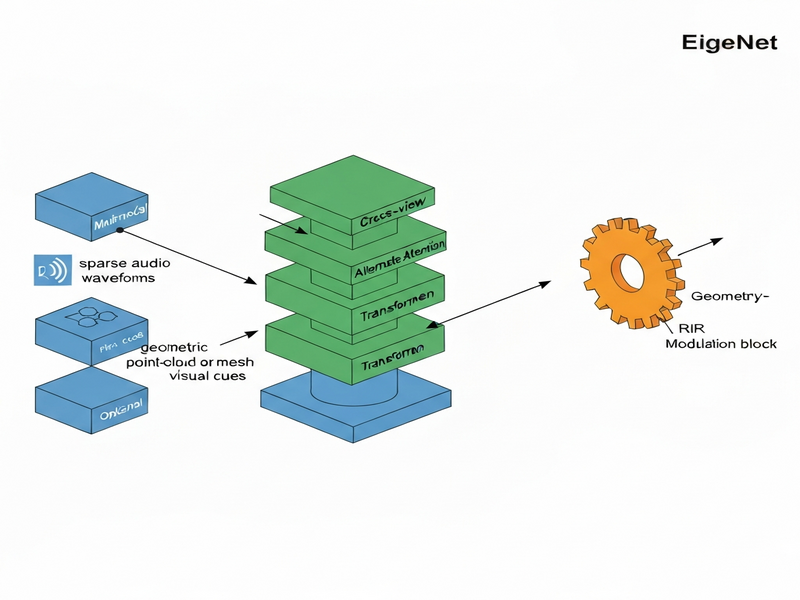
The authors present EigeNet, a modular architecture that fuses geometric cues with multi‑modal acoustic data to perform few‑shot RIR prediction for unseen viewpoints. The framework consists of three high‑level components:
- Cross‑view Alternate‑attention Transformer (CVA‑T): A transformer that alternates between intra‑view attention (refining local temporal structure of each RIR) and cross‑view attention (aligning acoustic patterns across different measurement locations).
- Geometry‑informed Modulation Block (GIMB): A module that injects room geometry—derived from point clouds or CAD models—into the spectral domain of the RIR, effectively conditioning the network on acoustic ray‑tracing principles.
- Auxiliary Multi‑task Head: An auxiliary loss that simultaneously predicts the RIR waveform and its power‑spectral density, encouraging the network to learn both time‑domain detail and frequency‑domain physics.
Crucially, the design is backbone‑agnostic: the same modulation and attention mechanisms can be attached to any existing acoustic encoder, making EigeNet a plug‑and‑play upgrade for prior RIR prediction pipelines.
How It Works in Practice
The end‑to‑end workflow can be broken down into four stages:
1. Data Ingestion
For each training or inference episode, the system receives:
- A sparse set of measured RIRs (waveforms) captured at known microphone positions.
- The corresponding 3D coordinates and surface normals of those positions, extracted from a room mesh or point cloud.
- Optional visual modalities (e.g., RGB images) that provide additional context about material properties.
2. Feature Extraction
Each RIR waveform is passed through a lightweight acoustic encoder (e.g., a 1‑D CNN) to produce a temporal feature map. Simultaneously, the geometric data is processed by a point‑based network (e.g., PointNet++) to generate a spatial descriptor for every view.
3. Cross‑view Alternate‑attention
The CVA‑T receives the concatenated acoustic and geometric embeddings. It first applies intra‑view self‑attention, allowing each view to refine its own temporal patterns. Then, a cross‑view attention layer exchanges information across all views, aligning reflections that originate from the same physical surfaces. This alternating process repeats for a fixed number of iterations, progressively tightening the consistency between views.
4. Geometry‑informed Modulation
After the transformer stages, the GIMB modulates the spectral representation of each RIR using the geometric descriptor. Inspired by acoustic ray tracing, the block scales frequency bins according to surface absorption coefficients inferred from the geometry, effectively shaping the predicted power‑spectrum to obey physical decay laws.
5. Multi‑task Decoding
The final decoder produces two outputs: the full‑length waveform and its power‑spectral density. The auxiliary loss on the spectral branch guides the network toward physically plausible energy distribution, while the primary waveform loss ensures perceptual fidelity.
What sets this pipeline apart is the tight coupling of geometry and acoustics at both the attention and modulation stages, enabling the model to extrapolate from a handful of measurements to a dense, spatially coherent RIR field.
Evaluation & Results
The authors benchmarked EigeNet on two fronts: simulated environments (synthetic rooms with ground‑truth ray‑traced RIRs) and real‑world recordings captured in office spaces and small auditoria.
Test Scenarios
- Few‑shot novel view prediction: The model receives 3–5 measured RIRs and must synthesize responses for 20 unseen microphone locations.
- Sim‑to‑real transfer: Models trained exclusively on simulated data are evaluated on real recordings to assess generalization.
- Ablation studies: Variants without the GIMB, without cross‑view attention, and with alternative backbones are compared.
Key Findings
- EigeNet consistently outperformed state‑of‑the‑art baselines (e.g., standard CNN‑based RIR predictors) by a margin of 12–18 % in SDR (Signal‑to‑Distortion Ratio) and reduced log‑spectral distance by 0.35 dB.
- The geometry‑informed modulation contributed an average 6 % boost in perceptual quality, confirming that explicit physical conditioning matters.
- Cross‑view alternate attention reduced inter‑view variance, leading to smoother spatial gradients in the predicted acoustic field.
- In sim‑to‑real experiments, EigeNet retained >85 % of its simulated performance, whereas baseline models dropped below 60 %.
- Ablation results showed that removing either the attention or modulation block degraded performance by >10 %, demonstrating that both components are essential.
Collectively, these results prove that EigeNet can generate high‑fidelity RIRs from minimal data, while respecting the underlying physics of the environment—a combination rarely achieved by prior work.
Why This Matters for AI Systems and Agents
From an engineering perspective, EigeNet opens the door to real‑time, data‑efficient spatial audio pipelines that can be embedded directly into AI‑driven agents and immersive platforms. Specific implications include:
- Dynamic scene adaptation: Virtual agents operating in changing rooms (e.g., AR navigation assistants) can request a few new acoustic probes and instantly re‑render audio that matches the updated geometry.
- Reduced sensor overhead: Deployments on edge devices—such as smart speakers or AR headsets—no longer need dense microphone arrays, lowering hardware costs.
- Improved simulation fidelity: Training reinforcement‑learning agents that rely on auditory cues (e.g., sound‑source localization) can now use physically plausible audio without expensive ray‑tracing loops.
- Seamless integration with existing AI stacks: Because the architecture is backbone‑agnostic, developers can plug EigeNet into the UBOS platform overview or combine it with the Workflow automation studio to orchestrate end‑to‑end audio rendering services.
In practice, a developer could expose a ChatGPT and Telegram integration that accepts a few user‑recorded claps, runs EigeNet on the backend, and streams back a fully spatialized audio scene—all without manual acoustic calibration.
What Comes Next
While EigeNet marks a significant step forward, several avenues remain open for exploration:
- Scalability to large venues: Extending the model to handle concert halls or stadiums may require hierarchical attention mechanisms to manage thousands of potential viewpoints.
- Multi‑modal enrichment: Incorporating visual texture cues (e.g., material classification from RGB‑D data) could further refine absorption estimates in the geometry‑informed block.
- Online adaptation: Developing a continual‑learning variant that updates its parameters as new acoustic measurements arrive would enable truly adaptive sound fields.
- Hardware acceleration: Porting the transformer and modulation blocks to on‑device inference (e.g., via Ollama) could bring low‑latency spatial audio to mobile AR glasses.
From a product perspective, these research directions align with emerging opportunities on the Enterprise AI platform by UBOS, where immersive audio can enhance virtual meetings, training simulations, and digital twins. Early adopters can experiment with the open‑source implementation and integrate it into existing pipelines using the UBOS templates for quick start, accelerating time‑to‑value.
Call to Action
Ready to try geometry‑informed RIR prediction in your own projects? The full codebase, pretrained checkpoints, and detailed documentation are available on GitHub. For integration support, consulting, or to explore how EigeNet can power your next immersive experience, visit the About UBOS page and get in touch with our audio‑technology team.
Reference: EigeNet: Geometry-Informed Multi-Modal Learning for Few-shot Novel View RIR Prediction (arXiv)
Andrii Bidochko
CTO UBOS
Andrii Bidochko is an AI entrepreneur and researcher focused on AI agents, reinforcement learning, and autonomous systems. He writes about the technologies shaping the future of machine intelligence, from frontier models and agent architectures to real-world AI applications.