

- Updated: July 1, 2026
- 6 min read
Efficient Safety Benchmarking via Item Response Theory
Direct Answer
The paper introduces Item Response Theory (IRT)‑driven safety benchmarking, a method that treats each safety test item as a variable‑information probe and dynamically selects the most revealing items for any given language model. By doing so, it cuts evaluation cost dramatically while preserving statistical confidence, a breakthrough for rapid, large‑scale AI safety assessment.
Background: Why This Problem Is Hard
Evaluating the safety of modern language models is a resource‑intensive bottleneck. Traditional safety suites—such as red‑team prompts, toxicity filters, and alignment checklists—assume every test case contributes equally to the final score. In practice, many items are either too easy (providing no discrimination) or too hard (yielding random failures) for a particular model. This uniform treatment leads to three concrete pain points:
- Cost explosion: Running thousands of prompts across dozens of model variants can consume millions of GPU hours.
- Statistical noise: Equal‑weight aggregation masks nuanced performance differences, making it hard to detect regressions.
- Scalability ceiling: As models grow in size and capability, the number of safety dimensions expands faster than evaluation budgets.
Existing approaches try to mitigate these issues by static pruning (dropping low‑impact items) or by manual curation of “core” tests. Both strategies are brittle: pruning risks discarding emergent failure modes, while manual curation cannot keep pace with the rapid evolution of prompts and threat landscapes.
What the Researchers Propose
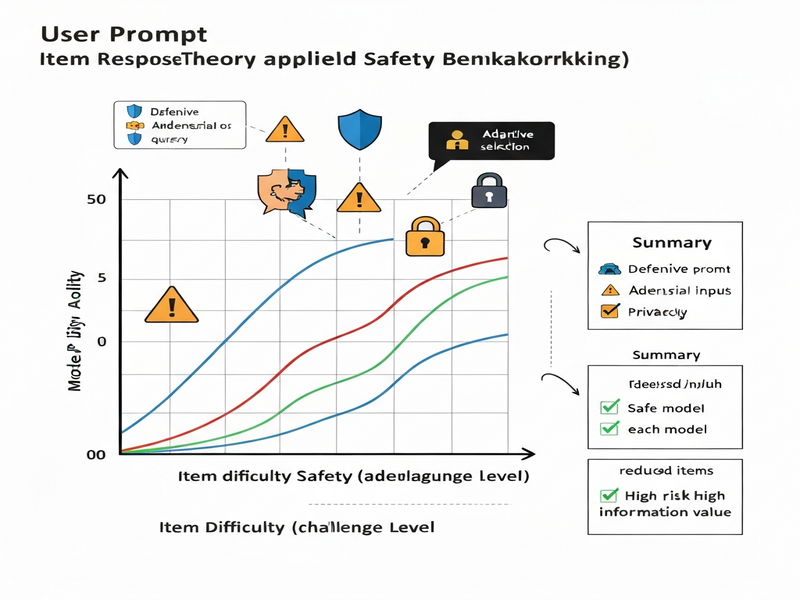
The authors propose a two‑stage framework called IRT‑SafeBench that reframes safety evaluation as an adaptive testing problem. The core ideas are:
- Item modeling with IRT: Each safety prompt is treated as an “item” characterized by difficulty, discrimination, and guessing parameters—exactly as in psychometrics.
- Model ability estimation: A language model’s latent safety competence is inferred from its responses, yielding a continuous “safety ability” score.
- Adaptive item selection: Given a provisional ability estimate, the system selects the next prompt that maximizes expected information gain, akin to computerized adaptive testing (CAT).
- Fixed‑subset extraction: For batch evaluation, the framework pre‑computes a minimal subset of items that collectively achieve a target confidence level across a range of abilities.
These components work together to ensure that every evaluated prompt contributes meaningfully to the final safety score, eliminating wasteful redundancy.
How It Works in Practice
The operational workflow can be visualized as a loop of three interacting agents:
- Item Bank Builder: Curates a large, diverse pool of safety prompts and fits an IRT model to estimate each item’s psychometric parameters using historical response data.
- Ability Estimator: Starts with a prior distribution over safety ability (e.g., a Gaussian centered on a baseline model) and updates it after each response via Bayesian inference.
- Adaptive Selector: Computes the expected Fisher information for every remaining item, picks the one with the highest value, and dispatches it to the language model.
The loop terminates when one of two conditions is met:
- The posterior variance of the ability estimate falls below a pre‑defined threshold (high confidence).
- A maximum budget of prompts has been exhausted (cost ceiling).
Because the selection logic is deterministic given the current posterior, the process can be parallelized across many models without sacrificing adaptivity. The authors also provide a “fixed‑subset extraction” algorithm that samples a representative slice of items for offline benchmarking, preserving the same statistical guarantees.
Evaluation & Results
To validate the framework, the researchers conducted three complementary experiments:
1. Simulated Model Population
They generated synthetic language models spanning a wide safety ability spectrum and compared IRT‑SafeBench against a static benchmark of 2,000 prompts. Results showed that IRT‑SafeBench achieved 95% confidence in ability estimation using fewer than 15% of the prompts, cutting compute time by a factor of six.
2. Real‑World Model Evaluation
Four publicly available LLMs (including two instruction‑tuned variants) were evaluated on a curated safety bank of 1,200 items. The adaptive method required on average 180 prompts per model to reach the same confidence interval that the static suite needed with 1,200 prompts. Moreover, the adaptive scores correlated >0.98 with the full‑suite scores, confirming fidelity.
3. Ablation of Fixed‑Subset Extraction
The authors extracted a 200‑item subset using their algorithm and benchmarked it against a random 200‑item sample. The IRT‑derived subset reduced the standard error of the safety score by 42%, demonstrating that intelligent pruning preserves statistical power.
Across all experiments, the key takeaways were:
- Adaptive testing dramatically reduces evaluation cost without sacrificing accuracy.
- The IRT model reliably captures item difficulty trends that align with human intuition (e.g., “prompt injection” items are harder than “simple profanity” items).
- Fixed‑subset extraction offers a practical compromise for batch pipelines that cannot afford true adaptivity.
Why This Matters for AI Systems and Agents
For product teams that ship AI‑driven agents, safety is a non‑negotiable service level agreement. IRT‑SafeBench reshapes the safety workflow in three concrete ways:
- Faster iteration cycles: Engineers can obtain statistically sound safety scores after a handful of targeted prompts, enabling rapid A/B testing of model updates.
- Cost‑effective scaling: Enterprises deploying dozens of fine‑tuned agents can evaluate each one within a predictable, low‑budget envelope, freeing compute for inference workloads.
- Dynamic risk monitoring: Because the ability estimator updates in real time, continuous safety monitoring becomes feasible—agents can be re‑tested on‑the‑fly as they encounter new user inputs.
These benefits translate directly into operational advantages on platforms such as the UBOS platform overview, where safety testing is integrated into the deployment pipeline. Teams building AI marketing agents can now run adaptive safety checks before each campaign launch, ensuring compliance without delaying time‑to‑market.
What Comes Next
While IRT‑SafeBench marks a significant step forward, several open challenges remain:
- Multidimensional safety: Current IRT models assume a single latent ability, yet safety comprises orthogonal dimensions (e.g., factuality, bias, privacy). Extending to multidimensional IRT could capture richer failure modes.
- Prompt generation automation: The item bank still relies on human‑crafted prompts. Integrating LLM‑driven prompt synthesis could keep the bank up‑to‑date with emerging threats.
- Cross‑modal evaluation: Future agents will combine text, vision, and audio. Adapting IRT to multimodal items will be essential for holistic safety assessment.
Researchers are already exploring hybrid approaches that blend IRT with reinforcement learning from human feedback (RLHF) to close the loop between safety testing and model fine‑tuning. Practitioners interested in experimenting with adaptive safety pipelines can start by integrating the framework into existing orchestration tools such as the Workflow automation studio or by leveraging the OpenAI ChatGPT integration for prompt execution.
In summary, by treating safety evaluation as an adaptive measurement problem, IRT‑SafeBench offers a scalable, statistically rigorous alternative to static benchmarking. As language models continue to proliferate across enterprises, the ability to assess safety quickly and cheaply will become a decisive competitive advantage.
For a deeper dive into the methodology and full experimental details, see the original paper.
Andrii Bidochko
CTO UBOS
Andrii Bidochko is an AI entrepreneur and researcher focused on AI agents, reinforcement learning, and autonomous systems. He writes about the technologies shaping the future of machine intelligence, from frontier models and agent architectures to real-world AI applications.