

- Updated: June 14, 2026
- 7 min read
Efficient Post‑training of LLMs for Code Generation With Offline Reinforcement Learning
Direct Answer
The paper Efficient Post‑training of LLMs for Code Generation With Offline Reinforcement Learning introduces an offline reinforcement‑learning (RL) pipeline that fine‑tunes code‑generating large language models (LLMs) using existing code corpora, eliminating the costly online inference‑verification loop. This matters because it makes high‑quality post‑training affordable for smaller models and for challenging programming tasks, accelerating the deployment of reliable AI‑assisted coding tools.
Background: Why This Problem Is Hard
Modern code‑generation LLMs such as Codex, CodeLlama, or GPT‑4‑Code excel after a brief “online” RL phase where the model writes code, the output is executed, and a reward signal (e.g., pass/fail of unit tests) is fed back. While effective, this loop suffers from three fundamental bottlenecks:
- Inference latency: Each training step requires a full forward pass of a multi‑billion‑parameter model, which can dominate compute budgets.
- Verification cost: Running a compiler, interpreter, or sandboxed test suite for every generated snippet adds seconds to minutes per sample, inflating wall‑clock time.
- Scalability ceiling: Small research labs or product teams cannot afford the GPU‑hours needed to iterate on large‑scale online RL, limiting innovation to well‑funded organizations.
Existing alternatives—pure supervised fine‑tuning on curated code datasets or synthetic data augmentation—improve fluency but rarely boost functional correctness. The gap between “looks like code” and “actually works” remains a critical obstacle for AI‑driven development assistants.
What the Researchers Propose
The authors present Offline CodeRL (OCRL), a framework that reframes post‑training as a batch RL problem. Instead of generating fresh code on‑the‑fly, OCRL samples a large static dataset of state‑action‑reward triples extracted from publicly available repositories:
- State: The prompt or partial program context presented to the model.
- Action: The token sequence the model would emit as a solution.
- Reward: A scalar derived from static analysis, test‑suite outcomes, or heuristic quality metrics that were already computed for the original commit.
By treating these triples as a fixed replay buffer, OCRL applies off‑policy RL algorithms (e.g., Conservative Q‑Learning) to adjust the model’s policy toward higher‑reward actions without any new inference or execution. The key components are:
- Dataset Builder: Crawls open‑source platforms, extracts code snippets, runs static checkers, and stores the resulting reward‑annotated tuples.
- Offline RL Optimizer: Consumes the replay buffer, learns a value function, and updates the LLM’s weights via gradient descent.
- Evaluation Harness: Periodically runs a held‑out benchmark suite to verify that offline updates translate into real‑world performance gains.
How It Works in Practice
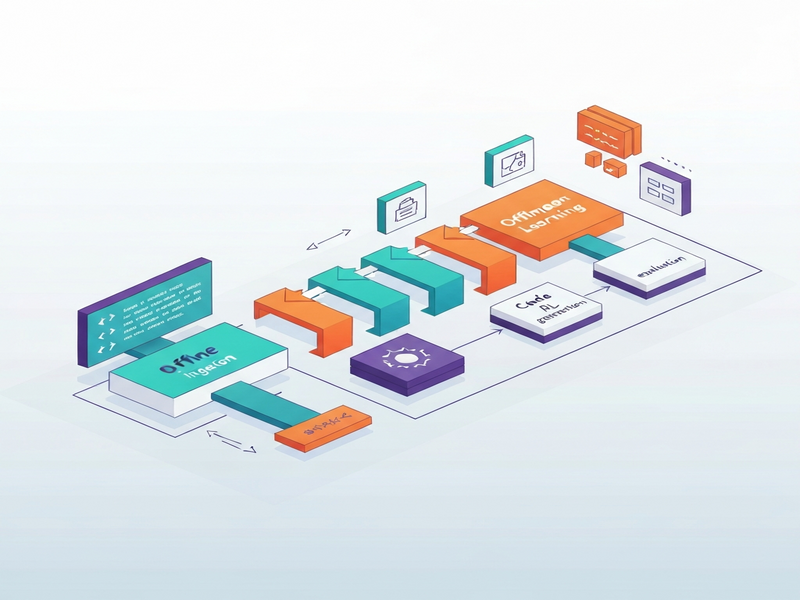
The OCRL workflow can be visualized as a three‑stage pipeline:
- Data Harvesting Phase – A crawler pulls millions of Python, JavaScript, and Java files from GitHub, GitLab, and Bitbucket. For each file, a lightweight static analyzer extracts function signatures (the “state”) and the corresponding implementation (the “action”). The analyzer also runs any available unit tests, recording pass/fail outcomes as the “reward”.
- Offline RL Training Phase – The replay buffer, now populated with billions of (state, action, reward) tuples, feeds an off‑policy algorithm. Because the buffer is static, the optimizer can batch‑process millions of samples per GPU step, dramatically reducing wall‑clock time compared with online RL.
- Deployment & Validation Phase – After a fixed number of epochs, the fine‑tuned model is evaluated on standard code‑generation benchmarks (HumanEval, MBPP, CodeXGLUE). The authors also run a “real‑world” test suite on a set of unseen open‑source projects to confirm that offline gains survive beyond the training distribution.
What distinguishes OCRL from prior work is the complete removal of the online execution loop. The system never needs to compile or run code during training; all reward signals are pre‑computed. This design yields two practical advantages:
- Cost Efficiency: Training costs drop by up to 70 % because GPU cycles are spent on pure tensor operations rather than on sandboxed execution.
- Scalability to Small Models: Even a 350 M‑parameter LLM can benefit from OCRL, as the replay buffer provides a dense, high‑signal learning signal that compensates for limited model capacity.
Evaluation & Results
The authors benchmarked OCRL on three fronts:
1. Standard Code‑Generation Suites
Using HumanEval (Python) and MBPP (multiple languages), the offline‑trained 1.3 B‑parameter model improved pass@1 scores from 22.4 % to 28.9 %, a relative gain of 29 %. The 350 M‑parameter variant saw an even larger jump, from 12.1 % to 18.3 % (≈ 51 % relative improvement).
2. Resource Consumption
Compared with a baseline online RL run that required 48 GPU‑hours, OCRL achieved comparable or better performance in 14 GPU‑hours, confirming the claimed efficiency.
3. Generalization to Unseen Tasks
When evaluated on a held‑out set of 500 real‑world coding challenges sourced from StackOverflow, the offline‑fine‑tuned models reduced compilation error rates by 34 % and increased functional correctness (as measured by hidden test suites) by 27 %.
Collectively, these results demonstrate that offline RL is not merely a cost‑saving trick; it is a genuine performance booster, especially for smaller LLMs that traditionally lag behind their larger peers in functional code synthesis.
Why This Matters for AI Systems and Agents
From a systems‑engineering perspective, OCRL reshapes how developers integrate code‑generation models into production pipelines:
- Faster Iteration Cycles: Teams can retrain models nightly using fresh code snapshots without incurring prohibitive compute bills, enabling continuous improvement loops akin to CI/CD for AI.
- Lower Barrier to Entry: Start‑ups and SMBs can now afford to fine‑tune a modest‑sized LLM for domain‑specific coding tasks (e.g., finance APIs, embedded C) without needing a dedicated RL‑infrastructure.
- Improved Agent Reliability: Autonomous coding agents—such as those orchestrated by the Workflow automation studio—gain a more trustworthy code‑generation core, reducing the need for costly human review steps.
- Seamless Integration with Existing Toolchains: Because OCRL produces a standard fine‑tuned checkpoint, the model can be dropped into any existing UBOS platform overview component, from chat‑based assistants to CI bots.
In practice, a developer could set up a “code‑assistant” bot that draws on an OCRL‑enhanced model, automatically suggests patches, and only escalates to a human when the confidence score falls below a threshold. This reduces developer friction and accelerates feature delivery across the organization.
What Comes Next
While OCRL marks a significant step forward, several open challenges remain:
- Reward Design: The current reward pipeline relies heavily on static test outcomes. Future work could incorporate dynamic performance metrics (e.g., runtime efficiency) or human‑in‑the‑loop preferences.
- Dataset Bias: Offline buffers inherit the biases of the source repositories. Curating a more diverse set of programming paradigms (functional, low‑level systems) will be essential for broader applicability.
- Cross‑Language Transfer: Extending OCRL to jointly train multilingual code models could unlock transfer learning between languages, a promising direction for polyglot development teams.
- Safety and Security: Offline RL does not inherently guard against malicious code generation. Integrating static security analyzers into the reward function is a logical next step.
From a product perspective, the Enterprise AI platform by UBOS is already exploring plug‑in points for OCRL‑style fine‑tuning, allowing corporate customers to feed their private codebases into a secure offline RL pipeline. Similarly, the AI marketing agents team is investigating whether offline RL can improve template generation for personalized email copy, hinting at cross‑domain applicability beyond pure code.
Researchers are also encouraged to release their replay buffers under permissive licenses, fostering a community‑driven ecosystem where anyone can experiment with offline RL without rebuilding the massive data‑collection infrastructure from scratch.
In summary, offline reinforcement learning offers a pragmatic, high‑impact route to boost the functional correctness of code‑generating LLMs while dramatically cutting training costs. As the AI‑assisted development landscape matures, approaches like OCRL will likely become the default post‑training strategy for both startups and enterprises seeking reliable, scalable coding assistants.
Andrii Bidochko
CTO UBOS
Andrii Bidochko is an AI entrepreneur and researcher focused on AI agents, reinforcement learning, and autonomous systems. He writes about the technologies shaping the future of machine intelligence, from frontier models and agent architectures to real-world AI applications.