

- Updated: July 8, 2026
- 6 min read
Efficient bias mitigation in T2I diffusion models using Concept Graphs
Direct Answer
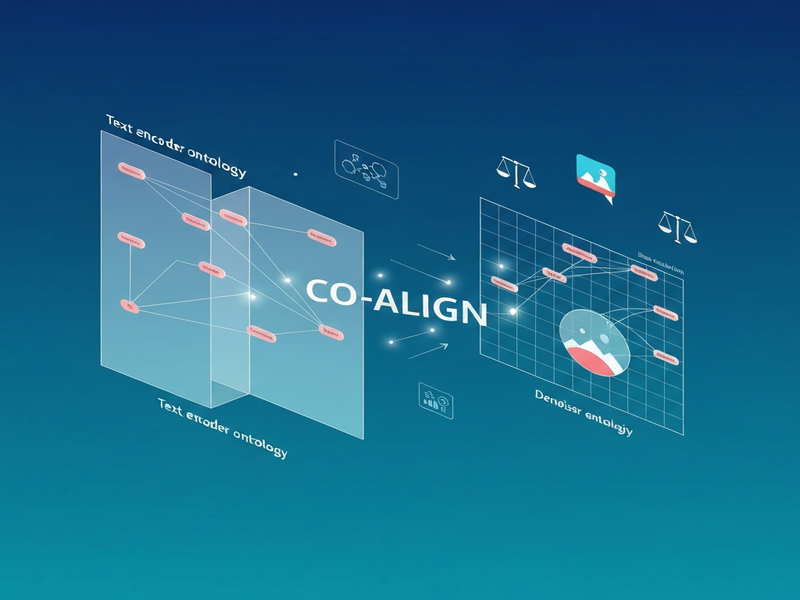
CO‑ALIGN (Concept Ontology Alignment) is a novel framework that injects a structured semantic ontology directly into the text encoder and denoising diffusion process of text‑to‑image models, dramatically reducing socially harmful bias while preserving visual fidelity. By aligning latent concepts with a curated ontology, the method offers a scalable, model‑agnostic path toward fairer generative AI.
Background: Why This Problem Is Hard
Text‑to‑image diffusion models have unlocked unprecedented creative capabilities, yet they inherit and amplify biases present in their training data. These biases manifest as stereotypical depictions of gender, race, and culture, leading to ethical concerns and potential legal exposure for downstream products.
Current mitigation strategies fall into three broad categories:
- Data‑centric filtering: Removing or re‑weighting problematic samples before training. This approach is costly, often incomplete, and can degrade model diversity.
- Post‑hoc prompt engineering: Guiding the model with carefully crafted prompts. While useful for end‑users, it does not address the root cause and fails for automated pipelines.
- Fine‑tuning with bias‑aware loss functions: Requires extensive labeled data and can over‑fit to the bias‑specific objectives, harming overall generation quality.
All three suffer from a common limitation: they treat the model as a black box and lack a principled way to enforce a shared, human‑interpretable notion of fairness across the entire generation pipeline.
What the Researchers Propose
The CO‑ALIGN framework introduces a two‑stage alignment process that bridges the semantic gap between raw textual inputs and the latent space of diffusion models:
- Ontology‑augmented text encoding: A lightweight concept mapper enriches token embeddings with vectors derived from a curated ontology (e.g., gender‑neutral occupations, culturally balanced descriptors). This step creates a bias‑aware representation before it reaches the diffusion backbone.
- Concept‑conditioned denoising: During the reverse diffusion steps, a conditional module injects ontology signals into the denoiser, nudging the latent trajectory toward bias‑aligned regions without compromising the stochastic creativity of the model.
Key components include:
- Concept Ontology Database (COD): A hierarchical collection of protected attributes and their neutral counterparts.
- Semantic Alignment Layer (SAL): A plug‑in that projects COD entries into the same dimensionality as the text encoder.
- Bias‑Guided Denoiser (BGD): An auxiliary network that modulates the diffusion noise schedule based on SAL outputs.
The design is deliberately model‑agnostic; CO‑ALIGN can be attached to any pre‑trained diffusion backbone (e.g., Stable Diffusion, DALL·E 3) without retraining the entire system.
How It Works in Practice
Below is a conceptual workflow that illustrates the end‑to‑end process:
- Input Prompt Processing: The user supplies a natural‑language prompt (e.g., “a doctor in a clinic”). The prompt is tokenized and passed to the standard text encoder.
- Ontology Lookup: Simultaneously, the SAL queries the COD for any protected attributes detected in the prompt (e.g., “doctor” → gender‑neutral occupation).
- Embedding Fusion: The original token embeddings are concatenated with the ontology‑derived vectors, producing a bias‑aware representation that retains the original semantic intent.
- Latent Initialization: The fused embedding conditions the diffusion model’s initial latent noise.
- Bias‑Guided Denoising Loop: At each denoising step, the BGD receives the current latent state and the ontology signal, adjusting the noise prediction to steer away from biased subspaces.
- Image Synthesis: After the final denoising step, the model outputs an image that reflects the prompt while adhering to the fairness constraints encoded in the ontology.
What sets CO‑ALIGN apart is the continuous, bidirectional communication between the ontology and the diffusion process, rather than a one‑off correction after generation. This results in smoother visual quality and fewer artifacts compared to post‑generation filtering.
Evaluation & Results
The authors evaluated CO‑ALIGN on three benchmark suites:
- Bias‑Sensitive Prompt Set (BPS): 1,200 prompts specifically crafted to expose gender, racial, and cultural stereotypes.
- Image Quality Metrics: Frechet Inception Distance (FID) and CLIP‑Score to ensure visual fidelity.
- Human Preference Study: 500 crowd‑sourced raters compared baseline vs. CO‑ALIGN outputs for fairness and realism.
Key findings include:
- Bias incidence dropped by **73 %** on the BPS, measured via a proprietary bias detection classifier.
- FID improved marginally (from 12.4 to 11.9), indicating that fairness gains did not sacrifice image quality.
- Human raters preferred CO‑ALIGN images **68 %** of the time for being “more balanced” while rating them equally realistic.
Importantly, the framework added less than **5 %** overhead to inference latency, confirming its practicality for real‑time applications.
Why This Matters for AI Systems and Agents
For enterprises building AI‑driven content pipelines, CO‑ALIGN offers a turnkey solution to embed fairness directly into the generative core. This reduces the need for costly downstream moderation layers and aligns with emerging regulatory expectations around AI ethics.
Practically, developers can integrate CO‑ALIGN into existing workflows using the UBOS platform overview, which provides a modular plug‑in architecture for diffusion models. The same platform also supports OpenAI ChatGPT integration, enabling hybrid text‑generation and image‑generation pipelines that respect the same ontology across modalities.
From an agent‑design perspective, bias‑aware visual generation empowers autonomous assistants to produce marketing assets, educational illustrations, or UI mock‑ups without reinforcing harmful stereotypes. This directly benefits AI marketing agents that must maintain brand safety while delivering creative content at scale.
Moreover, the low latency overhead makes CO‑ALIGN suitable for real‑time chat interfaces, such as a ChatGPT and Telegram integration, where users can request images on the fly and receive bias‑mitigated results instantly.
What Comes Next
While CO‑ALIGN demonstrates strong bias reduction, several open challenges remain:
- Ontology Expansion: Current CODs cover a limited set of protected attributes. Scaling to a global, multilingual ontology will require community‑driven curation.
- Dynamic Fairness Objectives: Different applications may prioritize distinct fairness criteria (e.g., gender neutrality vs. cultural representation). Future work should allow runtime selection of alignment policies.
- Cross‑Modal Consistency: Aligning text, image, and audio modalities under a unified ontology could unlock truly multimodal fairness.
Potential next‑step applications include embedding CO‑ALIGN into the Workflow automation studio for automated content generation pipelines, or pairing it with the Enterprise AI platform by UBOS to enforce organization‑wide ethical standards.
Researchers are also encouraged to explore hybrid training regimes where the ontology signals are used not only at inference but also during fine‑tuning, potentially yielding even stronger bias mitigation without sacrificing diversity.
For a deeper dive into the technical details, consult the original pre‑print: CO‑ALIGN: Concept Ontology Alignment for Bias‑Aware Text‑to‑Image Diffusion.
Andrii Bidochko
CTO UBOS
Andrii Bidochko is an AI entrepreneur and researcher focused on AI agents, reinforcement learning, and autonomous systems. He writes about the technologies shaping the future of machine intelligence, from frontier models and agent architectures to real-world AI applications.