

- Updated: July 16, 2026
- 2 min read
DrugGen 2: A Disease‑Aware Language Model for Enhancing Drug Discovery
DrugGen 2: A Disease‑Aware Language Model for Enhancing Drug Discovery
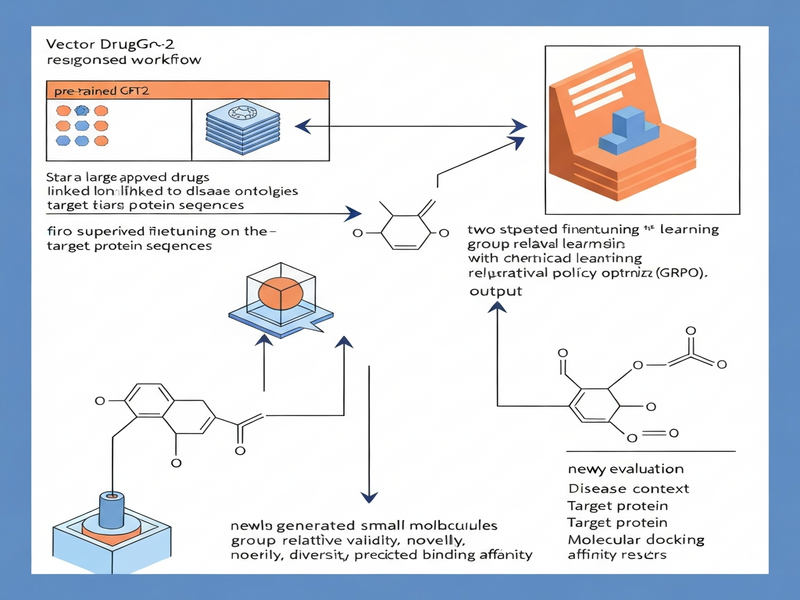
Artificial intelligence is reshaping drug discovery, yet most generative models ignore the disease context that drives therapeutic success. DrugGen 2 bridges this gap by conditioning molecule generation on both disease ontology and target protein sequences. Fine‑tuned from GPT‑2 on a curated dataset of approved drugs, diseases, and targets, the model uses a two‑step strategy – supervised fine‑tuning followed by reinforcement learning with Group Relative Policy Optimization (GRPO) – to optimise chemical validity, novelty, diversity, and predicted binding affinity.
When evaluated on five protein targets relevant to diabetic nephropathy, DrugGen 2 outperformed baseline models (DrugGPT, DrugGen) across all metrics. Notably, it generated unique molecules with higher structural similarity to approved drugs and achieved superior predicted binding affinities (e.g., –9.917, –9.485, –9.367 kcal/mol) compared with reference compounds such as enalapril (–8.283 kcal/mol). Molecular docking confirmed strong ligand‑protein interactions, highlighting DrugGen 2’s potential for de‑novo design and drug repurposing.
Key innovations of DrugGen 2 include:
- Disease‑aware conditioning: integrates disease ontology to guide molecular design.
- Reinforcement‑learning optimisation: GRPO aligns generated structures with multi‑objective reward functions.
- Robust validation: extensive docking and affinity predictions demonstrate real‑world applicability.
For a visual overview of the workflow, see the illustration below.
Explore more about our AI‑driven drug discovery platform on ubos.tech/solutions and read related case studies at ubos.tech/blog. Stay tuned for upcoming releases and detailed technical documentation.
Andrii Bidochko
CTO UBOS
Andrii Bidochko is an AI entrepreneur and researcher focused on AI agents, reinforcement learning, and autonomous systems. He writes about the technologies shaping the future of machine intelligence, from frontier models and agent architectures to real-world AI applications.