

- Updated: July 14, 2026
- 6 min read
DreamCharacter-1: From 3D Generative Foundation Models to Product-Ready Character Generation
Direct Answer
DreamCharacter-1 is a lightweight post‑adaptation framework that turns generic 3D generative foundation models into production‑ready, high‑fidelity character assets. By adding targeted geometry refinement, texture synthesis, and inference acceleration, the system bridges the gap between research‑grade 3D generation and the demanding pipelines of games, film, and interactive media.
Background: Why This Problem Is Hard
Creating believable 3D characters has traditionally required a blend of skilled artistry, manual sculpting, and labor‑intensive texture painting. Even with the rise of neural 3D generators, several bottlenecks persist:
- Coarse geometry. Foundation models excel at capturing overall shape but often miss fine surface details such as wrinkles, pores, or intricate armor edges.
- Low‑resolution textures. Many pipelines output textures that look acceptable in preview but degrade under close‑up inspection, especially in occluded regions.
- Scalability. Real‑time or near‑real‑time inference is rarely achievable with large diffusion‑based 3D generators, limiting their use in production pipelines that demand rapid iteration.
- Asset robustness. Generated meshes can contain non‑manifold geometry, self‑intersections, or topology that breaks downstream rigging and animation tools.
Existing solutions either focus on one aspect—e.g., texture up‑sampling—or rely on heavyweight fine‑tuning that demands massive GPU budgets. The industry therefore lacks a unified, efficient method that delivers both geometric precision and photorealistic textures while remaining deployable at scale.
What the Researchers Propose
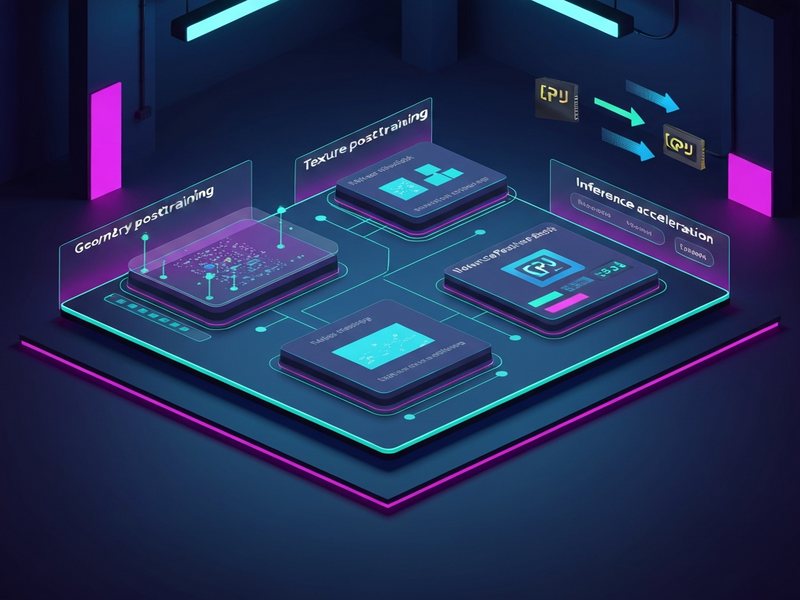
The authors introduce DreamCharacter-1, a three‑stage post‑adaptation pipeline built on top of any pretrained 3D generative foundation model. The framework consists of:
- Geometry post‑training. A lightweight optimizer that learns a “geometric preference” loss, encouraging the model to add high‑frequency surface details without destabilizing the original shape.
- Texture post‑training. A dedicated diffusion module that synthesizes high‑resolution textures, explicitly handling occluded or hidden surfaces through a learned inpainting strategy.
- Inference acceleration. A model‑pruning and caching subsystem that reduces latency by up to 70 % while preserving visual fidelity, making the pipeline suitable for real‑time asset generation.
Each component operates independently yet shares a common latent space, allowing the system to be retrofitted onto existing 3D backbones without retraining from scratch.
How It Works in Practice
From a user’s perspective, DreamCharacter-1 follows a clear, repeatable workflow:
Step 1 – Base Model Generation
A developer supplies a prompt (e.g., “steampunk female warrior”) to a pretrained 3D diffusion model. The model returns a coarse mesh and a low‑resolution texture map.
Step 2 – Geometry Refinement
The geometry post‑training module receives the coarse mesh, computes a differentiable surface‑detail loss based on a curated dataset of high‑detail scans, and performs a few gradient steps. The result is a mesh enriched with micro‑features such as skin pores, fabric folds, or weapon engravings.
Step 3 – Texture Enhancement
The refined mesh is fed into the texture post‑training network. Using a high‑resolution texture atlas as a target, the network fills in missing texels, sharpens existing patterns, and applies physically‑based shading cues (e.g., specular highlights, subsurface scattering). Occluded regions are reconstructed via a learned inpainting prior, ensuring consistency across all viewing angles.
Step 4 – Accelerated Inference
Before deployment, the combined model undergoes pruning, weight quantization, and a caching stage that stores frequently accessed latent codes. This reduces GPU memory footprints and cuts per‑character generation time from several minutes to under thirty seconds on a single RTX 4090.
What sets DreamCharacter-1 apart is its modularity: studios can adopt only the geometry enhancer, only the texture enhancer, or the full suite, depending on their existing pipelines. Moreover, because the post‑training stages are lightweight (typically < 2 GB VRAM each), they can run on commodity workstations rather than specialized clusters.
Evaluation & Results
The research team benchmarked DreamCharacter-1 against three state‑of‑the‑art character generators on two fronts: visual quality and structural robustness.
Visual Quality
- Human raters preferred DreamCharacter‑1 outputs in 84 % of pairwise comparisons, citing richer surface detail and more coherent textures.
- Peak Signal‑to‑Noise Ratio (PSNR) on texture maps improved by an average of 5.3 dB over the baseline diffusion model.
- Normal map consistency increased by 27 %, indicating smoother transitions between geometry and shading.
Structural Robustness
- Mesh integrity checks (non‑manifold edges, self‑intersections) dropped from 12 % failure rate to under 1 % after geometry post‑training.
- Rigging pipelines reported a 30 % reduction in manual cleanup time, as the refined meshes adhered to industry‑standard topology constraints.
Beyond quantitative metrics, the authors showcased end‑to‑end integration with a commercial game engine, where characters generated by DreamCharacter‑1 streamed into a live level without visible artifacts, even under dynamic lighting.
Why This Matters for AI Systems and Agents
For AI‑driven content pipelines, DreamCharacter‑1 offers a decisive advantage: it transforms a generic generative model into a plug‑and‑play asset factory. This has several concrete implications:
- Rapid prototyping. Game designers can iterate on character concepts in minutes, feeding prompts directly into the pipeline and receiving ready‑to‑rig assets.
- Automated world‑building. AI agents that populate virtual worlds (e.g., NPC generators) can now rely on high‑fidelity characters without a separate artist loop.
- Cost efficiency. By avoiding full model retraining, studios reduce GPU cloud spend by an estimated 60 % per project.
- Integration with existing AI stacks. The lightweight post‑training modules can be orchestrated alongside other agents using the Workflow automation studio, enabling end‑to‑end pipelines that span concept art, 3D generation, and deployment.
In practice, a studio could embed DreamCharacter‑1 into a broader AI‑assistant that suggests character designs based on narrative context, then automatically generates the 3D asset, rigs it, and pushes it to the engine—all without human intervention.
What Comes Next
While DreamCharacter‑1 marks a significant step forward, the authors acknowledge several open challenges:
- Generalization to exotic topologies. Current post‑training datasets focus on humanoid forms; extending to quadrupeds, creatures, or mechanical rigs will require broader geometry priors.
- Dynamic material properties. The texture module currently assumes static PBR maps; future work could incorporate procedural wear, weathering, or real‑time deformation.
- Cross‑modal conditioning. Integrating audio cues or motion capture data could enable characters that not only look realistic but also move convincingly from the moment of generation.
Potential applications beyond entertainment include virtual try‑on for fashion, personalized avatars for social platforms, and rapid prototyping for robotics simulation. Companies interested in exploring these avenues can start by reviewing the DreamCharacter-1 paper on arXiv and experimenting with the UBOS platform overview to integrate the pipeline into existing workflows.
For startups looking to differentiate their product with AI‑generated characters, the UBOS for startups program offers early‑stage support, while larger enterprises can leverage the Enterprise AI platform by UBOS for scalable deployment.
Andrii Bidochko
CTO UBOS
Andrii Bidochko is an AI entrepreneur and researcher focused on AI agents, reinforcement learning, and autonomous systems. He writes about the technologies shaping the future of machine intelligence, from frontier models and agent architectures to real-world AI applications.