

- Updated: June 11, 2026
- 7 min read
Dr‑CiK: A Testbed for Foresight‑Driven Agents – In‑Depth Analysis
Direct Answer
Dr‑CiK is a new benchmark that evaluates whether autonomous agents can actively discover, filter, and distill external documents to improve time‑series forecasts. It matters because it shifts the focus from static, pre‑provided context to dynamic, foresight‑driven reasoning—an ability that real‑world AI systems need to predict the future reliably.
Background: Why This Problem Is Hard
Most commercial forecasting pipelines assume that all relevant background information—economic reports, news articles, regulatory filings—is already curated and fed into the model. In practice, analysts spend hours sifting through noisy, heterogeneous sources to locate the few pieces of evidence that actually shift a forecast. This manual bottleneck creates three intertwined challenges:
- Discovery latency: Relevant documents may be buried in massive corpora, and traditional retrieval systems struggle to surface them quickly.
- Distractor overload: The same corpora contain abundant irrelevant citations that can mislead a model if not properly filtered.
- Evidence integration: Even when the right documents are found, converting raw text into a form that a time‑series model can consume is non‑trivial.
Existing context‑aided forecasting benchmarks sidestep these issues by providing the “supporting evidence” up front. Consequently, they do not test an agent’s ability to perform the full foresight loop—search, verification, and synthesis—leaving a critical gap between benchmark performance and operational capability.
What the Researchers Propose
The authors introduce Dr‑CiK (Document‑retrieval‑Context‑in‑Knowledge), a testbed that treats context acquisition as an integral part of the forecasting task. Instead of handing the model a pre‑packaged evidence set, Dr‑CiK supplies a large, noisy document corpus and a set of ground‑truth citations that truly influence each target series. An agent must:
- Search: Issue queries against the corpus to retrieve a candidate set of documents.
- Filter: Distinguish genuine supporting evidence from distractors.
- Distill: Extract or summarize the factual nuggets that are predictive for the target horizon.
- Forecast: Combine the distilled evidence with historical observations to produce a final prediction.
Dr‑CiK therefore evaluates the entire pipeline, measuring both the quality of retrieved context (precision/recall of supporting citations) and the downstream forecasting accuracy.
How It Works in Practice
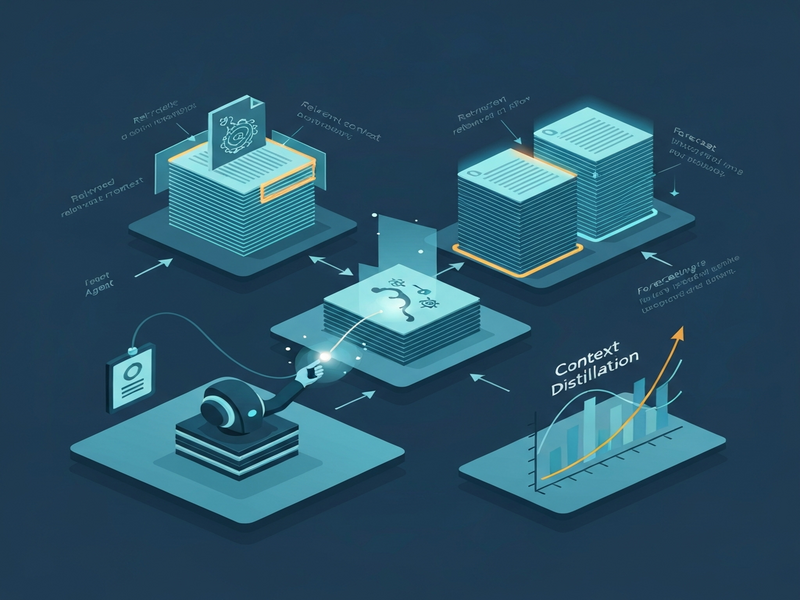
At a conceptual level, Dr‑CiK can be visualized as a modular workflow:
Component Overview
- Document Corpus Engine: A searchable index (e.g., Elasticsearch or a vector store) containing millions of heterogeneous texts—news, research papers, regulatory filings.
- Retrieval Agent: Typically a large language model (LLM) or a hybrid retriever that formulates queries based on the target time series and returns a ranked list of documents.
- Evidence Filter: A classifier or ranking model that predicts the likelihood that a retrieved document contains forecast‑relevant information.
- Distillation Module: Either a summarizer or a structured extractor that converts raw text into numeric or categorical signals (e.g., sentiment scores, event counts).
- Forecaster: A conventional time‑series model (ARIMA, Prophet, Transformer‑based) that ingests both historical values and the distilled signals.
Interaction Flow
- The forecaster signals a need for context (e.g., “predict next‑quarter revenue for Company X”).
- The Retrieval Agent queries the Document Corpus Engine, returning the top‑k documents.
- The Evidence Filter scores each document; only those above a confidence threshold proceed.
- The Distillation Module extracts predictive cues—such as “new product launch announced” or “regulatory approval granted”—and encodes them as features.
- The Forecaster combines these features with the time‑series history to emit a final forecast.
What sets Dr‑CiK apart is that the benchmark penalizes agents for both missing true evidence (80% of citations are irrelevant). This dual pressure forces developers to balance recall and precision, mirroring real‑world decision‑making.
Evaluation & Results
To assess the benchmark, the authors paired state‑of‑the‑art retrieval models (BM25, dense vector retrievers) with leading forecasting architectures (Temporal Fusion Transformers, N‑BEATS). They conducted three families of experiments:
- Context Ablation: Comparing forecasts with perfect ground‑truth context, retrieved context, and no context.
- Retriever‑Forecaster Pairings: Measuring how different retrieval strategies affect downstream accuracy.
- Distractor Stress Tests: Injecting synthetic irrelevant documents to gauge robustness.
Key takeaways include:
- When agents receive perfect context, forecasting error drops by up to 30% relative to the no‑context baseline.
- Current retrieval pipelines recover less than 5% of the true supporting citations, leading to negligible or even negative gains.
- High distractor rates (>80%) cause many forecasters to overfit to noise, worsening predictions.
- Hybrid approaches that combine sparse (BM25) and dense (embedding‑based) retrieval improve recall to ~12% but still fall short of the ideal.
These results demonstrate that while context is undeniably valuable, the community has yet to build agents capable of reliably surfacing it in an open‑world setting. The benchmark therefore serves as a diagnostic tool, highlighting where research effort should be concentrated.
Why This Matters for AI Systems and Agents
For practitioners building production‑grade AI agents, Dr‑CiK offers a realistic yardstick that mirrors the end‑to‑end workflow of many enterprise use cases—financial planning, supply‑chain risk assessment, and policy impact analysis. The implications are threefold:
- Designing Retrieval‑First Pipelines: Teams must treat document search as a first‑class component, not an afterthought. Integrations such as the Chroma DB integration provide vector‑store capabilities that can be plugged directly into the Retrieval Agent.
- Orchestrating Multi‑Modal Evidence: The Distillation Module often needs to combine textual sentiment, numeric tables, and even audio transcripts. Platforms like the Workflow automation studio enable developers to chain these steps without custom glue code.
- Evaluating End‑User Impact: By measuring forecast quality with and without retrieved context, product owners can quantify ROI for investing in richer knowledge bases. The Enterprise AI platform by UBOS includes built‑in dashboards for tracking such KPI shifts.
In short, Dr‑CiK pushes the industry toward agents that are not just “smart” in isolation but “foresighted” in the sense of actively seeking the right information before making a decision.
What Comes Next
While Dr‑CiK establishes a solid foundation, several open challenges remain:
- Scalable Retrieval at Scale: Real‑world corpora can exceed billions of documents. Efficient indexing strategies—such as hierarchical IVF‑PQ or hybrid sparse‑dense models—are needed to keep latency low.
- Robust Distractor Detection: Current classifiers rely heavily on surface‑level cues. Future work could explore causal inference or counterfactual reasoning to better separate signal from noise.
- Interactive Feedback Loops: Human analysts often correct or augment retrieved evidence. Incorporating reinforcement learning from human feedback (RLHF) could close the loop.
- Cross‑Modal Evidence Fusion: Beyond text, images, audio, and structured tables can carry predictive power. Extending Dr‑CiK to multimodal corpora will broaden its applicability.
Potential applications span from AI marketing agents that adapt campaign forecasts based on emerging consumer sentiment, to Openclaw (Clawdbot, MoltBot) style bots that monitor regulatory changes for compliance teams. By integrating with the OpenAI ChatGPT integration, developers can prototype conversational agents that ask clarifying questions before finalizing a forecast.
For those interested in exploring the benchmark directly, the full dataset, code, and evaluation scripts are available in the Dr‑CiK paper on arXiv. Early adopters are encouraged to contribute additional corpora and domain‑specific extensions, turning Dr‑CiK into a community‑driven platform for foresight research.
Conclusion
Dr‑CiK reframes forecasting as a proactive, knowledge‑seeking problem rather than a passive pattern‑matching task. By exposing the weaknesses of current retrieval‑forecaster pairings, it charts a clear research agenda: build agents that can locate, verify, and synthesize the right context at scale. Organizations that invest in such foresight‑driven pipelines will gain a decisive edge in any domain where the future is shaped by a constantly evolving information landscape.
Andrii Bidochko
CTO UBOS
Andrii Bidochko is an AI entrepreneur and researcher focused on AI agents, reinforcement learning, and autonomous systems. He writes about the technologies shaping the future of machine intelligence, from frontier models and agent architectures to real-world AI applications.