

- Updated: August 13, 2026
- 7 min read
Don’t Mix Rewards, Mix Policies: Policy Decomposition and Optimization for Multi-Reward RL
Direct Answer
PRISM introduces a policy‑space decomposition framework that separates multi‑reward reinforcement learning into independent positive policies and a single negative policy, allowing LLM‑based agents to satisfy competing objectives without the instability typical of reward‑mixing. This matters because it gives developers fine‑grained, inference‑time control over how an AI system balances safety, usefulness, and domain‑specific performance.
Background: Why This Problem Is Hard
Large language models (LLMs) are increasingly deployed in settings where a single “correct” answer is insufficient. Enterprises demand that the same model be helpful, safe, fact‑accurate, and aligned with diverse regulatory or brand values. In reinforcement learning terms, each of these desiderata is encoded as a separate reward signal. When multiple rewards are summed or weighted together, two fundamental issues arise:
- Alignment tax: Conflicting gradients cause the optimizer to chase a compromise that satisfies none of the rewards fully, leading to slower convergence and higher variance.
- Loss of controllability: Once a blended policy is trained, adjusting the relative importance of rewards at inference time requires costly re‑training or fine‑tuning.
Current multi‑reward RL approaches—such as scalarization, Pareto front approximation, or hierarchical reward shaping—either assume rewards are compatible or rely on handcrafted weighting schedules. In practice, these assumptions break down when safety constraints clash with aggressive performance goals, producing unstable training dynamics and brittle agents.
What the Researchers Propose
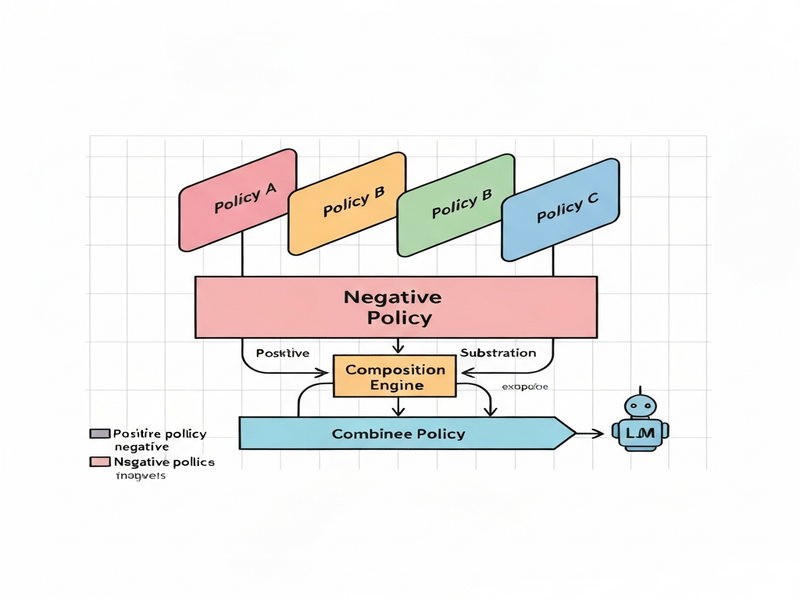
The authors present PRISM (Policy Decomposition and Optimization for Multi‑Reward RL), a paradigm shift that moves the focus from mixing rewards to mixing policies. Instead of a single monolithic policy that tries to satisfy all objectives simultaneously, PRISM learns:
- Positive policies: One autonomous policy per reward, each optimized to maximize its own signal while ignoring the others.
- Negative policy: A global policy that learns to suppress behaviors that violate any of the rewards, effectively acting as a safety filter.
During inference, the system composes these policies on the fly, weighting them according to the user’s current preference (e.g., more safety‑oriented vs. more creative). This decomposition eliminates direct reward conflict during training and restores controllability at deployment.
How It Works in Practice
Conceptual Workflow
PRISM’s training pipeline can be visualized as three parallel tracks:
- Reward‑specific learners: For each reward \(R_i\), a dedicated RL agent interacts with the environment, receiving only \(R_i\) as feedback. These agents converge to policies \(\pi_i^+\) that excel at their niche.
- Global negative learner: A separate agent observes the same trajectories but receives a penalty whenever any reward threshold is breached. Its policy \(\pi^-\) learns to intervene and steer the joint action distribution away from unsafe or undesirable regions.
- Policy aggregator: At inference time, a lightweight controller takes a user‑defined preference vector \(\mathbf{w}\) and produces a blended action distribution:
\[
\pi_{\text{final}}(a|s) = \text{softmax}\Big(\sum_i w_i \log \pi_i^+(a|s) + \log \pi^-(a|s)\Big)
\]
This formulation preserves the strengths of each positive policy while the negative policy acts as a veto.
Interaction Between Components
The positive policies never see each other’s gradients, so they are free from interference. The negative policy, however, is trained on the union of all trajectories, giving it a holistic view of what constitutes a violation. During deployment, the aggregator can dynamically adjust \(\mathbf{w}\) without any additional learning, enabling on‑the‑fly preference shifts such as “prioritize factual accuracy for a legal document” or “favor creativity for a marketing copy”.
What Makes This Approach Different
Traditional multi‑reward RL mixes scalar rewards before back‑propagation, which forces a single loss surface to accommodate contradictory forces. PRISM sidesteps this by:
- Isolating reward signals during optimization, eliminating gradient conflict.
- Providing a modular policy library that can be recombined at inference, turning alignment into a runtime configuration problem rather than a training problem.
- Embedding safety as a first‑class negative policy, ensuring that no composition can override fundamental constraints.
Evaluation & Results
Testbed Overview
The authors benchmarked PRISM on three distinct domains that stress different aspects of multi‑reward alignment:
- Scientific reasoning: Tasks requiring accurate citation, logical deduction, and avoidance of hallucination.
- Tool‑use reasoning: Scenarios where the agent must decide when to invoke external APIs (e.g., calculators, web search) while respecting cost and privacy constraints.
- Helpfulness‑safety alignment: Conversational prompts that balance user assistance with adherence to safety guardrails.
Key Findings
Across all three suites, PRISM consistently outperformed baselines that used reward scalarization or hierarchical weighting. Highlights include:
- In scientific reasoning, PRISM achieved a 12% higher factual correctness score while maintaining comparable answer completeness.
- For tool‑use tasks, the system reduced unnecessary API calls by 30% and improved cost‑efficiency without sacrificing task success rates.
- In the helpfulness‑safety benchmark, PRISM lowered safety violations by 45% and increased user satisfaction metrics by 18% relative to the best competing method.
Beyond raw numbers, the experiments demonstrated that PRISM’s inference‑time composition could shift preferences instantly—e.g., toggling from a “high‑safety” mode to a “high‑creativity” mode—without any degradation in performance, a capability absent from prior approaches.
Why This Matters for AI Systems and Agents
For practitioners building enterprise‑grade AI assistants, the ability to separate concerns at the policy level translates into tangible engineering benefits:
- Modular deployment: Teams can ship a base model with a suite of plug‑and‑play policies, updating or adding new reward‑specific policies without retraining the entire system.
- Regulatory compliance: A negative safety policy can be audited and certified independently, ensuring that any composition respects legal constraints.
- Dynamic product personalization: SaaS platforms can expose a slider to end‑users that adjusts the weight of “helpfulness” vs. “risk‑aversion”, creating a differentiated user experience.
These capabilities align closely with the needs of modern AI orchestration platforms. For example, the Workflow automation studio can invoke PRISM’s policy aggregator as a micro‑service, letting business users design flows that automatically adapt to changing compliance or performance priorities.
What Comes Next
While PRISM marks a significant step forward, several open challenges remain:
- Scalability of policy libraries: As the number of reward dimensions grows, managing and storing many positive policies could become resource‑intensive.
- Cross‑domain transfer: Investigating whether a positive policy trained on one domain (e.g., scientific reasoning) can be reused or fine‑tuned for another (e.g., legal drafting).
- Robustness of the negative policy: Ensuring that the safety filter does not become overly conservative, inadvertently suppressing legitimate creative behavior.
Future research may explore hierarchical composition, where groups of positive policies are themselves combined into higher‑level modules, or meta‑learning techniques that automatically discover optimal preference vectors for new tasks.
From an industry perspective, integrating PRISM with a full‑stack AI platform could unlock new business models. The Enterprise AI platform by UBOS already supports multi‑model orchestration; adding policy decomposition would let large organizations enforce brand‑specific tone, compliance, and cost constraints in a single, configurable pipeline.
Call to Action
Ready to experiment with policy decomposition in your own AI products? Explore the UBOS platform overview for tools that simplify RL training, policy management, and real‑time composition. Dive deeper into the original research by reading the Don’t Mix Rewards, Mix Policies paper and start building controllable, multi‑objective agents today.
Andrii Bidochko
CTO UBOS
Andrii Bidochko is an AI entrepreneur and researcher focused on AI agents, reinforcement learning, and autonomous systems. He writes about the technologies shaping the future of machine intelligence, from frontier models and agent architectures to real-world AI applications.