

- Updated: June 14, 2026
- 7 min read
Diffusion Large Language Models for Visual Speech Recognition
Direct Answer
DLLM‑VSR introduces a diffusion‑based large language model that treats visual speech transcription as an iterative masked‑denoising problem, allowing the system to defer low‑confidence decisions until richer bidirectional context is available. This shift from left‑to‑right autoregression yields a new state‑of‑the‑art word error rate (WER) of 19.5 % on the LRS3 benchmark, demonstrating that diffusion decoding can substantially improve visual speech recognition (VSR) without extra data.
Background: Why This Problem Is Hard
Visual speech recognition—also known as lip‑reading—aims to convert silent video of a speaker’s mouth into text. In real‑world deployments such as video conferencing, surveillance, or assistive technologies, the visual signal is often ambiguous: similar mouth shapes can correspond to multiple phonemes, lighting conditions vary, and speakers differ in articulation style. Traditional VSR pipelines rely on left‑to‑right autoregressive decoders that must commit to each token as soon as it is generated. This early commitment forces the model to make hard decisions before the full temporal context is observed, leading to error propagation especially on visually ambiguous segments.
Recent advances in audio‑visual speech models have reduced the gap to audio‑only systems, yet two fundamental bottlenecks remain:
- Premature token selection: Autoregressive decoders cannot revise earlier predictions, so a single mis‑read can cascade.
- Length uncertainty: The model must simultaneously infer how many words are spoken while generating them, a problem that is especially acute when the video duration does not map cleanly to a fixed transcript length.
These challenges limit the reliability of VSR in commercial products where robustness across speakers, languages, and recording conditions is non‑negotiable.
What the Researchers Propose
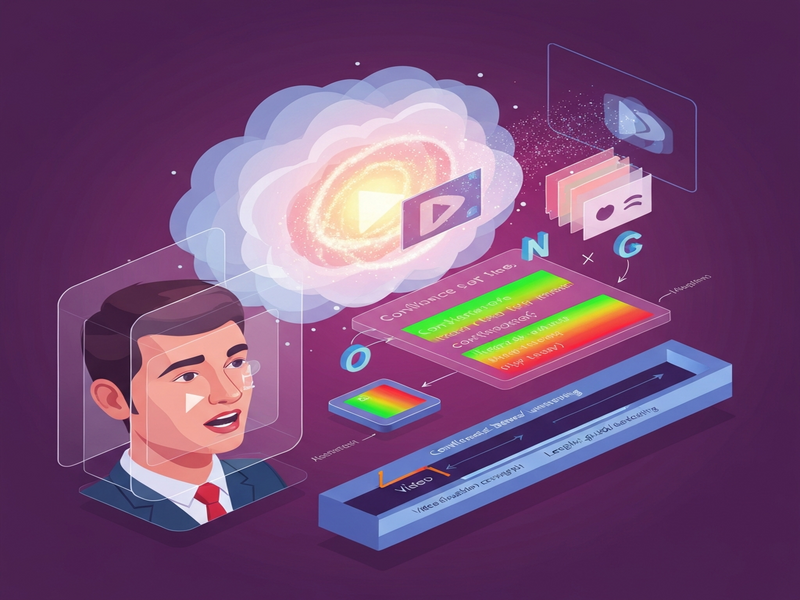
The authors present DLLM‑VSR, the first framework that couples a diffusion‑style large language model (DLLM) with visual front‑ends for speech. Instead of generating text token by token, DLLM‑VSR frames transcription as a series of masked‑denoising steps:
- Iterative masking: At each diffusion step, a subset of transcript positions is masked, and the model predicts the most likely tokens for those slots.
- Confidence‑based unmasking: Positions with high prediction confidence are permanently unmasked early, providing reliable bidirectional context for later, more ambiguous positions.
- Two‑stage training: The first stage aligns visual features with textual content, while the second stage learns to model transcript length separately, reducing interference between content and length estimation.
Key components include a visual encoder that extracts spatiotemporal mouth features, a diffusion‑based language decoder that operates on a masked token sequence, and a length‑guided candidate generator that proposes plausible transcript lengths based on video duration.
How It Works in Practice
The practical workflow of DLLM‑VSR can be broken down into four sequential modules:
- Visual Feature Extraction: A convolutional‑transformer backbone processes the raw video frames, producing a compact representation for each time step.
- Initial Masked Transcript: The system starts with a fully masked token sequence of a hypothesized length (e.g., the maximum plausible length derived from video duration).
- Diffusion Denoising Loop: For a fixed number of diffusion steps, the DLLM predicts token probabilities for the currently masked positions. Tokens whose confidence exceeds a dynamic threshold are unmasked and fed back as context for the next iteration.
- Length‑Guided Candidate Decoding: Multiple length hypotheses are generated (e.g., short, medium, long). Each hypothesis runs through the diffusion loop independently, and a reranker selects the final transcript based on a combined score of length plausibility and average token confidence.
This approach differs from conventional autoregressive decoders in two crucial ways:
- It treats the transcript as a whole, allowing the model to leverage future visual cues when resolving earlier ambiguous tokens.
- It decouples length prediction from content generation, which reduces the risk of early length mis‑estimation corrupting the entire output.
Visually, the process resembles a painter gradually revealing a canvas: confident strokes are laid down first, and the remaining details are refined as the picture becomes clearer.
Evaluation & Results
To validate the approach, the authors conducted extensive experiments on the LRS3 dataset, a large‑scale benchmark containing thousands of spoken sentences extracted from TED talks. The evaluation protocol followed standard practice: word error rate (WER) served as the primary metric, and the model was trained solely on the publicly available labeled portion of LRS3 (no external data or self‑training).
Key findings include:
- State‑of‑the‑art performance: DLLM‑VSR achieved a WER of 19.5 %, surpassing the previous best autoregressive baseline by more than 2 % absolute.
- Length‑guided decoding impact: When the oracle transcript length was supplied, the WER dropped to 17.8 %, confirming that length uncertainty remains a primary error source.
- Ablation studies: Removing confidence‑based unmasking increased WER by 1.4 %, while training without the two‑stage strategy added a 1.1 % penalty, demonstrating the complementary value of each design choice.
- Robustness to visual noise: Experiments with artificially degraded video (blur, reduced frame rate) showed a slower degradation curve compared to autoregressive models, indicating better resilience to real‑world visual artifacts.
Collectively, these results prove that diffusion‑based decoding can close the performance gap caused by premature decisions, while the length‑guided candidate mechanism mitigates the remaining uncertainty around transcript length.
Why This Matters for AI Systems and Agents
For practitioners building multimodal agents—such as virtual assistants that must understand silent video, surveillance analytics platforms, or accessibility tools for the hearing impaired—the improvements introduced by DLLM‑VSR translate into tangible product benefits:
- Higher reliability: Lower WER means fewer transcription errors, which directly improves downstream natural language understanding modules.
- Flexible integration: Because the diffusion decoder operates on a masked token sequence, it can be combined with existing language models, enabling seamless upgrades to current pipelines.
- Better user experience: Agents can wait for sufficient visual context before committing to a response, reducing the “jump‑the‑gun” behavior that frustrates users.
- Scalable orchestration: The length‑guided candidate generation aligns well with workflow automation tools, allowing developers to parallelize decoding across multiple length hypotheses.
These capabilities map directly onto the AI marketing agents that need to parse video ads, the UBOS platform overview for building end‑to‑end AI services, and the Workflow automation studio where developers can orchestrate the diffusion decoding steps as reusable components. Moreover, integrating DLLM‑VSR with conversational back‑ends such as OpenAI ChatGPT integration or ChatGPT and Telegram integration opens new avenues for silent‑video‑enabled chat experiences.
What Comes Next
While DLLM‑VSR sets a new benchmark, several open challenges remain:
- Length prediction refinement: The current candidate generation relies on heuristics derived from video duration. Learning a more precise length estimator could close the remaining gap to the oracle performance.
- Cross‑lingual scalability: Extending the model to languages with different phonetic inventories and writing systems will require multilingual visual encoders and tokenizers.
- Real‑time deployment: Diffusion decoding involves multiple iterative steps, which can be computationally intensive. Optimizing the number of diffusion steps or employing distillation techniques will be essential for latency‑sensitive applications.
- Self‑supervised pretraining: Leveraging large amounts of unlabeled video could further improve visual feature robustness, especially in low‑resource domains.
Future research may also explore hybrid architectures that combine diffusion decoding with transformer‑based beam search, or integrate audio cues when available to create truly multimodal speech recognizers.
From a product perspective, the UBOS for startups can prototype a VSR‑enabled chatbot by wiring the diffusion decoder into their low‑code pipeline, while the Enterprise AI platform by UBOS offers the scalability and security needed for large‑scale deployments in call centers or video analytics suites. Smaller businesses can also benefit from the UBOS solutions for SMBs, which provide pre‑built connectors for video ingestion and downstream language services.
For readers who want to dive deeper into the technical details, the full paper is available on Diffusion Large Language Models for Visual Speech Recognition (arXiv). The authors also release code and pretrained checkpoints, making it straightforward to reproduce the results and experiment with custom video datasets.
Andrii Bidochko
CTO UBOS
Andrii Bidochko is an AI entrepreneur and researcher focused on AI agents, reinforcement learning, and autonomous systems. He writes about the technologies shaping the future of machine intelligence, from frontier models and agent architectures to real-world AI applications.