

- Updated: June 11, 2026
- 7 min read
DiagramRAG: A Lightweight Framework to Retrieve Scientific Diagram for Figure Generation
Direct Answer
DiagramRAG introduces a lightweight, retrieval‑augmented framework that turns rough sketch inputs into complete, publication‑ready scientific diagrams. By coupling sketch‑driven retrieval with generative guidance, it dramatically reduces the time and expertise needed to produce high‑quality visualizations for research papers.
Background: Why This Problem Is Hard
Scientific diagrams are the lingua franca of technical communication. Researchers spend hours hand‑crafting figures that convey algorithms, system architectures, or experimental setups. The bottleneck arises from two intertwined challenges:
- Semantic ambiguity: A sketch captures only a fragment of the intended meaning—labels, arrows, and rough shapes hint at concepts but lack precise terminology.
- Topological incompleteness: Sketches often omit details such as exact node placement, connector routing, or styling conventions required for a polished figure.
Existing sketch‑based generation tools focus on reconstructing the sketch itself, producing a higher‑resolution version of the same incomplete drawing. Text‑only diagram generators, on the other hand, ignore the spatial cues that sketches naturally provide, leading to figures that may be semantically correct but visually disjointed. Consequently, researchers either settle for sub‑optimal visuals or invest manual effort that could be spent on scientific discovery.
What the Researchers Propose
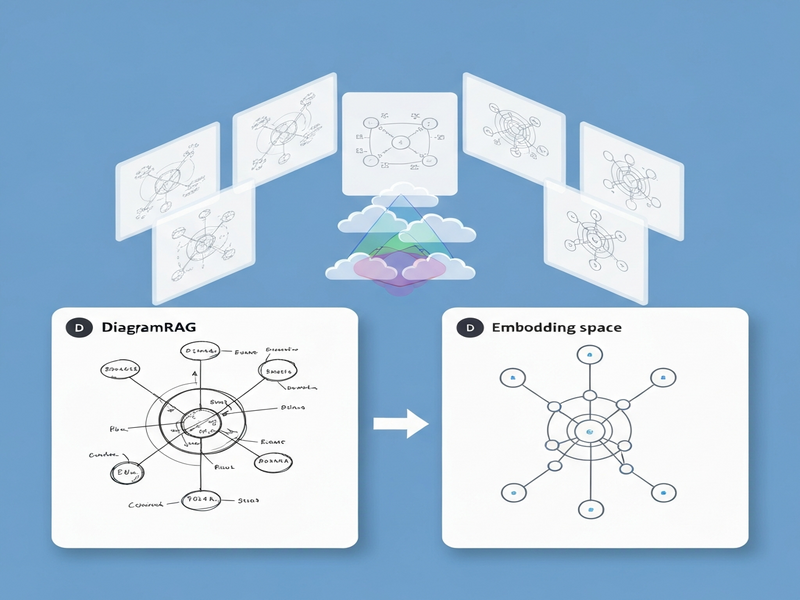
DiagramRAG reframes the problem as a two‑step process: first retrieve a set of reference diagrams that align both semantically and topologically with the user’s sketch, then use those references to guide a generative model that fills in missing details. The framework consists of three core components:
- Structure‑aware Retrieval Engine: Encodes sketches and candidate diagrams into a shared embedding space, emphasizing both textual labels and graph‑like topology.
- Knowledge‑Graph Representation: Transforms each diagram into a graph of entities (shapes, labels) and relations (connectors), enabling efficient similarity matching.
- Generation Module: A vision‑language model that consumes the retrieved references as content, topology, and visual priors to synthesize the final figure.
This separation allows DiagramRAG to leverage existing diagram corpora without retraining a massive end‑to‑end model, keeping the system lightweight and adaptable to new domains.
How It Works in Practice
The end‑to‑end workflow can be broken down into four intuitive stages:
1. Sketch Ingestion
The user uploads a hand‑drawn or digitally sketched diagram. The system extracts textual labels via OCR and detects primitive shapes (boxes, circles, arrows) using a lightweight vision backbone.
2. Graph Construction & Simplification
From the extracted elements, DiagramRAG builds a knowledge graph where nodes represent shapes or text blocks and edges capture connector relationships. To improve retrieval robustness, the system also generates simplified variants of the graph (e.g., removing optional nodes) to match a broader set of references.
3. Structure‑Aware Retrieval
Both the query graph and all diagrams in the reference library are embedded using a dual‑encoder model trained to align sketches with compatible diagrams. Retrieval returns the top‑k candidates that share label semantics and similar connectivity patterns.
4. Guided Generation
The selected references are fed into a vision‑language model (e.g., a fine‑tuned Stable Diffusion or a multimodal transformer). The model treats the references as priors, copying layout cues, style elements, and missing content while respecting the user’s original sketch constraints. The output is a high‑resolution, vector‑compatible diagram ready for publication.
Evaluation & Results
To validate the approach, the authors benchmarked DiagramRAG on two public datasets: DiagramBank and FigureBench. The evaluation focused on two dimensions:
- Structural Fidelity: Measured by F1‑score on node and edge matching between generated and ground‑truth diagrams.
- Visual Quality: Assessed using a Vision‑Language Model as a judge (VLM‑as‑a‑Judge), which scores realism and adherence to scientific conventions.
Key findings include:
- DiagramRAG achieved an F1‑score of 0.848 on DiagramBank, surpassing prior sketch‑only baselines by over 12 percentage points.
- On FigureBench, the framework recorded an F1‑score of 0.802, demonstrating consistent performance across diverse domains (e.g., neural network architectures, workflow pipelines).
- The VLM‑as‑a‑Judge metric peaked at 7.170, indicating that human evaluators would likely rate the outputs as “publication‑ready.”
- Inference latency dropped to 35.48 seconds per sample, a 40% reduction compared with end‑to‑end generative baselines, thanks to the retrieval shortcut.
These results illustrate that leveraging existing diagram corpora not only boosts accuracy but also trims computational overhead, making the system viable for interactive research tools.
Why This Matters for AI Systems and Agents
DiagramRAG’s retrieval‑augmented paradigm aligns closely with emerging AI agent architectures that combine external knowledge sources with generative capabilities. For developers building autonomous research assistants, the framework offers several practical advantages:
- Modular Knowledge Integration: Agents can query DiagramRAG’s retrieval engine to fetch visual priors, enriching their explanations with accurate figures without re‑training large models.
- Reduced Hallucination Risk: By grounding generation in real, vetted diagrams, agents avoid fabricating misleading visual content—a critical concern for scientific communication.
- Scalable Orchestration: The lightweight retrieval step can be parallelized across a diagram database, enabling high‑throughput pipelines for batch figure generation.
- Enhanced User Interaction: Researchers can iteratively refine sketches, receiving near‑instant visual feedback, which accelerates the drafting phase of papers.
Integrating DiagramRAG into an UBOS platform overview could empower AI‑driven documentation bots that automatically generate diagrams from code comments or design specs. Moreover, the framework’s compatibility with existing vector graphics standards means downstream tools—such as LaTeX editors or collaborative whiteboards—can ingest the output without format conversion.
What Comes Next
While DiagramRAG marks a significant step forward, several avenues remain open for exploration:
Limitations
- Domain Coverage: The current reference library focuses on computer‑science and engineering diagrams. Extending to biomedical pathways or chemical structures will require domain‑specific graph schemas.
- Sketch Quality Sensitivity: Extremely noisy or ambiguous sketches can degrade retrieval accuracy; robust preprocessing pipelines are needed.
- Fine‑Grained Styling: The generation module inherits visual styles from references but may struggle with custom branding or journal‑specific templates.
Future Research Directions
- Incorporate multimodal feedback loops where agents ask clarifying questions about ambiguous sketch elements before retrieval.
- Explore hierarchical retrieval that first selects a high‑level diagram category, then refines within sub‑categories to improve scalability.
- Integrate with Workflow automation studio to automate end‑to‑end pipelines: from sketch capture in a collaborative notebook to final figure insertion in a manuscript.
- Leverage Enterprise AI platform by UBOS for secure, on‑premise deployment in regulated environments where data privacy is paramount.
Potential Applications
- AI‑assisted Grant Writing: Researchers can sketch experimental setups and instantly receive polished diagrams for proposals.
- Educational Content Creation: Instructors can draft quick schematic outlines that are automatically refined for textbooks or slide decks.
- Automated Documentation: Software teams can generate architecture diagrams from high‑level design notes, reducing manual diagramming effort.
For developers interested in experimenting with DiagramRAG, the code and datasets are publicly available on original arXiv paper. Community contributions could expand the reference corpus, improve retrieval embeddings, or adapt the generation module to new visual styles.
Conclusion
DiagramRAG demonstrates that coupling sketch‑driven retrieval with generative refinement can overcome the long‑standing bottleneck of scientific diagram creation. By treating existing diagrams as reusable knowledge assets, the framework delivers higher fidelity, faster inference, and a more interactive user experience. As AI agents become increasingly responsible for synthesizing and communicating complex information, retrieval‑augmented visual generation will likely become a cornerstone capability across research, education, and enterprise workflows.
Call to Action
Explore how DiagramRAG can accelerate your documentation pipelines, or integrate its retrieval engine into your AI‑powered research assistants. Visit the UBOS homepage to learn about platform features, or join the UBOS partner program for early access to upcoming AI diagram tools.
Andrii Bidochko
CTO UBOS
Andrii Bidochko is an AI entrepreneur and researcher focused on AI agents, reinforcement learning, and autonomous systems. He writes about the technologies shaping the future of machine intelligence, from frontier models and agent architectures to real-world AI applications.