

- Updated: June 18, 2026
- 6 min read
Detection Without Correction: A Two-Parameter Decomposition of Multi-Stage LLM Pipelines
Direct Answer
The paper introduces a two‑parameter decomposition that separates downstream agent behavior into detection (deciding whether upstream content can be trusted) and conditional generation (what to produce when the content is rejected). This matters because it pinpoints “detection‑without‑correction” as the dominant failure mode in multi‑stage LLM pipelines, explaining why debate, self‑correction, and retrieval‑augmented verification often stall or regress.
Background: Why This Problem Is Hard
Modern AI systems increasingly rely on multi‑stage pipelines: a first LLM generates an answer, a second LLM (or a set of agents) critiques it, and a final LLM decides whether to accept or revise the result. In theory, each stage should improve overall accuracy, but practitioners observe puzzling plateaus, occasional drops in performance, and inconsistent gains across model families. The root causes are twofold:
- Ambiguous decision boundaries. Downstream agents must infer whether the upstream answer is correct without explicit ground truth, leading to noisy “trust” judgments.
- Coupled error propagation. When an upstream mistake is detected but not corrected, the system may double‑down on the error, amplifying the original fault.
Existing approaches—such as multi‑agent debate, intrinsic self‑correction, or retrieval‑augmented verification—treat detection and correction as a single monolithic step. This conflation masks the distinct dynamics of “detecting” versus “correcting,” making it difficult to diagnose why a pipeline fails to improve beyond a certain point.
What the Researchers Propose
The authors propose a conceptual framework that models downstream agent response as two coupled binary decisions:
- Detection decision: Should the upstream content be treated as authoritative?
- Conditional generation decision: If the content is not authoritative, what alternative output should be produced?
These decisions generate four observable regimes:
- Detect & Correct – the ideal case where the system both rejects a bad answer and produces a better one.
- Detect & No‑Correction – the system rejects the answer but fails to generate a useful replacement (often a “I don’t know”).
- Undetect & Correct – the system accepts the answer yet still modifies it (rare).
- Undetect & No‑Correction – the failure mode the paper highlights: the system accepts a wrong answer and does nothing to fix it.
By isolating detection from correction, the framework reveals that the “detect‑without‑correction” regime dominates empirical results, accounting for 53‑94% of downstream errors across diverse models and benchmarks.
How It Works in Practice
Implementing the two‑parameter decomposition requires a lightweight orchestration layer that explicitly routes each downstream step through a detection checkpoint before invoking a correction module. The workflow can be visualized as follows:
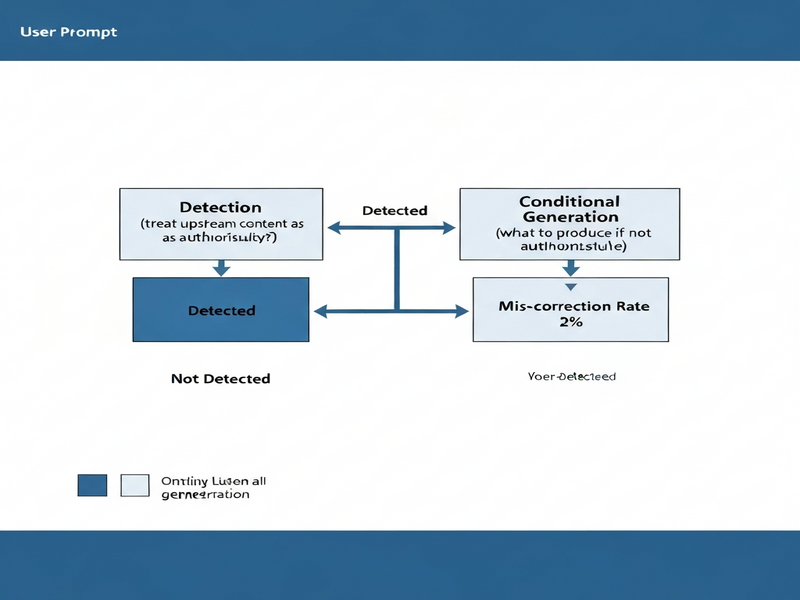
- Stage 1 – Generation. An upstream LLM (e.g., GPT‑4, Claude, or a domain‑specific model) produces an answer to a user query.
- Stage 2 – Detection. A dedicated detection agent evaluates the answer using confidence scoring, factual consistency checks, or external tool verification (e.g., retrieval from a knowledge base).
- Decision Branch. If the detection score exceeds a calibrated threshold, the answer is forwarded as final. If not, the pipeline proceeds to correction.
- Stage 3 – Conditional Generation. A correction agent, possibly a different model or a chain‑of‑thought prompt, generates an alternative response conditioned on the detection failure.
- Stage 4 – Post‑Processing. The corrected answer is optionally re‑evaluated by the detection module to guard against cascading errors.
What distinguishes this approach from prior “debate” or “self‑correction” pipelines is the explicit, tunable detection threshold that remains constant across methods and benchmarks. The authors demonstrate that this threshold behaves as a stable regularity, persisting even when the underlying model family or task difficulty changes.
Evaluation & Results
The researchers constructed a nine‑cell empirical grid covering:
- Four model families (e.g., GPT‑4, Claude, Llama‑2, and a proprietary open‑source model).
- Four benchmarks spanning arithmetic (GSM8K), competition‑level math (MATH‑500, AIME), and multi‑choice science (GPQA‑Diamond).
- Two pipeline methods (multi‑agent debate and intrinsic self‑correction).
Key observations include:
- Conditional miscorrection dominates. Across all cohorts, the rate at which the system fails to correct a detected error ranges from 53% to 94%.
- Detection rate varies widely. Depending on model size and benchmark difficulty, the probability of correctly flagging a wrong answer shifts by more than an order of magnitude.
- Consistent detection threshold. When benchmark difficulty is matched, the detection threshold remains stable across both debate and self‑correction methods, suggesting a protocol‑level regularity.
- Plateau and reversal patterns. Accuracy improvements plateau after a few debate rounds, and in some cases, additional rounds cause performance to dip—a direct consequence of the undetected‑without‑correction regime.
These findings collectively validate the two‑parameter decomposition: the dominant source of error is not the inability to generate better answers, but the system’s reluctance or inability to act on detection signals.
Why This Matters for AI Systems and Agents
Understanding that “detection‑without‑correction” is the primary bottleneck reshapes how engineers design, evaluate, and deploy multi‑stage LLM pipelines. The implications are concrete:
- Metric design. Traditional pipeline metrics (e.g., final accuracy) conflate detection and correction performance. Separating them enables more granular diagnostics and targeted improvements.
- Orchestration strategies. System architects can allocate dedicated resources to detection (e.g., external fact‑checking APIs) without over‑investing in correction models that may never be invoked.
- Risk mitigation. In high‑stakes domains—finance, healthcare, legal—failing to correct a detected error can be catastrophic. Explicit detection thresholds provide a controllable safety valve.
- Product differentiation. Platforms that expose detection confidence to end‑users (e.g., “answer confidence: 62%”) can build trust and enable human‑in‑the‑loop interventions.
Practitioners looking to operationalize these insights can leverage existing UBOS capabilities. For instance, the Enterprise AI platform by UBOS offers built‑in detection modules that integrate with any LLM, while the AI marketing agents demonstrate how detection thresholds can be tuned for brand‑compliant content generation.
What Comes Next
While the two‑parameter decomposition clarifies the failure landscape, several open challenges remain:
- Dynamic threshold adaptation. Current work treats the detection threshold as static. Future research should explore context‑aware thresholds that adjust based on query difficulty or downstream risk.
- Cross‑modal detection. Extending detection beyond text—into code, images, or multimodal outputs—will be essential as agents become more versatile.
- Human‑in‑the‑loop feedback loops. Incorporating real‑time user feedback to refine detection confidence could close the loop between AI and end‑users.
- Benchmark diversification. The current grid focuses on math and science. Adding domains like legal reasoning or medical diagnosis will test the generality of the detection regularity.
UBOS is already positioning its ecosystem to address these directions. The Workflow automation studio enables developers to prototype dynamic detection policies without writing extensive glue code, and the UBOS pricing plans make scaling these pipelines affordable for startups and enterprises alike.
References
For a complete technical exposition, see the original arXiv paper titled “Detection Without Correction: A Two‑Parameter Decomposition of Multi‑Stage LLM Pipelines”.
Andrii Bidochko
CTO UBOS
Andrii Bidochko is an AI entrepreneur and researcher focused on AI agents, reinforcement learning, and autonomous systems. He writes about the technologies shaping the future of machine intelligence, from frontier models and agent architectures to real-world AI applications.