

- Updated: August 15, 2026
- 2 min read
Detecting a Route Flip Is Easier Than Knowing Whether to Fix It: Causal Route-Mediated Damage in Quantized Mixture-of-Experts
Detecting a Route Flip Is Easier Than Knowing Whether to Fix It: Causal Route-Mediated Damage in Quantized Mixture‑of‑Experts
Abstract
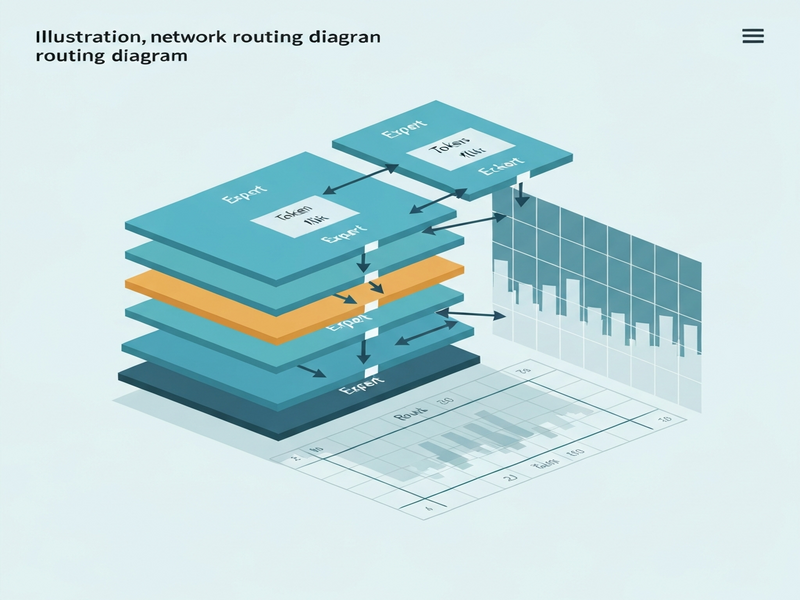
Top‑k Mixture‑of‑Experts (MoE) routing is discontinuous, and a deployment‑motivated numerical disturbance—simulated 4‑bit KV‑cache quantization read by a protected BF16 gate—pushes tokens across decision boundaries, flipping which experts fire. This paper introduces a causal apparatus to quantify the route‑mediated fraction (RMF) of quantization damage, provides token‑level attribution, and demonstrates that while a router‑margin detector can flag a flip (AUC 0.772), it cannot predict whether the flip is harmful or helpful.
Introduction
Quantized MoE models promise efficiency, yet their routing mechanisms are highly sensitive to tiny perturbations. Our study reveals that roughly one‑third of the performance degradation in a 4‑bit KV‑cache setting stems from route flips (RMF ≈ 0.31). Understanding this phenomenon is crucial for reliable deployment of large language models.
Methodology
- Four‑run apparatus: Measures the RMF by comparing clean and quantized runs.
- Token‑level attribution: Decomposes damage by mechanism (quantization noise vs. routing flip).
- Pre‑registered probes: Validate findings across three architectures, including OLMoE‑1B‑7B.
Key Findings
- RMF ≈ 0.31 (95% CI [0.20, 0.41]) in the pilot 4‑bit KV setting.
- The router‑margin detector reliably signals a flip (AUC 0.772) but cannot infer the sign of the loss.
- Signed‑flip tax and sign‑inseparability are consistent across models.
- Real int4 KV kernels produce comparable fractions, confirming the simulation’s relevance.
Implications
The inability to distinguish harmful from beneficial flips creates a detection barrier, limiting selective repair strategies. However, the causal framework we provide enables developers to quantify routing‑mediated damage and explore mitigation pathways such as gate‑normalization adjustments.
Conclusion
Route flips are a measurable source of quantization damage in MoE models. While detection of a flip is feasible, predicting its impact remains an open challenge. Future work should focus on richer router statistics or alternative mitigation techniques to break the sign‑inseparability barrier.
Further Reading & Resources
- Ubos Tech Blog – for more AI‑hardware integration insights.
- Ubos Tech Research Hub – explore related publications.
- Contact Us for collaboration opportunities.
Stay tuned for upcoming updates on quantization‑aware routing strategies.
Andrii Bidochko
CTO UBOS
Andrii Bidochko is an AI entrepreneur and researcher focused on AI agents, reinforcement learning, and autonomous systems. He writes about the technologies shaping the future of machine intelligence, from frontier models and agent architectures to real-world AI applications.