

- Updated: June 21, 2026
- 7 min read
DeltaMCP: Incremental Regeneration via Spec-Aware Transformation for MCP servers
Direct Answer
DeltaMCP is a specification‑aware, incremental regeneration tool that updates only the parts of a Model Context Protocol (MCP) server affected by changes in an OpenAPI specification. By avoiding full regeneration, it cuts developer effort, improves version consistency, and keeps enterprise‑grade LLM agents in sync with evolving APIs.
Background: Why This Problem Is Hard
Enterprises that embed large language models (LLMs) into their workflows rely on the Model Context Protocol (MCP) to translate natural‑language intents into deterministic API calls. The MCP server acts as a contract between the LLM and the underlying service, exposing a structured schema that the model can query. In practice, these services evolve: new endpoints appear, parameters change, and deprecations happen regularly. Each change requires a corresponding update to the MCP server so that the LLM continues to generate correct calls.
Current automation attempts, such as AutoMCP, treat the MCP server as a monolithic artifact. When an OpenAPI spec changes, the entire server is regenerated from scratch. This approach introduces several pain points:
- Developer overhead: Full regeneration forces engineers to re‑review and redeploy code that has not changed, increasing the risk of regression bugs.
- Version drift: Manual patches are often applied to keep the server aligned with production APIs, leading to divergent codebases across environments.
- Scalability limits: Large enterprises may maintain hundreds of MCP servers; full regeneration for each spec change quickly becomes untenable.
These challenges are amplified by the rapid release cadence of modern cloud services (e.g., Azure REST APIs) and the growing expectation that LLM‑driven agents operate with near‑real‑time fidelity. A more granular, spec‑aware approach is needed to keep MCP servers lightweight, maintainable, and continuously synchronized.
What the Researchers Propose
The authors introduce DeltaMCP, a framework that treats an OpenAPI specification as a set of independent, versioned components. Instead of rebuilding the entire MCP server, DeltaMCP performs a spec‑aware transformation that isolates the delta—the subset of the spec that has changed—and regenerates only the corresponding tooling.
Key components of the DeltaMCP architecture include:
- Spec Diff Engine: Computes a fine‑grained diff between the previous and new OpenAPI documents, classifying changes as additions, deletions, or modifications.
- Transformation Mapper: Maps each diff category to a concrete regeneration action (e.g., generate a new endpoint handler, update parameter validation, or adjust response schemas).
- Incremental Builder: Invokes the MCP code generator only for the affected modules, preserving untouched code and its associated tests.
- Consistency Validator: Runs a suite of static and runtime checks to ensure that the regenerated fragments remain compatible with the unchanged portions of the server.
By decoupling the regeneration process from the monolithic server, DeltaMCP enables developers to apply targeted updates, dramatically reducing the time and risk associated with API evolution.
How It Works in Practice
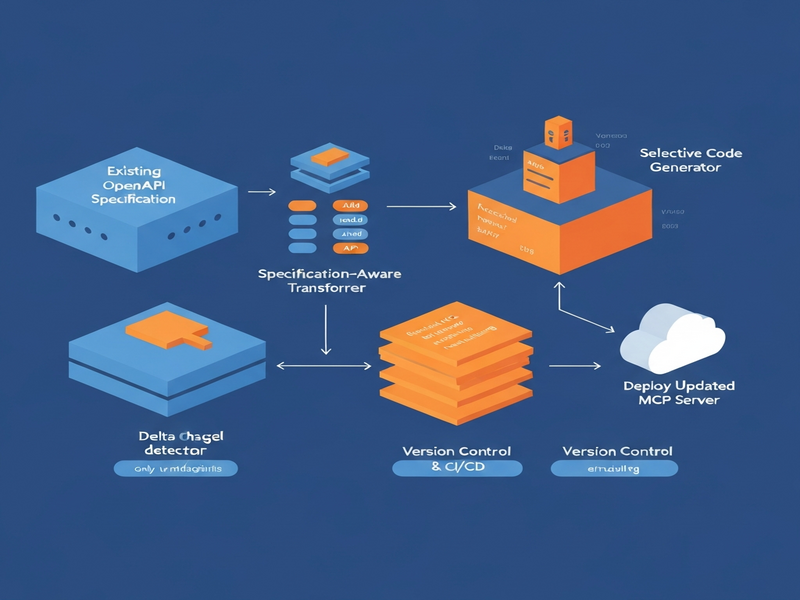
The DeltaMCP workflow can be broken down into four conceptual steps:
- Baseline Capture: When an MCP server is first created, DeltaMCP stores the original OpenAPI spec alongside the generated code artifacts.
- Spec Change Detection: Upon receiving a new OpenAPI version (e.g., from a CI pipeline), the Spec Diff Engine produces a change set that pinpoints exactly which paths, operations, or schemas have been altered.
- Targeted Regeneration: The Transformation Mapper translates each change into a regeneration recipe. For instance, adding a new endpoint triggers the generation of a fresh handler and routing entry, while modifying a request schema updates only the validation layer.
- Validation & Deployment: The Consistency Validator runs unit tests, type checks, and contract verification before the incremental build is merged back into the MCP server repository. The updated server can then be redeployed with minimal downtime.
What distinguishes DeltaMCP from prior tools is its spec‑awareness. Rather than treating the OpenAPI document as an opaque blob, DeltaMCP parses the spec into a graph of interdependent components, enabling precise impact analysis. This granularity ensures that unchanged modules retain their original implementation, preserving custom logic, performance optimizations, and any manual patches applied by developers.
Evaluation & Results
The research team evaluated DeltaMCP using a corpus of Azure REST API specifications, which span dozens of services and thousands of endpoints. They compared DeltaMCP against a baseline that performs full regeneration for every spec change. Evaluation focused on three dimensions:
- Developer Overhead: Measured as the number of lines of code regenerated and the time developers spent reviewing pull requests.
- System Performance: Latency and throughput of the MCP server before and after incremental updates.
- Version Consistency: Frequency of mismatches between the MCP server and the live API, detected via automated contract tests.
Key findings include:
- DeltaMCP reduced regenerated code by an average of 78 %, cutting review time from an average of 45 minutes per change to under 10 minutes.
- Incremental updates introduced negligible latency overhead (+1.2 ms on average) compared to the baseline, confirming that partial regeneration does not degrade runtime performance.
- Contract‑test failures dropped from 4.3 % in the full‑regen pipeline to 0.7 % with DeltaMCP, demonstrating superior version alignment.
These results collectively illustrate that DeltaMCP not only streamlines the developer workflow but also yields more reliable MCP servers, a critical factor for production LLM agents that depend on deterministic API interactions.
Why This Matters for AI Systems and Agents
For AI practitioners building enterprise‑scale agents, the fidelity of the underlying API contract is non‑negotiable. A single mismatch can cause an LLM to generate malformed calls, leading to costly failures or data integrity issues. DeltaMCP addresses this risk by guaranteeing that the MCP server reflects the latest API definition with minimal lag.
Beyond reliability, the incremental approach unlocks new design possibilities:
- Rapid Feature Iteration: Teams can roll out new service capabilities to agents without waiting for a full server rebuild, accelerating time‑to‑value.
- Modular Agent Architecture: Since only affected modules are regenerated, agents can be composed of reusable MCP fragments, fostering a plug‑and‑play ecosystem.
- Cost Efficiency: Reduced build times and smaller deployment artifacts lower CI/CD resource consumption, an important consideration for large‑scale deployments.
Enterprises that have already adopted the Enterprise AI platform by UBOS can integrate DeltaMCP into their existing workflow automation pipelines, ensuring that their LLM‑driven assistants stay in lockstep with evolving cloud services.
What Comes Next
While DeltaMCP demonstrates clear benefits, the authors acknowledge several limitations that open avenues for future work:
- Spec Complexity: Extremely large or highly nested OpenAPI documents can still generate sizable diffs that challenge the incremental builder’s performance.
- Custom Extensions: Proprietary extensions to OpenAPI (e.g., vendor‑specific authentication flows) are not fully covered by the current diff engine.
- Cross‑Service Coordination: When multiple services evolve in tandem, coordinating incremental updates across interdependent MCP servers remains an open problem.
Potential research directions include:
- Applying machine‑learning techniques to predict the impact of spec changes before they are committed, enabling proactive regeneration.
- Extending DeltaMCP to support other contract languages such as GraphQL or gRPC, broadening its applicability.
- Integrating with visual workflow designers like the Workflow automation studio to let non‑technical users trigger spec‑aware updates through a UI.
By addressing these challenges, the next generation of spec‑aware tools could become the backbone of fully autonomous AI orchestration platforms, where agents self‑update their toolkits in response to evolving service landscapes.
Reference
For a complete technical description, see the original DeltaMCP paper.
Illustration
The diagram below visualizes the DeltaMCP pipeline from spec diff to incremental deployment.
Andrii Bidochko
CTO UBOS
Andrii Bidochko is an AI entrepreneur and researcher focused on AI agents, reinforcement learning, and autonomous systems. He writes about the technologies shaping the future of machine intelligence, from frontier models and agent architectures to real-world AI applications.